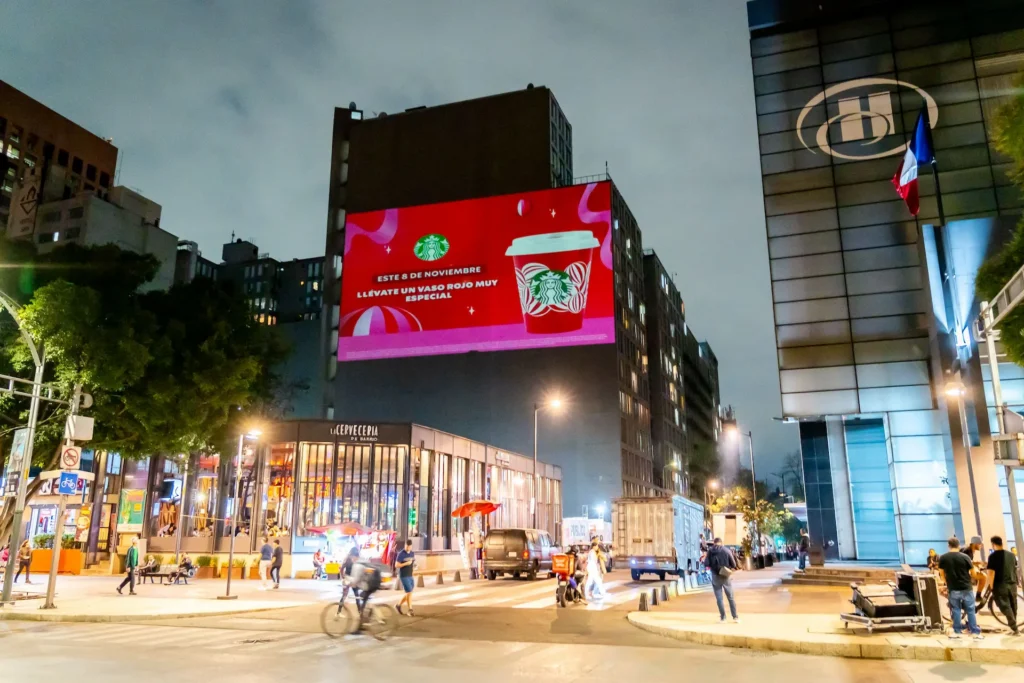
There is a specific quality to the light in Condesa at 10 PM on a Saturday. The tree canopy of Parque Mexico filters the streetlamps into something softer and more dappled than you find in the open colonias to the north. People are walking the Amsterdam loop with the unhurried pace of a neighborhood that knows it is one of the most pleasant urban spaces in Latin America. The restaurants spilling onto the sidewalks of Tamaulipas and Michoacan are full, loud, and visually open to the street. When you project onto the broad cream facade of an Art Deco building on the outer edge of Amsterdam at this moment, you are entering an environment where people are already in a state of relaxed visual attention. They are looking at things. They are noticing architecture. They are present in a way that people on a commercial strip or a transit corridor are not.
Condesa is the Art Deco heart of Mexico City, built out between roughly 1920 and 1950 on the grounds of a former horse racing track whose elliptical layout is still visible in the extraordinary circular geometry of Avenida Amsterdam. It is a neighborhood of high-design residential buildings, shaded streets, sophisticated restaurants, and an audience of established professionals, creative entrepreneurs, and foreign residents who have been in the city long enough to know it deeply. For projection advertising, Condesa is distinct from Roma Norte in character but equal in opportunity, with its own specific surface types, its own audience logic, and its own strategic framework that experienced campaign planners develop over time.
This guide covers what we know about Condesa as a projection market in specific, operational detail. The architecture, the streets, the key buildings, the park geometry, the audience profile, and how Condesa’s campaign logic differs from its immediate neighbor to the east.
The Condesa Geography: Understanding the Ellipse
Condesa’s defining geographic feature is a layout that does not follow Mexico City’s standard grid. When the Hipódromo de la Condesa, the colonial-era horse racing track, was redeveloped in the 1920s as a residential colonia, the developers retained the elliptical geometry of the track as the organizing principle for the new neighborhood. This is why Avenida Amsterdam runs in a complete ellipse and why Parque Mexico, which occupies the interior of that ellipse, has its distinctive oval shape.
This geometry matters for projection campaigns in a way that is not immediately obvious until you spend time scouting in the colonia. The elliptical layout means that sightlines in Condesa are curved rather than straight. A building on the outer edge of Amsterdam, viewed from the park side, is not facing a flat open space — it is facing the curved interior of the ellipse. Pedestrians walking the Amsterdam loop see the building facades at constantly changing angles as they move around the curve. This means a projection on an Amsterdam-facing facade is visible for a longer continuous stretch of sidewalk than a projection on a straight-line street, because the curve keeps presenting the illuminated surface to walkers approaching from the flanks, not just from directly in front.
The Amsterdam Loop as Campaign Infrastructure
Avenida Amsterdam functions as both a street and a walking path for Condesa residents and visitors. The broad sidewalks on both sides of the street, lined with mature ficuses and flanked by Art Deco buildings on the outer edge and Parque Mexico greenery on the inner edge, make it one of the most popular walking routes in the colonia. On weekend mornings, it is full of joggers and dog walkers. On weekend evenings, after the afternoon restaurant rush, it fills with people strolling, seated at café terraces, or moving between the various restaurants and bars that occupy the ground floors of buildings along the route.
The Amsterdam loop is approximately 1.6 kilometers in circumference, which means a complete circuit takes about 20 minutes on foot. For a projection campaign on a facade on the outer edge of Amsterdam, this creates a remarkable situation: people on the walking loop will naturally orbit around and return to viewing positions relative to the projection multiple times over the course of an evening without making any special effort to do so. A well-positioned projection on Amsterdam is not a one-time encounter for people already in the park area — it is a recurring visual presence across the evening.
The Two Parks: Parque Mexico and Parque España
Condesa’s social life is organized around two parks rather than around commercial streets as in Roma Norte. Parque Mexico is the larger and more famous of the two, a 60,000-square-meter space inside the Amsterdam ellipse with gardens, fountains, outdoor amphitheater space, a dog park, and extensive tree cover. It draws a constant stream of users from early morning through late evening. On weekends, the park functions as a gathering point for large numbers of people who are spending the day in the colonia, and its perimeter is lined with some of the colonia’s most architecturally significant residential buildings.
Parque España, smaller and less famous, sits to the northeast of Parque Mexico and is bounded by Tamaulipas, Sonora, Veracruz, and España streets. Its character is more intimate than Parque Mexico, with a central fountain, shaded benches, and a more quiet residential feel. The facades surrounding Parque España include both Art Deco residential buildings and several structures with clean contemporary exteriors that serve as good projection surfaces for modern brand aesthetics.
Parque Mexico covers approximately 60,000 square meters and is one of the largest green spaces in Mexico City’s central urban colonias. The park receives an estimated 15,000-20,000 visitors on a typical Saturday, making it one of the highest foot-traffic outdoor spaces in the Federal District.
The Art Deco Architecture as Projection Canvas
Condesa’s Art Deco buildings are among the finest examples of that architectural period in Latin America, and they are also, somewhat serendipitously, extremely well-suited for projection advertising. The qualities that make these buildings architecturally significant — their smooth plaster and concrete surfaces, their predominantly light color palettes, their geometric proportions — are the same qualities that make them outstanding projection surfaces.
Edificio Basurto: The Iconic Surface
The Edificio Basurto on Avenida Mexico, half a block from Parque Mexico, is the most architecturally celebrated building in Condesa and one of the most important pieces of Art Deco residential architecture in Mexico. Designed by Francisco J. Serrano and built between 1940 and 1945, it is fourteen stories tall, which makes it unusually prominent in a colonia where most residential buildings run four to eight stories. Its facade is post-Art Deco in its restrained elegance, with smooth concrete surfaces, horizontal banding, and a circular form that wraps the corner of Avenida Mexico.
As a projection surface, the Edificio Basurto is both an opportunity and a careful exercise in scale management. At fourteen stories and occupying a corner position, it is one of the tallest available projection targets in the colonia. The smooth concrete facade reflects cleanly and the building’s curved form creates an interesting visual dynamic when projection content is designed to wrap around the curve rather than treat it as a flat surface. Because the building is an architectural landmark, projections on its facade carry an immediate association with Condesa’s identity that campaigns in other locations cannot replicate.
The Amsterdam Building Facades
The buildings lining the outer edge of Avenida Amsterdam represent the most concentrated collection of Art Deco residential architecture in Mexico City. Running around the complete ellipse, these buildings vary from four to eight stories in height, with facades that share several key projection-friendly characteristics: smooth cream or light-ochre plaster surfaces, flat wall areas between window bays, and enough overall height and width to support a projector output that fills a comfortable screen-equivalent area.
The surface quality on these buildings varies depending on maintenance and age of the most recent exterior renovation. Well-maintained buildings with fresh light-colored exterior paint are the best performers. Buildings that have been repainted in darker colors, a darker taupe or gray, sacrifice brightness. Our standard Amsterdam scouting protocol involves walking the full loop on a daytime visit to assess the surface condition of each building face and identify the three to five facades that have both the best surface quality and the best sight lines for evening projection deployment.
The Tamaulipas and Michoacan Restaurant Corridor Facades
Calle Tamaulipas, running between Amsterdam and Sonora through the heart of Condesa’s most active restaurant zone, is lined on both sides with buildings whose facades are visible to the dense evening pedestrian traffic the restaurants generate. The ground floors of most of these buildings have been converted to restaurant and cafe use, with the residential upper floors retaining their original exteriors. The upper-floor facades above the restaurant signage and terrace activity are often clean, well-maintained plaster surfaces with minimal competing visual elements.
A projection aimed at the upper floors of a Tamaulipas building from a position on the other side of the street creates a visual effect that is visible over the heads of the street-level restaurant crowd — the projection appears in the building’s upper registers while the street below continues its normal activity. This layered visual environment, animated people and restaurant life at ground level, projected brand content above, creates an unusually rich composition for photography and video content.
Calle Nuevo Leon and Calle Sonora: The Transition Buildings
The western end of Condesa, along Calle Nuevo Leon and the blocks of Calle Sonora that cross into the colonia from Roma Norte, has a slightly different building stock: a mix of Art Deco residential buildings and mid-century concrete structures that were built in the 1950s and 1960s as the original Art Deco fabric was supplemented by newer construction. These mid-century buildings often have broader, flatter facades than the Art Deco stock, with less ornamental detail and more continuous flat wall area, making them useful for content that requires maximum legibility rather than architectural integration.
Condesa is where you deploy when you want the audience to be in a genuinely good mood. People in Parque Mexico on a Saturday evening are there by choice, in their favorite neighborhood, doing something they love. A projection that catches them in that moment lands in a completely different emotional register than one that catches people on a commuter corridor.
The Amsterdam Loop: Projection Geometry in Detail
We have already established that Amsterdam’s elliptical geometry is unusually favorable for projection campaigns. Here is the specific geometry that makes it work and how to take full advantage of it in campaign planning.
Throw Distance and Projector Placement
Amsterdam varies in width from approximately 12 to 18 meters depending on the section of the ellipse. The walking path and cycle lane on the park side reduce the available roadway to 6-8 meters in some sections. This means that a projector placed on the inner (park) side of Amsterdam has a throw distance to the building facades on the outer edge of 12-15 meters — well within the effective range of a 20,000-lumen projector for producing a vivid, legible image at a scale equivalent to a 10-12 meter wide screen.
The best projector placement on Amsterdam is in the park interior near the inner edge of the walking path, with the projector aimed at a right angle to the outer building facade. This placement keeps the projection rig away from vehicle traffic, provides a stable surface for equipment mounting, and maximizes the angle of projection incidence with the building surface (closer to 90 degrees means better image geometry and less keystoning).
The Audience Movement Pattern
The key insight for Amsterdam projection deployment is that the audience is already in orbital motion. People walking the Amsterdam loop are following the curve, which means they approach a projection on a building facade from a range of angles over several minutes of walking rather than in a single direct approach. The practical effect is that the campaign impression window for each individual viewer is longer on Amsterdam than on a straight street, because each person sees the projection from an oblique approach angle, then a direct frontal angle, then an oblique departing angle, over a period of two to three minutes of continuous walking.
This longer impression window has implications for content design. On a linear street, a projection loop needs to be fully legible in a few seconds because that is often all the time any given viewer spends in front of it. On Amsterdam, a viewer might spend several minutes in a position where the projection is visible to them, which means longer content loops, more narrative content, and more detailed visual information are all viable in ways that they are not on a standard street deployment.
Avenida Amsterdam is 1.6 kilometers in circumference, making it one of the few elliptical streets in any major world city. This unique geometry was preserved from the original Hipódromo de la Condesa horse racing track when the neighborhood was redeveloped in the 1920s.
Condesa vs Roma Norte: Understanding the Strategic Differences
Campaign planners who work across both colonias consistently report that the same creative assets, the same projector output, and the same deployment timing produce noticeably different results in Condesa versus Roma Norte. Understanding why helps you make better strategic decisions about where to invest in each market.
The Audience Age and Life-Stage Difference
Roma Norte’s audience skews younger and more transient. The large population of recent arrivals, younger remote workers, students, and early-career creatives means that the colonia’s evening crowd is in an exploratory mode — looking for things to discover, highly active on social media, and responsive to novelty. Condesa’s resident population is somewhat older and more settled. The typical Condesa resident is an established professional who has been in the colonia for years, knows the neighborhood intimately, and responds to projection campaigns more as a sophisticated consumer of public experience than as a social media content creator looking for something to share.
Neither profile is better in an absolute sense. They are different, and they respond differently to the same campaign. Roma Norte generates more immediate organic social sharing from the younger, more socially active audience. Condesa generates deeper engagement, longer viewing times, and stronger word-of-mouth through a smaller but more socially influential network of established professional contacts.
Building Height and Projection Scale
Condesa’s buildings are generally shorter than those in Roma Norte and much shorter than those in Polanco. The typical Art Deco residential building in Condesa runs four to eight stories. This means that maximum-scale projection work in Condesa tops out at roughly 20-25 meters in height. This is still substantial, but it is different from the warehouse wall campaigns we run on industrial buildings in Roma Norte or the tower-scale work we do in Polanco. In Condesa, the scale of projection is matched to the intimate scale of the colonia itself, which is actually an aesthetic advantage — projections feel proportionate to their environment rather than overwhelming it.
The Park Gathering Point vs. Linear Street Model
Roma Norte’s nighttime energy moves along linear corridors: Álvaro Obregón, Orizaba, Colima. People are in motion. In Condesa, the parks create natural gathering points where people sit, linger, and occupy the same space for extended periods. This fundamentally changes the audience dynamics for projection campaigns. In Roma Norte, you need to make an impression on a moving audience in a short window. In Condesa, you have a stationary audience in the park spaces who will engage with projection content for as long as it holds their attention.
This difference argues for different content strategies. Roma Norte benefits from high-impact, instantly legible content that makes a strong impression in seconds. Condesa, where the park audience might watch a projection loop for five or ten minutes, can support more complex, longer-form content with genuine narrative or aesthetic depth. The two colonias do not require different projection equipment, but they do require genuinely different content briefs.
Audience Profile and Brand Strategy in Condesa
Condesa’s 28-45 core demographic with above-average income and strong cultural literacy creates a specific brand environment. Here is how we assess brand fit in this market.
Premium Consumer Goods and Lifestyle Brands
Condesa is one of Mexico City’s primary markets for premium consumer goods — not the ultra-luxury positioning of Polanco, but the premium-everyday consumer category that includes design-forward home goods, premium food and beverage, high-quality personal care, and sophisticated fashion. The resident population has the income to spend on quality and the aesthetic sensibility to distinguish it from mass-market alternatives. Premium brands launching in the Mexico City market consistently include Condesa in their activation geography because of this audience profile.
Architecture, Design, and Art
Given the colonia’s architectural heritage and the large population of design professionals who choose to live there, campaigns in the design, architecture, art, and creative culture categories have a natural home in Condesa. The Zona MACO art fair, which brings an enormous international audience to Mexico City each February, concentrates much of its peripheral programming and after-party activity in Condesa and Roma Norte. Projection campaigns aligned with Zona MACO’s schedule, running in the colonia in the evenings during the fair week, reach exactly the right audience at the right moment of cultural engagement.
Premium Food and Restaurant Campaigns
Condesa’s restaurant scene is among Mexico City’s finest, with a concentration of high-profile chef-driven restaurants on Tamaulipas, Michoacan, and Amsterdam. New restaurant openings, major chef collaborations, and food brand campaigns all play well in Condesa because the colonia’s residents and visitors are people who take food seriously and who make restaurant decisions through the recommendations of trusted sources in their social networks. A well-executed projection campaign for a restaurant opening in Condesa reaches exactly the audience that the restaurant wants — the food-sophisticated, design-literate Condesa resident who will become a regular if the first experience is strong.
Automotive and Mobility
Condesa’s wide streets and the Amsterdam loop’s scale make it a comfortable environment for automotive brand campaigns. The colonia is home to a high density of the imported and premium automotive brands that drive Mexico City’s luxury vehicle market, and the streetscape is visually compatible with premium vehicle aesthetics in a way that some of the narrower colonias are not. We have executed projection campaigns for automotive brands on the larger facade surfaces around Parque Mexico, and the park setting consistently provides a more polished, art-adjacent backdrop than an industrial or commercial street surface would.
Timing and Deployment Windows in Condesa
Condesa’s rhythm differs from Roma Norte’s in ways that affect optimal deployment timing. Understanding those rhythms is essential for maximizing campaign exposure.
Weekday Evening Patterns
Condesa’s restaurants and cafes drive evening foot traffic on weeknights. Tuesday and Wednesday evenings see a moderate crowd on Tamaulipas and the Amsterdam restaurant strip, primarily the local resident population making weeknight dinner plans. Thursday evenings begin to pick up significantly as the weekend visitor influx starts to arrive. For a projection campaign that needs to run on weekday nights, Thursday is by far the strongest of the true weekday options, delivering an audience that begins to approach weekend volume from around 8 PM onwards.
Weekend Patterns
Saturday is the peak day in Condesa. The park is full from morning through evening, the restaurant corridors are at maximum capacity from noon through midnight, and the Amsterdam walking loop carries heavy traffic throughout the afternoon and into the night. A Saturday evening deployment at 9 PM, targeted at the facades around Parque Mexico or on the Amsterdam loop, reaches the maximum daily audience for any projection campaign in Condesa.
Sunday morning and afternoon carry their own distinct Condesa crowd — residents walking dogs and jogging on Amsterdam, families using the park, and the brunch crowds occupying the terraces of the neighborhood restaurants. For brands that want to reach this daytime audience with a projection presence, early afternoon deployment on Sunday, timed for the maximum shadow period when facades on the west and north sides of buildings are in shadow, can extend viable projection hours into the afternoon window.
Seasonal Adjustments
Condesa’s dry season deployment window runs from November through late May. The Festival de Zona MACO in February is one of the highest-value activation windows in the annual calendar, bringing an influx of international art world visitors into the colonia’s gallery and restaurant scene. The Cervantino International Festival in October, which extends from Guanajuato into Mexico City venues, generates a cultural programming surge in Condesa that lifts foot traffic above typical October levels.
| Location |
Surface Type |
Approx. Scale |
Peak Audience Window |
| Edificio Basurto, Av. Mexico |
Smooth concrete, Art Deco |
14 stories, curved facade |
Friday–Saturday 9PM–midnight |
| Amsterdam outer facades |
Plaster, Art Deco, 4–8 stories |
10–15m wide per building |
Sat afternoon–evening, loop walkers |
| Tamaulipas restaurant strip |
Mixed plaster, upper floors |
8–12m wide sections |
Thursday–Saturday 8PM–midnight |
| Parque Mexico perimeter buildings |
Art Deco plaster, varied |
8–20m wide |
Saturday afternoon and evening |
| Parque España surrounding facades |
Art Deco and mid-century |
6–12m wide |
Thursday–Saturday 9PM–midnight |
3D Projection Mapping in Condesa: Working With the Architecture
Condesa’s Art Deco architecture is particularly well-suited for 3D projection mapping work, where the content is designed to interact with the building’s physical form rather than using the facade as a flat screen. The geometric ornamental vocabulary of Art Deco — the stepped cornices, horizontal fins, geometric window surrounds, banded facade surfaces — provides a rich three-dimensional framework that skilled projection designers can animate in ways that create a genuine visual spectacle.
What 3D Mapping Adds to the Campaign
Standard projection advertising treats a building facade as a large flat screen. The projected content might be beautiful, but the building and the content exist as separate things. 3D projection mapping creates a relationship between the content and the building’s physical form that makes the projection feel like it is transforming the building itself. The building appears to crack open, fold, or animate. Elements of the facade seem to come forward or recede. The structural details become part of the content rather than obstacles to it.
For the right campaign brief in Condesa, 3D mapping on an Art Deco building delivers a qualitatively different experience than standard projection, one that audiences consistently describe as more memorable and more surprising. The tradeoff is higher production cost and a longer pre-production timeline, because 3D mapping requires detailed architectural documentation of the target surface and a custom content build that matches the specific geometry of that building. But in a colonia where the architectural context is itself a significant cultural asset, investing in content that honors and plays with that architecture is often the right strategic choice.
The Geometric Vocabulary of Condesa’s Art Deco
Condesa’s Art Deco buildings were designed in a period when architects were working with a strong geometric formal language: straight lines and curves in deliberate tension, ornamental elements derived from abstract geometric forms rather than historical references, and a strong sense of horizontal and vertical rhythm in facade composition. This vocabulary translates directly into projection content design. Geometric animation, modular pattern work, and content that uses strong horizontal and vertical line elements will align naturally with the physical lines of the building, creating a visual coherence between content and surface that reinforces both.
Frequently Asked Questions
What makes Condesa’s Art Deco buildings good projection surfaces?
Condesa’s Art Deco buildings from the 1930s and 1940s have smooth plaster and poured-concrete facades with minimal texture that reflects projector light cleanly and evenly. The predominantly light color palettes of these buildings — cream, pale ochre, off-white — maximize projection brightness at any given projector output level. The geometric ornamental detailing at cornices and window surrounds can be incorporated into 3D mapping work that makes the building’s physical form part of the content rather than just a neutral background surface. The overall result is a projection environment that is both practically efficient and aesthetically rich.
How does Avenida Amsterdam’s elliptical layout affect projection strategy in Condesa?
Avenida Amsterdam runs in a full ellipse around Parque Mexico, which creates a unique situation for projection: pedestrians walking the Amsterdam loop approach building facades on the outer edge from a constantly changing angle as they move around the curve. This means each individual viewer has a longer total impression window for a projection on an Amsterdam-facing facade than they would on a straight street, because the curve keeps presenting the illuminated surface as they approach and then pass it. Content with more narrative depth and visual complexity can be used effectively on Amsterdam for this reason, and the projection remains visible to loop walkers for a higher proportion of their total walk time than a straight-street projection would be.
What is the demographic profile of Condesa’s projection audience?
Condesa skews toward the 28-45 age range with above-average income and strong cultural and design literacy. The colonia has a large population of established professionals, entrepreneurs, architects, media figures, and senior corporate executives who have chosen to live in one of Mexico City’s most design-forward residential environments. The foreign resident community tends toward people who have been in the city for years rather than newer arrivals. On weekend evenings, visitors from the city’s affluent north and west districts, drawn by Condesa’s restaurant scene, add significantly to the base resident population.
How does Condesa differ from Roma Norte for projection campaign strategy?
Condesa operates at a slightly more refined register than Roma Norte. The park-centered geography creates natural gathering-point venues where stationary audiences will engage with projection content for extended periods, in contrast to Roma Norte’s linear street model where people are generally in motion. Content in Condesa can carry more complexity and length because the audience dwells longer. The colonia also supports a broader range of premium brand positioning, where Roma Norte’s cultural edge skews slightly harder toward creative-industry and youth-culture brands. Both are strong markets, but they reward different creative and strategic approaches.
What are the best specific locations in Condesa for guerrilla projection campaigns?
The facades around Parque Mexico on Avenida Amsterdam and Avenida Mexico are the highest-value combination of architectural quality and audience concentration. The Edificio Basurto is the most architecturally significant surface in the colonia and carries an immediate identity association for campaigns that want to draw on Condesa’s design heritage. The restaurant corridor on Calle Tamaulipas delivers strong evening foot traffic with an audience already in a leisure-spending mindset. The perimeter of Parque España offers intimate-scale projection opportunities in a quieter setting that works well for campaigns with a residential or lifestyle positioning.