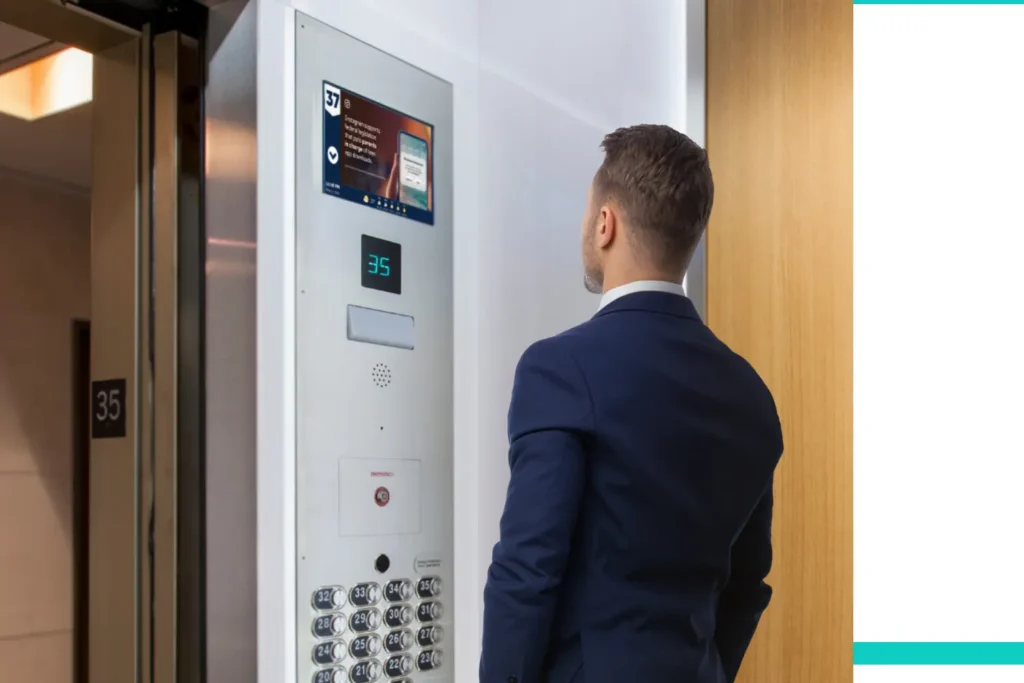
Elevator advertising is built on a simple premise: people inside an elevator have nowhere else to look. The ride lasts 30 to 60 seconds, the space is small, the phone signal is often weak, and the branded surface is right there at eye level. That captive window is what makes elevator media valuable in dense urban markets where outdoor advertising competes for attention against an enormous volume of visual noise.
The format is not new, but its strategic application has evolved. Brands that get the most from elevator advertising are not simply buying access to buildings. They are selecting properties where their specific audience lives or works, designing creative that works in a small enclosed space, and integrating elevator placements into broader campaigns that create repeated exposure across multiple touchpoints. When those elements align, elevator media can punch well above its placement cost.
Our team at American Guerrilla Marketing approaches elevator advertising as one layer within a larger out-of-home strategy. This guide explains what the format does well, where it falls short, and how we build campaigns that use elevator media alongside street-level formats to create consistent brand presence across a target audience’s daily movement pattern.
How Elevator Advertising Actually Works
Elevator advertising takes several physical forms. The most common in residential buildings is a backlit panel inside the cab, typically at eye level opposite the door. In office buildings, digital screens are increasingly replacing static panels, allowing ad rotation across multiple advertisers. Lobby panels near elevator banks serve audiences before they board. Parking structure elevators and hotel elevators round out the format’s footprint in most major markets.
What unites all of these placements is the attention environment. The elevator cab eliminates most of the competing stimuli that defeat outdoor advertising at street level. There are no passing vehicles, no other pedestrians, no storefronts competing for the eye. The brand has a moment of relative exclusivity, repeated multiple times daily as the same residents or tenants ride up and down.
Frequency and Repetition as the Core Mechanism
A resident in a high-rise building may take four to six elevator rides per day. If the building runs a 30-day campaign, that individual could encounter the branded message 120 times or more across the campaign period. That frequency is what separates elevator advertising from most other out-of-home formats, where a given individual might see a placement once or twice at most.
Repetition is how brand recall builds. The first few exposures register the brand at a subconscious level. By the tenth or fifteenth exposure, the message and its associated brand become familiar. By the thirtieth exposure, that familiarity starts driving behavioral consideration. Elevator media earns those exposures quietly, over time, without requiring the audience to seek the brand out.
Captive Attention Versus Active Attention
There is an important distinction between captive attention and active attention. Captive attention means the audience has limited alternatives. Active attention means the audience is genuinely engaging with the content. Elevator advertising reliably delivers the first. The second depends on creative quality.
A panel that delivers a sharp, clear message with a single visual hook earns active attention more often than a panel that crowds too much information into a small space. The creative constraint of an elevator is different from a billboard or a transit poster: the space is smaller, the viewing distance is shorter, and the audience is not moving past the ad. They are standing in front of it. That calls for design decisions that differ from standard outdoor advertising.
Building Selection: The Variable That Changes Everything
The quality of an elevator advertising campaign depends more on building selection than on format format. Buying elevator panels in the wrong buildings, regardless of how many buildings or how strong the creative, will produce weak results. Buying the right buildings with disciplined selection criteria produces campaigns that efficiently reach the intended audience.
Matching Building Type to Audience Profile
Residential high-rises in urban markets typically have defined demographic profiles based on rental price point, ownership rates, and neighborhood character. A campaign targeting 25-35 year old renters with above-average disposable income should be selecting buildings where that profile matches the resident population, not simply buildings in a general geographic area.
Office towers work differently. The audience is defined by the companies tenanting the building rather than by residential demographics. A B2B campaign targeting financial services professionals should target buildings where those professionals work, which often means premium addresses in financial districts rather than mixed-use buildings in retail corridors.
Traffic Volume and Ride Frequency
Not all elevator banks are equal. A 40-story residential building with 400 units generates far more daily rides than a six-story building with 50 units. We evaluate daily traffic volume when selecting buildings, because frequency is the mechanism through which elevator advertising earns its value.
Hotels require a different traffic logic. Hotel elevator audiences are transient rather than repeat, which changes the frequency equation significantly. Hotels work best for campaigns targeting travelers or event-adjacent audiences rather than campaigns built around the accumulation of repeat impressions.
Creative Strategy for Elevator Environments
Elevator creative has its own set of constraints and opportunities. Designing a campaign specifically for the elevator environment produces better results than adapting existing creative assets that were designed for other formats.
What Works at Short Viewing Distance
Elevator panels are typically viewed at two to four feet. That is much closer than a transit poster, a billboard, or a street-level banner. At that distance, fine detail is visible in a way it is not on outdoor formats. Typography can be smaller and still legible. Texture and finish choices become noticeable. A high-quality printed panel in an elevator does not need a massive headline to communicate: the detail itself signals quality.
That said, the message still needs to be instantly clear. Riders spend 30 to 60 seconds in the elevator, but their conscious attention to the panel may be as short as five seconds. The core message, the brand identity, and the call to action all need to be readable in a single glance before the doors open.
What Fails in Elevator Creative
The most common failure in elevator creative is trying to say too much. Copy-heavy panels that explain the product at length are not read. QR codes without a compelling reason to scan are ignored. Abstract imagery without a clear brand anchor creates impressions that dissolve before the rider exits the building.
We recommend treating the elevator panel like a headline: one clear statement, one brand identity, one action. Everything else can live on the landing page.
Integrating Elevator Advertising With Street-Level Campaigns
Elevator advertising performs best when it is not the only touchpoint in a campaign. The format builds frequency among a defined residential or professional audience, but it does not reach that audience when they are outside the building. Pairing elevator media with street-level formats creates the repetition effect across a wider geographic footprint and a larger portion of the audience’s daily movement pattern.
Layering With Poster Campaigns
A poster campaign in the neighborhood surrounding the target buildings creates brand presence at street level that reinforces the elevator impression. When the same audience encounters the brand in the elevator lobby and again on the walk to the subway, the repetition compounds. Two touchpoints in a single day generate stronger recall than either touchpoint alone.
Layering With Street Teams
Our brand ambassador teams can be deployed near building exits during morning commute windows or lunch hours to create a direct-contact moment that follows the elevator impression. The audience has already seen the brand multiple times in the elevator. A confident street team interaction at the building entrance converts that pre-established familiarity into a concrete action, whether that is sampling, redemption, or a digital opt-in.
Connecting to Digital Amplification
We build campaign-specific QR codes or short URLs into elevator creative when the campaign objective includes digital conversion. When those codes are used, they provide a direct signal of elevator-to-digital engagement. Even when QR scan rates are modest, the data point is useful for understanding which buildings and which markets drive the most active engagement.
Measurement and Documentation Standards
Every campaign our team runs includes documented proof of execution. For elevator advertising, that means installation confirmation photos, building address logs, and campaign duration verification. When the campaign ends, the recap document gives the client a clear record of what ran, where, and for how long.
We do not treat documentation as an afterthought. Brands that are investing in out-of-home campaigns should be able to demonstrate the reach and execution quality to internal stakeholders. Clean documentation makes that conversation possible.
Beyond Impression Estimates
Industry-standard elevator advertising is often sold on impression estimates derived from building traffic models. Those estimates are useful but approximate. We supplement them with building-specific data where available, and we integrate elevator media performance into broader campaign measurement frameworks that account for digital amplification, downstream conversion tracking, and multi-touch attribution where possible.
When Elevator Advertising Is the Right Format and When It Is Not
Elevator advertising earns its place in a campaign when the goal is frequency-driven brand building among a defined residential or professional audience in dense urban markets. It is the wrong format for campaigns that need immediate scale, broad geographic reach, or high-velocity conversion events. The format builds slow and steady, not fast and wide.
Right Fit: Brand Launches in Specific Markets
A new consumer brand launching in a specific urban neighborhood can use elevator advertising to build name recognition among a tightly defined residential population before expanding to broader awareness channels. The concentrated frequency in the right buildings creates a foundation of recognition that makes subsequent digital and street-level campaigns more effective.
Right Fit: B2B Lead Generation in Office Markets
A B2B company targeting a specific industry sector can use office tower elevator advertising to create repeated impressions among the decision-makers who work in those buildings. Combined with street-level guerrilla marketing near those office addresses, the campaign creates a physical presence that digital-only approaches cannot replicate.
Wrong Fit: High-Volume Retail Conversion Campaigns
If the campaign goal is driving immediate retail traffic or capturing high volumes of short-cycle conversions, elevator advertising is too slow and too narrow. Formats like LED billboard trucks or high-footfall sidewalk stencils create faster, broader reach across the market.
Markets Where AGM Deploys Elevator Media Strategies
Our team operates across 50-plus U.S. markets. Major urban markets with strong elevator advertising infrastructure include New York City, Chicago, Los Angeles, Miami, Seattle, Boston, and Washington D.C. In each of these markets, we have relationships with property operators and surface vendors, route knowledge of high-value building concentrations, and crew infrastructure for installation and removal.
New York City is particularly strong for elevator advertising given the density of high-rise residential buildings across Manhattan, Brooklyn, and Queens. A campaign targeting a specific demographic in a specific borough can be built with surgical precision by selecting buildings where the target profile is concentrated, rather than buying broad geographic coverage.
Frequently Asked Questions
What is elevator advertising and how does it work?
Elevator advertising places branded content inside elevator cabs or on lobby panels in residential buildings, office towers, hotels, or parking structures. The format benefits from captive attention: riders have limited alternatives for where to direct their gaze during a 30-60 second ride. That captive window, repeated multiple times daily, builds brand frequency among a defined audience.
What types of buildings work best for elevator advertising?
High-rise residential buildings in dense urban markets, premium office towers, and boutique hotels all deliver strong results. The key variable is whether the building’s residents or tenants match the target audience, not simply how tall the building is or how prestigious the address. We evaluate building profiles against campaign audience specifications before recommending a building list.
Does captive attention in elevators guarantee ad recall?
Captive attention improves the odds of recall but does not guarantee it. Creative quality, message clarity, and frequency of exposure across multiple rides all influence whether the campaign registers and is remembered. Weak creative in a captive environment still underperforms. We recommend designing elevator creative specifically for the format rather than adapting assets from other channels.
How does elevator advertising fit with street-level campaigns?
Elevator advertising works well as a frequency layer within a broader out-of-home strategy. When the same audience encounters a brand in the elevator, on the surrounding streets, and through digital channels, the repetition accelerates brand recognition and message retention. We routinely combine elevator media with poster campaigns and street team activations for integrated market presence.
Can AGM handle elevator advertising alongside other formats?
Yes. We operate across multiple out-of-home formats including street teams, poster campaigns, LED billboard trucks, and sidewalk stencils. We build integrated campaigns that use elevator media strategically alongside street-level formats to maximize geographic and demographic reach.
What markets does AGM cover for out-of-home campaigns?
AGM operates across 50+ U.S. markets including New York, Los Angeles, Chicago, Miami, Houston, and Atlanta. Our team manages campaigns from our Industry City, Brooklyn headquarters with GPS-tracked field execution and proof-of-performance documentation in every market. Call us at (646) 776-2770 to discuss your target market.