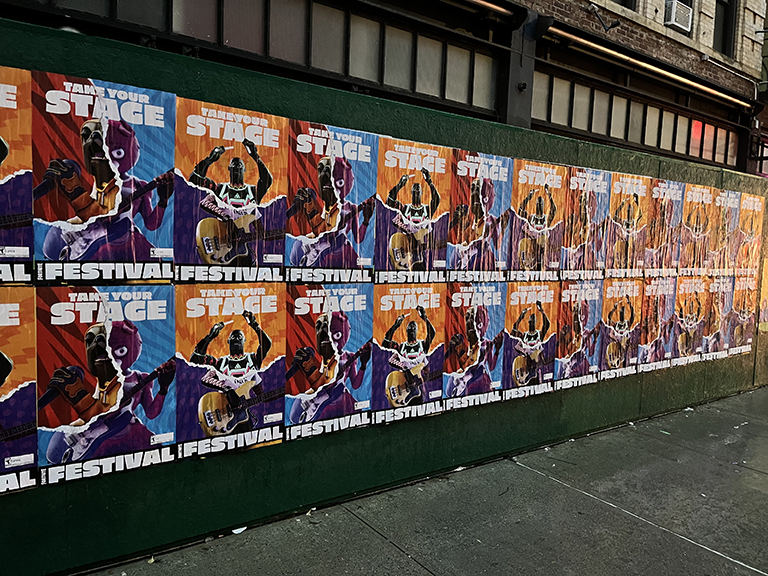
A city takeover wheatpaste campaign looks effortless when it works. Paste goes up overnight. By morning, the brand is on walls from Williamsburg to the Lower East Side, or running the length of a Chicago neighborhood, or covering SoHo building faces that cost a fraction of what a billboard would run. The client sees the photos, the photos hit social, and the campaign feels like it just happened.
It didn’t just happen. What you’re looking at is the output of a production sequence that started three weeks earlier — a sequence where the difference between a clean execution and a train wreck usually traces back to something that got skipped in the weeks before anyone touched a paste bucket.
American Guerrilla Marketing field operators have been running city takeover campaigns for over a decade. We’ve placed posters across every major US media market, in London, in Mexico City, in markets where we had to learn the local conditions firsthand because no playbook existed. The checklist that follows is what we actually use. It’s organized by timeline phase because that’s how the failures occur — not randomly, but at specific points where pressure mounts and shortcuts get taken.
If you’re planning a city takeover wheatpaste campaign and want to know what preparation actually looks like, here it is.
📋 Field Reference: Over a decade of city takeover wheatpaste campaigns across 40+ US media markets and international cities — including New York, Chicago, Los Angeles, London, and Mexico City (CDMX). Our GPS-tagged documentation archive covers thousands of individual wheatpaste placements. The patterns in this checklist reflect real failure modes we’ve seen repeat across markets, clients, and campaign types.
3 Weeks Out: Creative
Artwork Finalized and Print-Ready
This is the step that sounds obvious until you’ve watched a campaign slip a week because the client’s design team sent a screen file instead of a print file. “Print-ready” is a specific technical state, not a general description of finished-looking artwork. Here’s what it actually means:
- CMYK color mode, not RGB. Screen files look correct on a monitor because monitors display in RGB. When a printer converts RGB to CMYK — which it will, automatically, if you don’t do it yourself — colors shift. Reds flatten. Blues go green. Bright colors lose punch. You don’t see this until the run is done.
- 300ppi resolution at final print size. A file that looks sharp at a small screen preview may be 72ppi, which prints as pixelated garbage at 24×36. Resolution must be confirmed at the actual output dimensions, not scaled up from a smaller file.
- Bleed included. US formats require 0.125 inches of bleed on all sides. ISO metric formats (used in UK and European markets) use 3mm. Bleed is the area outside the final trim line that gets cut away — without it, you get white edges where the cut line falls short.
- Saved as high-resolution PDF. Not a screen-export JPEG. Not a PNG that someone exported from Canva. A press-quality PDF with fonts embedded and color profile confirmed.
Why does this week matter? Because changing artwork after production has started costs 3-7 days minimum depending on market. If you catch a color mode error after 5,000 posters have been printed for a Chicago campaign, you’re either reprinting at speed and cost, or launching with a color that doesn’t match your brand standards. Neither is a good option.
Format Specification Confirmed
Confirming format means knowing — in writing — the exact dimensions being used in the market where the campaign runs. This is not assumed. It is confirmed with the operator for that market.
- US domestic: Standard is 24×36 inches. Some New York operators use 27×40 for specific wall configurations.
- London and UK: A1 format (594x841mm). Not the same as US 24×36. A US file submitted to a London printer without conversion will be wrong.
- Mexico City (CDMX): A1 is standard in most neighborhoods. Some operators in specific colonias use custom dimensions — confirm with your CDMX operator directly.
- Japan: JIS B1 (728x1030mm) is the standard poster format. This is different from ISO B1.
The format confirmation happens at 3 weeks out because it controls the file prep. If you’ve been building artwork at 24×36 and the operator needs A1, that’s a resize and recheck — not a crisis, but not free either. The person responsible for confirming the spec before the file leaves the client’s hands is usually the account lead, but it must be named explicitly in the campaign brief. “Someone will check it” isn’t a plan.
Common mistake at this step: the client sends the screen-presentation version of the artwork — the one built for a slide deck or a PDF pitch — and the print house auto-converts it. The conversion may fix the file format but it can’t fix an underlying resolution problem, and the color shift from an RGB-to-CMYK auto-conversion often isn’t caught until the physical output is in hand.
2 Weeks Out: Logistics
Wall Inventory Confirmed and Permissioned
At 2 weeks out, the operator re-verifies every wall in the plan. “Confirmed” does not mean “was available when we originally surveyed.” It means confirmed again, now. Building owners change their minds. Other campaigns take walls. Construction appears on streets that were clear six weeks ago. We’ve walked territories in Williamsburg to find scaffolding on two of our best walls from a survey taken eight weeks before campaign week. That’s not an exceptional situation — it’s a known variable in any urban market.
“Permissioned” is a specific status with a specific standard. A permissioned wall has one of the following:
- Written authorization from the property owner or tenant
- Documented verbal authorization from the property owner or tenant
- Confirmed compliance with applicable local posting ordinances (some municipalities have defined legal posting zones where wheatpasting is permitted without individual property authorization)
We are certified and licensed operators in the markets where we work. That means our permissioning process isn’t informal. It’s documented, it’s consistent, and it happens before production — not day-of. A crew showing up to a wall without confirmed permission isn’t just a legal risk, it’s an ops failure that reflects on the client’s brand.
Paste Crew Briefed on Territory Assignments
At 2 weeks out, every crew member knows which territory they’re covering, what the walls in that territory look like, where the pickup point is, and what the timing looks like for their run. Territory assignments are not communicated the morning of — not for a city takeover. For a single-neighborhood run, you can brief on the day. For a campaign touching SoHo, LES, and Williamsburg simultaneously, or running parallel in Chicago’s Wicker Park and Logan Square, you brief the crews at least a week in advance so questions get answered before the 3am crew call.
Documentation Protocol Agreed in Writing
This is the step clients most often try to defer. “We’ll work out what the proof-of-posting looks like after we see how it goes.” No. Documentation protocol goes in the brief, agreed in writing, before installation day. What the agreement covers:
- How many photos per placement (our standard: minimum 3 — approach shot, direct face shot, contextual environment shot)
- Metadata requirements (timestamp, GPS coordinates, location description)
- Delivery format and channel
- Delivery deadline (standard: full documentation delivered by 9am the morning after installation)
Documentation disputes after a campaign — “I thought we’d get more photos,” “the timestamps don’t have location data,” “we needed geotagged files not screenshots” — are entirely preventable. They happen when documentation is treated as an afterthought. Boots on the ground documentation is what makes a campaign defensible to the client’s internal stakeholders. Get it right before the paste goes up.
Client Proof-of-Posting Format Confirmed
Separate from the documentation protocol, the client’s internal requirements for proof of posting need to be confirmed at this stage. Some clients need photos in a specific folder structure. Some need a formatted report with photos embedded alongside location descriptions. Some need GPS coordinates exported as a spreadsheet. We’ve run campaigns where the client’s media team had specific requirements for how GPS-tagged data needed to be formatted for their internal reporting tool — requirements that took 20 minutes to understand and set up in advance, but would have taken two days to retrofit after delivery.
Backup Walls Identified
A minimum of 1 backup wall per primary wall. Ideally 2. The backup walls are confirmed in the same pass as the primary confirmation — not pulled from a list at the last minute. If a primary wall falls out on installation day (access denied, unexpected construction, a competing poster campaign took the space), the crew does not stop. They go to the backup. This only works if the backup is confirmed, permissioned, and briefed in advance.
We’ve run campaigns in London where two of our primary walls near Shoreditch were papered over by another operator two days before our installation window. Because we had backups already confirmed, we made the shift without touching the delivery timeline. That’s not luck. That’s planning.
1 Week Out: Production
Print Run Complete and Quality-Checked
By 1 week out, the physical posters are in hand and have been reviewed. “Quality-checked” means our field team reviews a sample from the run before approving the full quantity for distribution. The review covers:
- Color accuracy: Does the printed output match the approved color profile? Color shift between the proof and the run can happen for several reasons — ink calibration, substrate absorption, print house quality control failures. We check it before it ships, not after the campaign runs.
- Print registration: Multi-color prints need registration alignment. A poster that’s off-register by even a small amount looks sloppy at scale — especially at 24×36 on a high-traffic wall in SoHo where pedestrians are close enough to see the detail.
- Substrate weight: Thin paper tears during application. Heavy stock that isn’t appropriate for the paste formulation being used can lift at the edges. The substrate spec is confirmed with the print house at order time, then verified on receipt.
- Edge quality: Cut edges should be clean. Ragged edges telegraph low production value and can cause tearing during application.
If a quality issue shows up at 1 week out, there’s still time to reprint for most markets. At 3 days out, you’re in emergency reprint territory — possible, but expensive and stressful. At day-of, you run with what you have or you don’t run. This is why the 1-week quality check exists.
Paste Supplies Sourced and Pre-Mixed
Paste is not a commodity input that’s the same across every market. The formulation that works in Los Angeles’s dry heat is different from what works in London. Here’s why that matters at the production stage:
- London: Wet-weather conditions require a heavier paste formulation that maintains bond strength in high humidity and rain contact. A standard US paste mix applied to a London wall in January will fail within 24-48 hours. We’ve learned this firsthand through early campaigns where we used the same formulation across markets before we understood the variable.
- Chicago: Temperature swings between seasons require formulation adjustments. A summer Chicago campaign runs with a different ratio than a late-fall run, where surface temperatures affect bonding during the cure window.
- Los Angeles: Dry heat accelerates curing. The paste window (the time between application and set) is shorter than in humid markets. Crews need to work faster or mix for a longer working time.
- Mexico City (CDMX): Altitude affects cure time calculations. At 7,350 feet, drying happens differently than at sea level. CDMX campaigns require altitude-adjusted formulations — something we confirmed through on-the-ground testing in the market, not from a formula sheet.
Paste supplies are sourced and pre-mixed before crew assignments are locked, so that if there are supply issues in the market, they’re resolved before the crew has a start time.
Crew Assignments Finalized
At 1 week out, the crew roster is complete and specific. “Who covers which territory” is a named person with a named territory, not a general assignment. The field coordinator for each territory is identified. Supply pickup time is confirmed. Start time for each crew is confirmed. If there are multiple markets running simultaneously — a true city takeover across several neighborhoods or cities — each market’s crew is independently coordinated, with a single point of contact who manages the full operation.
Installation Windows Locked
The standard installation window for a city takeover wheatpaste campaign is 3am-6am. That window exists for two reasons:
- Pedestrian interference is minimal. A paste crew working a busy wall at 11pm is drawing attention. At 3am, the street is quiet, the work goes faster, and the finished placement isn’t going to be bumped or smeared by foot traffic before it cures.
- Cure time before morning. Paste applied at 3am has 3-4 hours to cure before morning foot traffic arrives. In most weather conditions, that’s enough time to set a solid bond. In cold or wet conditions, the formulation accounts for the longer cure time needed.
The installation window is locked — crew confirmed, equipment staged, permits or documentation in order — by 1 week out. Last-minute window adjustments create cascading problems: crews get updated late, the field coordinator is managing changes instead of executing, backup planning goes out the window.
Installation Day
Crew Check-In Protocol
A city takeover with multiple crews across multiple territories needs a communication protocol that actually tracks the operation as it runs. Our standard check-in sequence:
- Departure check-in: Crew confirms they have supplies and are en route to territory
- Territory arrival check-in: Crew confirms arrival at first wall in territory
- First placement check-in: Crew confirms first placement is complete and documented
- Active pasting check-ins: Every 45 minutes during active pasting
- Territory completion check-in: Crew confirms all placements in territory are done and documented
This isn’t bureaucracy — it’s how you run a multi-crew operation without surprises. If a crew goes silent at 4am during active pasting, the field coordinator knows within 45 minutes and can respond. Without the protocol, silence is ambiguous until it becomes a problem.
Documentation Workflow
Documentation happens at each placement, not at the end of the run. The workflow:
- Placement completed
- Timestamp confirmed (phone clock, GPS-tagged photo)
- GPS coordinates confirmed at placement location
- Photos taken per the agreed protocol (minimum 3 per placement)
- Photos submitted to the documentation channel before the crew moves to the next wall
End-of-run documentation — “we’ll gather everything when we’re done” — creates a situation where photos get missed, GPS data is reconstructed from memory, and timestamps are inconsistent. Placement-by-placement documentation is slower per individual placement and faster overall because nothing has to be reconstructed after the fact.
Communication Chain for Issues
Before installation day, the issue escalation chain is defined in writing. What counts as an issue that requires escalation to the field coordinator or client:
- Access denied to a primary wall (field coordinator notified, backup activated)
- Crew member unable to complete territory (field coordinator notified, coverage reassigned)
- Safety concern at a location (immediate escalation, no exceptions)
- Weather conditions outside the pre-planned contingency (field coordinator call on continue/pause/reschedule)
What counts as a crew judgment call without escalation:
- Minor placement adjustments (wall position, exact height) within the confirmed location
- Order of placements within a territory
- Minor surface prep decisions
The line between judgment call and escalation is agreed before the crew deploys. Ambiguity at 4am, in the field, with a paste bucket in your hand, is where coordination breaks down.
Client Update Cadence
The first client update during a city takeover campaign goes out when the first territory is complete — typically between 5am and 6am. It includes: number of placements completed so far, photo confirmation for 2-3 signature walls, and estimated completion time for remaining territories. This is agreed with the client in advance, not improvised.
Post-Installation: 24-48 Hours
Full Documentation Delivery
Standard delivery: full documentation package by 9am the morning after installation. The package includes every GPS-tagged photo from every placement, organized by territory, with timestamps and location data matching what was agreed in the brief. If the brief specified a formatted report, the report is included. If it specified a raw folder of geotagged files, that’s what gets delivered.
Late documentation delivery is one of the most common post-campaign friction points, and it’s almost always traceable to documentation standards that weren’t locked in the brief. When the client’s internal team is waiting on proof-of-posting to send to their CMO, a 24-hour documentation delay isn’t trivial — it affects how the campaign lands internally, regardless of how well the physical execution went.
Condition Check at Day 3
A field pass at day 3 confirms which placements are holding and which need attention. In most markets, well-executed placements on appropriate surfaces hold for 4-6 weeks without maintenance. But “most markets” isn’t “all markets” — and the day-3 check catches early failures before they affect the campaign’s run.
What the day-3 check looks for:
- Edge lift (usually caused by paste that didn’t fully bond at the edges — fixable with a spot application)
- Surface failures (rare, but some wall surfaces — particularly high-gloss paint or heavily weathered surfaces — don’t hold as expected)
- Coverage by competing materials (in high-traffic markets like the LES or Williamsburg, other operators move fast)
- Environmental damage (significant rain events in the first 24-48 hours can affect bond on some surface types)
Maintenance Schedule for Extended Campaigns
Campaigns running longer than 7 days typically benefit from a top-up pass at day 5-7. What “top-up” means: a field crew revisits placements showing edge lift or partial coverage and reinforces them. On a campaign that’s running for 2-3 weeks — common for album releases, product launches, or sustained brand awareness pushes — we build the maintenance pass into the campaign plan, not as an optional add-on but as a standard component of an extended run.
The maintenance pass is most valuable in high-pedestrian markets where placements get more physical contact (people brushing against walls, bags hitting posters, etc.) and in markets with variable weather. A Chicago campaign in April may face rain, cold, and wind within a single week. Planning for that means the campaign holds — which means the client’s media value holds.
Campaign Performance Notes
Delivered with the documentation: a brief summary of how the campaign ran. What this covers: any placements that shifted from primary to backup walls and why, any market conditions that affected the run, notes on surface performance for any walls that will be used in future campaigns, and a summary of total documented placements against planned placements. This is part of how our firsthand, on-the-ground observations translate into better planning for the next campaign — ours or the client’s.
Common Failures and How to Prevent Them
1. Wrong File Format Sent to Printer
The single most common cause of reprint delays across every market we’ve worked in over a decade. It’s not rare — it happens on campaigns run by experienced teams, not just first-timers. The pattern: the client’s design team sends the file they have, the print house receives it and either auto-converts it (silently) or flags it (after starting the job), and by the time anyone knows there’s a problem, time has been lost.
Prevention: confirm file specs with the print house before submitting the file, not after. Get the printer’s spec sheet. Match the file to it. Do a proof check before approving the full run. This is a 30-minute conversation that prevents a 3-day delay.
2. Wall Access Denied Day-Of
This happens when backup walls weren’t identified in advance. A crew arrives at a primary wall, the access is denied — building owner changed their mind, there’s unexpected construction, a competing operator got there first — and the crew has nowhere to go. The result is either a gap in the coverage map or a scrambled last-minute search for alternatives at 4am.
Prevention: every primary wall needs a confirmed backup before production starts. Non-negotiable on a city takeover. The backup isn’t a maybe — it’s a confirmed, permissioned position that the crew knows about and can execute without calling anyone for directions.
3. Rain During the Paste Window
Rain is not a reason to cancel a campaign. It is a reason to have a contingency timing plan agreed before campaign week. Paste can be applied in light rain with the right formulation — heavier paste, technique adjustments to minimize wash during cure, and a confirmed understanding of what conditions cross the line from “workable” to “reschedule.”
Prevention: before campaign week, the field coordinator and the client agree on what weather conditions trigger the contingency window, and the contingency window is already identified and cleared with the crew. The decision to move to the contingency window is made by the field coordinator, not improvised by the crew in the field at 3am.
4. Documentation Delivery Delay
Usually caused by documentation standards that weren’t set in the brief. The crew captures photos but not GPS data. The photos are timestamped but not organized. The delivery format wasn’t agreed so it takes extra time to compile. All of this is fixable before it happens.
Prevention: documentation requirements go into the brief before production begins. Every requirement — format, metadata, organization, delivery deadline — is confirmed in writing with the operator. The crew is briefed on those requirements before installation night, not briefed on them after the fact.
5. Format Conversion Missed
A US client sends a 24×36 file to a London printer. The London printer runs A1. The file gets resized or the job gets rejected. Either way, the production timeline slips.
Prevention: format conversion is confirmed at the 2-week logistics step. When a campaign runs in multiple markets with different format standards, the operator for each market confirms the required format, and the file prep step explicitly accounts for each variant. One file does not serve all markets unless the campaign was built for that from the start.
The Full Pre-Launch Checklist
| Item |
Timeline |
Responsible Party |
Common Failure Mode |
| Artwork finalized in CMYK at 300ppi with bleed |
3 weeks out |
Client design team / AGM account lead |
RGB file auto-converted at print — color shift on output |
| File saved as high-resolution PDF (not JPEG/PNG screen export) |
3 weeks out |
Client design team |
Screen export submitted — pixelated output at print size |
| Format specification confirmed for each market |
3 weeks out |
AGM account lead + market operator |
US file sent to London printer — wrong dimensions for A1 |
| Print spec sheet confirmed with printer before file submission |
3 weeks out |
AGM production |
File submitted without spec check — reprint required |
| Wall inventory re-verified (not just originally surveyed) |
2 weeks out |
Market operator |
Construction or competing campaign takes primary walls |
| Permissioning documented for every wall in plan |
2 weeks out |
Market operator + AGM compliance |
Day-of access denial — no permission on record |
| Backup walls confirmed (min. 1 per primary, ideally 2) |
2 weeks out |
Market operator |
Primary denied, no backup — coverage gap |
| Crew territory assignments briefed |
2 weeks out |
Field coordinator |
Day-of confusion about territories — delayed start |
| Documentation protocol agreed in writing |
2 weeks out |
AGM account lead + client |
Post-campaign dispute over photo count/metadata requirements |
| Client proof-of-posting format confirmed |
2 weeks out |
AGM account lead + client |
Delivery format wrong — client needs reformatting for internal use |
| Print run complete |
1 week out |
Print house + AGM production |
Print delay discovered at 3 days out — emergency reprint |
| Quality check: color accuracy, registration, substrate, edges |
1 week out |
AGM production |
Color shift or registration error discovered post-install |
| Paste formulation confirmed for market conditions |
1 week out |
Field coordinator |
Standard US formula used in London — bond failure within 48 hours |
| Paste supplies sourced and pre-mixed |
1 week out |
Field coordinator |
Supply shortage discovered day-of — incomplete run |
| Crew assignments finalized with named individuals |
1 week out |
Field coordinator |
Last-minute crew change — unfamiliar territory, slow execution |
| Installation window locked (3-6am standard) |
1 week out |
Field coordinator + client |
Window changed day-of — crews not updated, coordination fails |
| Contingency weather window identified and cleared with crew |
1 week out |
Field coordinator |
Rain cancels campaign — no alternate window pre-planned |
| Issue escalation chain defined in writing |
Before installation day |
Field coordinator |
Crew makes wrong call on access denial — no escalation protocol |
| Client update cadence agreed |
Before installation day |
AGM account lead + client |
Client gets no update until 9am — internal anxiety, loss of trust |
| Crew check-in protocol communicated to all crew |
Before installation day |
Field coordinator |
Crew goes silent during pasting — problem unknown until morning |
| Full documentation delivered by 9am morning after |
Post-installation |
Field coordinator + AGM account lead |
Delivery delayed — client can’t show proof to internal stakeholders |
| Day-3 field condition check |
Post-installation |
Market operator |
Edge lift goes unaddressed — placements fail early |
| Maintenance pass planned for campaigns over 7 days |
Post-installation (day 5-7) |
Field coordinator + client |
No top-up — campaign degrades in week 2 |
| Campaign performance notes delivered with documentation |
Post-installation |
AGM account lead |
No field notes — next campaign starts from scratch |
A Note on What This Checklist Actually Represents
Every item on this checklist is on it because something went wrong when it was skipped. Not in a case study we read — in campaigns we’ve run. We’ve had the color shift. We’ve had the day-3 wall failures. We’ve had the documentation dispute. We’ve had the crew show up to a wall that was taken. And because we’ve been running this for over a decade, those failures didn’t stay in the system — they got built into the checklist and the briefing process so they don’t repeat.
That’s what firsthand, on-the-ground experience actually looks like. Not a flawless track record of campaigns that never had friction — a track record of identifying where friction occurs and building the systems that prevent it from becoming a failure.
“The campaigns that look effortless are the ones where the checklist got done. Not partially done — done. Every item, every week, every market. That’s the whole game.”
If you’re planning a city takeover wheatpaste campaign and you’re working through this checklist, the single most useful thing you can do is identify which items you don’t have answers for yet and close those gaps now — at 3 weeks out, or wherever you are in the timeline. The items without clear answers are the items that will cause problems.
Our nationwide portfolio of case studies covers markets from New York (Williamsburg, LES, SoHo) to Chicago, Los Angeles, and international markets including London. The field conditions differ. The checklist stays the same.
Frequently Asked Questions
How far in advance should artwork be finalized for a city takeover wheatpaste campaign?
Artwork needs to be print-ready at least 3 weeks before installation day. That gives the production team time to run the print job, quality-check the output, and still have a buffer if a reprint is needed. Submitting files in the final week of production is the single most common cause of launch delays. Print-ready means CMYK, 300ppi at final size, with bleed, saved as a high-resolution PDF — not a screen-export file that looks correct on a monitor.
What does “permissioned” mean in the context of wheatpaste placements?
A permissioned wall has documented authorization from the property owner or tenant, or has been confirmed compliant with applicable local posting ordinances. American Guerrilla Marketing field operators are certified and licensed in the markets where we work. Our permissioning process is documented before production begins — not confirmed on installation day. A crew showing up to a wall without confirmed permission is an ops failure, not a gray area.
Why does paste formulation differ by city?
Ambient humidity, temperature, and surface conditions all affect how paste bonds and how fast it cures. London requires a heavier paste mix because of wet-weather conditions. Chicago paste differs from LA because LA’s dry heat accelerates curing. In Mexico City, altitude affects cure time calculations. We adjust formulation for every market based on on-the-ground conditions, not a one-size formula. We confirmed the CDMX formulation through firsthand testing in the market — not from a spec sheet.
What is the standard documentation requirement for a city takeover wheatpaste campaign?
Our standard is GPS-tagged photos with timestamps delivered by 9am the morning after installation. Each placement gets a minimum of 3 photos — approach shot, direct face shot, contextual environment shot. Metadata requirements, including coordinates, time, and location description, are agreed in writing with the client before production starts. The delivery format — whether that’s a formatted report, a raw folder of geotagged files, or a spreadsheet export — is confirmed at the 2-week logistics step, not day-of.
What happens if it rains on installation day?
Rain isn’t a cancellation — it’s a contingency timing scenario you plan for in advance. Before campaign week, we identify an alternate installation window and clear it with the crew. Paste can be applied in light rain with the right formulation and technique. The risk without a contingency plan isn’t the weather — it’s not having a confirmed backup window already cleared with the crew and approved by the client. That decision is made before campaign week, not at 2am when the forecast changes.