
July 13, 2026
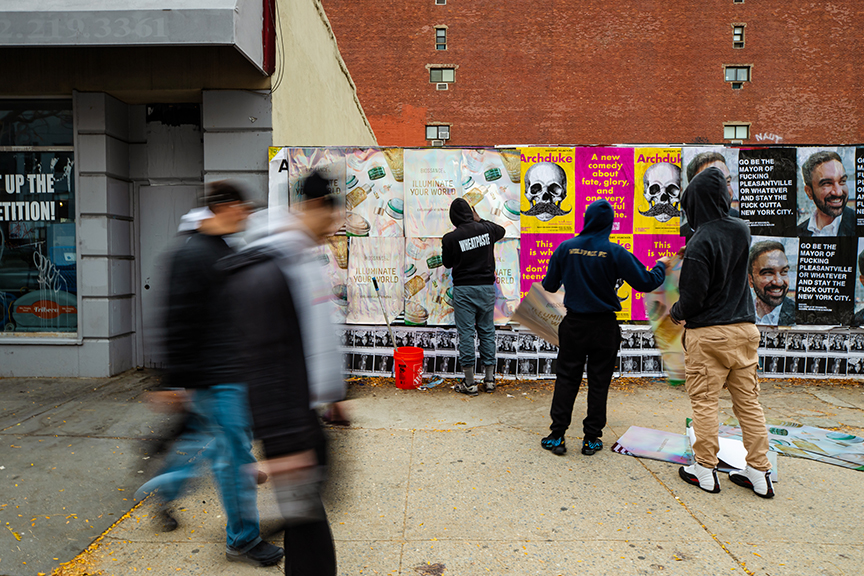
There are campaigns that build slowly over weeks, layering installations across a city as a product or event approaches. And then there are campaigns where timing is the entire point — where what matters is not how gradually the city learns about something but how completely it knows about it the moment it needs to. A 24-hour wheatpaste blitz is built for that second scenario. It compresses everything into a single overnight window, placing hundreds of installations across multiple neighborhoods before most of the city wakes up.
American Guerrilla Marketing field operators have executed 24-hour blitzes in New York, Los Angeles, Chicago, and other major US media markets over the past decade. Every one of those campaigns taught us something about what this kind of operation requires — and what it punishes when you get it wrong. The most consistent lesson: the blitz night itself is the smallest part of the equation. The three weeks before it determine everything.
This piece covers when a 24-hour blitz makes sense, what’s achievable in each major market, how crew structure works, the specific installation window that matters, what the full pre-production calendar looks like, and a case study of a music label that needed 300 walls across six New York neighborhoods before a midnight album drop.
Not every campaign benefits from compression into a single window. Multi-night campaigns that build gradually have their own advantages — they create a visible spread that audiences notice building over days, which generates anticipation. But there are specific scenarios where the 24-hour blitz is the right call.
Album drops with hard midnight release times are the clearest case. When an album is available on streaming at midnight Friday, the brand wants walls in every major neighborhood visible to morning commuters on Friday. A campaign that’s still going up Friday night — after the album is already out — misses the window when fan anticipation and search behavior peak. The blitz ensures the physical campaign is fully in place before the digital release, not catching up to it.
Product launch windows tied to press embargoes work similarly. When editorial coverage of a product breaks on a specific date, the brand wants physical presence in the market ready to greet consumers who’ve just seen the news. Having half the campaign up when the embargo breaks and the other half finishing two nights later undermines the sense of scale that physical campaigns are meant to create.
Event approach marketing — campaigns for a show, a premiere, a brand activation — also benefits from the blitz format when the event date is fixed and the brand wants a fully saturated city by the time event-goers start arriving. In these cases, the 24-hour window is usually the night before the event, with crews working through the night so walls are visible to people traveling to the venue the following day.
The honest answer to “how many walls can you cover in 24 hours” depends on format size, crew count, pre-production quality, and wall density in the target neighborhoods. But after 10 years of city takeover campaigns across the country, here are the realistic baselines American Guerrilla Marketing certified field operators have established.
In New York, with four to five two-person crews operating simultaneously and a full pre-production package, a 24-hour blitz can cover 150 to 300 walls across four to six neighborhoods. New York’s density is an advantage — walls are closer together, travel between territories is faster (especially in Brooklyn neighborhoods like Williamsburg and Bushwick where walking routes work well), and the 24×36 format installs quickly. Manhattan neighborhoods have more complex access logistics but higher visibility per wall.
In Los Angeles, the geometry changes. Neighborhoods are farther apart, and each crew needs vehicles and navigates more complex driving routes. With the same four to five crew teams, the realistic NYC-equivalent in LA is 100 to 200 walls across four to five neighborhoods, with longer transit times eating into installation hours. LA also has more variability in surface condition and access than New York, which adds contingency time to every blitz plan.
In Chicago, the wall density in Wicker Park and Logan Square is strong, and the neighborhood layout favors efficient crew movement along the Milwaukee Ave corridor. A Chicago blitz with three to four crew teams covering Wicker Park, Logan Square, Pilsen, and Andersonville can realistically place 100 to 175 walls in a 24-hour window with solid pre-production.
A 24-hour blitz runs on parallel crew teams, not a single large group. One crew team of eight people moving together is dramatically less efficient than four two-person teams covering four territories simultaneously. The math is straightforward: eight people moving as one unit can only be in one location at a time. Four teams of two are in four locations at once.
Each two-person team consists of one primary installer and one documentation and logistics operator. The installer handles paste application and poster placement. The documentation operator handles GPS-tagged photography, maintains the wall log, and manages the paste bucket, print rolls, and supply kit. On high-wall-count installations (27×40 or larger), both operators work the installation together and alternate documentation.
Territory division is not purely geographic. American Guerrilla Marketing field coordinators divide territories based on wall density, surface type, and access window, not just by drawing lines on a map. A neighborhood with 30 walls that are all on ground-floor accessible surfaces is a different territory than a neighborhood with 30 walls that includes two elevated locations and several surfaces requiring scaffold access. The first territory can be handled by a standard two-person crew; the second may need a three-person team or a different format altogether.
On a major blitz, there is also a field coordinator role — one person who is not pasting, not documenting individual walls, but managing all crew teams from a central communications point. The field coordinator tracks each team’s progress, manages any real-time adjustments (a wall that’s unavailable, a crew that’s running ahead or behind), and begins aggregating documentation as photos come in from the field. On a 300-wall campaign, the documentation aggregation job alone is a full-night operation.
In every major US city, the window from 3am to 6am is the primary installation window for city takeover wheatpaste campaigns. This is not arbitrary. It reflects the specific operational reality of street environments in major cities and what it means for both efficiency and visibility.
From midnight to 3am, bars are closing, foot traffic is irregular and concentrated near entertainment districts, and the social environment is less predictable. Installation in this window is possible but creates more variables — more pedestrian interaction, more active streets, more potential for attention from audiences who are not the campaign’s target demographic.
From 3am to 6am, the city is as quiet as it gets. Streets in residential and commercial neighborhoods are largely empty. The installation pace is faster because crews don’t need to work around pedestrians or pause for street interaction. Access to walls is cleaner. And the light is still low enough that installations are going up in the dark — meaning the full visual impact of the campaign is revealed at sunrise rather than gradually accumulated over a visible overnight process.
From 6am onward, the city starts waking up. Early commuters, dog walkers, and joggers begin moving through the neighborhoods where crews have been working. These are the first organic observers of the campaign — the people who will take the first photographs, share the first posts, and begin the word-of-mouth chain that a blitz campaign depends on. For this audience to find a complete, fully installed campaign, all of the core installation work needs to be finished before they arrive. That means the 3am to 6am window is the production window and 6am onward is the documentation and visibility window.
The 3am to 6am installation window only works if everything is ready before crews go out. On blitz day, crews are executing, not figuring things out. Every decision that can be made before that night should be made before that night.
Wall inventory secured: Every wall on the list should be confirmed as available, permissioned where required, and physically appropriate for the format being installed. American Guerrilla Marketing field operators conduct boots on the ground scouting walks for every campaign in our nationwide portfolio — not relying on satellite images or previous campaign notes. Surfaces change. Buildings get painted. Property ownership changes. A wall that was clean and available three months ago may not be available today. Scouting happens within two weeks of blitz day.
Paste pre-mixed: Wheat paste needs to be mixed, cooled, and loaded into buckets before crews deploy. On a large blitz, paste mixing happens at a staging location 24 to 36 hours before installation. Each crew team has its own pre-loaded paste supply for its territory — no sharing between teams, because teams won’t be near each other during the installation window.
Routes mapped: Each crew team has a printed and digital route showing every wall in their territory in optimal installation order, with GPS coordinates, surface notes, and any access notes. The route minimizes backtracking and sequences walls in the order that allows for the fastest movement through the territory.
GPS documentation protocol confirmed: Every crew member knows exactly how to document each wall — GPS photo taken immediately after installation, before moving to the next location, with location services active and timestamp enabled. This is not a “take some pictures” protocol. It is a specific documentation standard that produces a client-ready report, not a folder of unorganized images.
One of the overlooked logistics challenges in a 24-hour blitz is documentation aggregation. When four crew teams are working simultaneously across a city from 3am to 6am, they are collectively generating hundreds of GPS-tagged installation photos. By 7am, those photos need to be organized, labeled, and ready for the client report.
American Guerrilla Marketing’s field coordinator role exists partly for this reason. As installation photos come in from each team throughout the overnight window, the field coordinator is receiving, sorting, and logging them in real time. By the time the last crew wraps at 6am, the documentation package is largely complete — it needs final formatting and QA, not a from-scratch organization job.
For a music label client whose team in New York needs documentation proof before their 9am morning meeting, this timeline matters. The campaign was executed overnight. The album drops at midnight. The label’s marketing team wakes up to find a documentation package in their inbox with GPS-tagged photos of every wall in every neighborhood, timestamped from the overnight installation window. That documentation is not just operational confirmation — it is the client’s internal proof of performance for their own marketing reporting.
Things go wrong on blitzes. Not sometimes — routinely. A wall that was confirmed has been painted over in the past week. A property manager shows up unexpectedly at 4am. Rain starts at 3:30am and paste won’t cure on wet surfaces. A crew vehicle gets a flat tire in Bushwick at 4am.
The way a blitz handles problems is a function of pre-production quality. American Guerrilla Marketing builds contingency walls into every blitz plan — additional pre-scouted locations that can absorb capacity if primary walls are unavailable. A plan that accounts for only the exact number of walls needed has zero buffer. A plan with 15% contingency built in can absorb most mid-blitz disruptions without affecting total coverage.
Rain is the hardest variable. If rain starts mid-blitz, crews can often complete already-started installations and move to covered surfaces, but fresh paste on a wet wall will not cure correctly and will slide before morning. The decision to pause, continue, or redirect to covered surfaces is made by the field coordinator with real-time weather data, not by individual crews on the ground. This is one of the reasons field coordinator is a distinct role on major blitz campaigns — someone needs to be watching the full picture while crews are focused on their own territory.
Crew access issues — a property that denies access, a security guard who challenges installation — are handled by immediate escalation to the field coordinator, who redirects the crew to contingency walls rather than spending time negotiating on-site. In over a decade of city takeover campaigns, American Guerrilla Marketing’s certified and licensed operators have developed protocols for every common access scenario. The goal is always to resolve the situation without confrontation and keep the crew moving.
Every 24-hour blitz debrief we’ve ever done has said the same thing: the campaigns that went smoothly went smoothly because of preparation, not execution skill. Execution skill matters — experienced crews install faster and document more cleanly — but preparation is what determines whether execution is possible at all.
The difference between a blitz that delivers 300 walls and one that delivers 180 is almost never crew quality. It’s almost always preparation quality. The wall list wasn’t fully scouted. The paste wasn’t pre-mixed and staged. The documentation protocol wasn’t briefed clearly enough. The route wasn’t optimized. Any one of these gaps costs hours on blitz night.
This is why American Guerrilla Marketing’s planning process for a major blitz begins three weeks before the installation date, not one week. Three weeks is the minimum timeline to do proper pre-production for a city-scale blitz. Two weeks is survivable with some compromises. One week is not enough time to do it right.
| Week | Activities |
|---|---|
| Week 1 (21-14 days out) | Campaign brief finalized. Neighborhood territories mapped. Initial wall scouting walks in all target territories. Format selection confirmed (24×36 for density, 27×40 for premium walls). Print production file delivery to printer. Crew team assignments confirmed. |
| Week 2 (14-7 days out) | Scouting walks completed. Wall inventory finalized and loaded into crew route plans. Print production completed and prints delivered to staging location. Paste ingredient procurement. Permission and property owner confirmations where applicable. GPS documentation protocol briefing. |
| Week 3 (7-1 days out) | Pre-installation scouting verification (walking final wall list to confirm surface conditions). Paste mixed and staged at crew supply points. Crew final briefing with route plans, wall lists, documentation protocol, and communication timeline. Contingency wall list confirmed. Field coordinator briefed on aggregation workflow. Weather monitoring begins 72 hours out. |
| Blitz Day | Crews deploy at staggered start times based on territory. Core installation window 3am-6am. Field coordinator active throughout. Documentation aggregation begins as photos arrive. Client documentation package delivered by 9am. |
A music label with an album dropping at midnight needed maximum physical presence across New York before the release. The brief: 300 walls across six neighborhoods, all installed before midnight on release day, with full GPS-tagged documentation delivered to their New York office by 8am the following morning.
The neighborhoods: Williamsburg, Bushwick, LES, Crown Heights, Harlem, and the Bronx. The format: 24×36 for the primary run, with 27×40 installed on eight selected premium walls identified during scouting.
Planning began 21 days before the album drop. The first week was territory mapping and wall scouting. The Williamsburg walk identified 58 walls across the Bedford Ave corridor, North 6th, and the blocks around the L train entrance. Bushwick produced 62 walls along Myrtle Ave and the surrounding residential blocks. LES produced 44 walls on Delancey, Orchard, and Canal. Crown Heights, Harlem, and the Bronx were scouted with a focus on high foot traffic corridors and surfaces with clean paste acceptance.
Five two-person crew teams were assigned territories. A field coordinator managed communications and documentation from a central location with real-time access to all crew GPS feeds.
Paste was mixed and staged at two Brooklyn locations (one serving the Brooklyn teams, one for the Manhattan and outer borough teams) 36 hours before installation night. Print delivery happened four days before the blitz — never the night before, because any print production delays at that stage kill the timeline.
Installation began at 2:30am. Williamsburg and Bushwick crews started simultaneously; LES and Crown Heights started at 3am; Harlem and the Bronx at 3:30am. By 5:45am, all 300 primary walls were installed and documented. Touch-up teams ran from 6am to 8am on any walls that needed reinforcement after installation.
The field coordinator delivered the GPS-tagged documentation package — 300 installation photos with coordinates, timestamps, and neighborhood labels — at 7:52am. The label’s marketing team had it before their 9am call.
Organic social coverage began appearing from Williamsburg and Bushwick accounts at approximately 7am, within an hour of morning foot traffic hitting the streets. By noon, the campaign was documented on three street culture accounts with a combined following in the hundreds of thousands. The album release was accompanied by physical presence across six neighborhoods that fans found and photographed throughout the day.
American Guerrilla Marketing coordinates city takeover wheatpaste campaigns across the US from a single New York contact.
A 24-hour blitz is the right format when a launch has a hard deadline — an album drop with a midnight release, a product launch tied to a specific event or press embargo, or a campaign that needs to be fully in place before a news cycle breaks. American Guerrilla Marketing field operators have executed blitz campaigns for music labels, consumer brands, entertainment companies, and retail clients. When timing is the strategic variable and physical presence needs to precede digital release, compressing everything into a single overnight window is the right call.
With multiple simultaneous crew teams operating from a fully prepared pre-production package, American Guerrilla Marketing certified field operators can cover 150 to 300 walls across 4 to 6 New York neighborhoods in a single 24-hour window. The number depends on format size, wall density in the target neighborhoods, and how complete pre-production is. This is based on firsthand execution across our nationwide portfolio, not estimates from satellite scouting.
Pre-production. The three weeks before blitz day — scouting, wall inventory, paste staging, print production, route planning, crew briefing — determine whether the blitz night goes cleanly or struggles through constant improvisation. Experienced blitz operators know that execution on the night is a function of preparation quality. A well-prepared blitz runs almost automatically. An underprepared one fights itself from midnight to sunrise.
American Guerrilla Marketing builds contingency walls — pre-scouted backup locations — into every blitz plan, typically 15% above target wall count. When a primary wall is unavailable mid-blitz, crews redirect to contingency locations without losing momentum. The field coordinator manages all real-time adjustments so individual crews are not making solo decisions at 3am. Rain, access issues, and surface problems are handled through the coordinator role, not by ad hoc crew judgment.
GPS-tagged photos are collected from all crew teams throughout the installation window and aggregated by the field coordinator in real time. A consolidated documentation package — GPS coordinates, timestamps, and installation photos for every wall — is delivered to the client the morning after blitz night, typically before 9am Eastern. This documentation meets the standard for marketing performance reporting and can be used for media accounting and internal campaign tracking.
Millie Phillips
Campaign Architect — American Guerrilla Marketing
Email: [email protected]
Office: (646) 776-2770
Ready to Run Your Campaign?
Call us or email us. We’ll tell you exactly what we can do in your market and what it costs.
American Guerrilla Marketing — Los Angeles
Street-level campaigns in Los Angeles and nationwide. Wheatpasting, LED trucks, street teams, and more.
(646) 776-2770
July 13, 2026
July 13, 2026
July 13, 2026
July 13, 2026
July 13, 2026
