
July 13, 2026
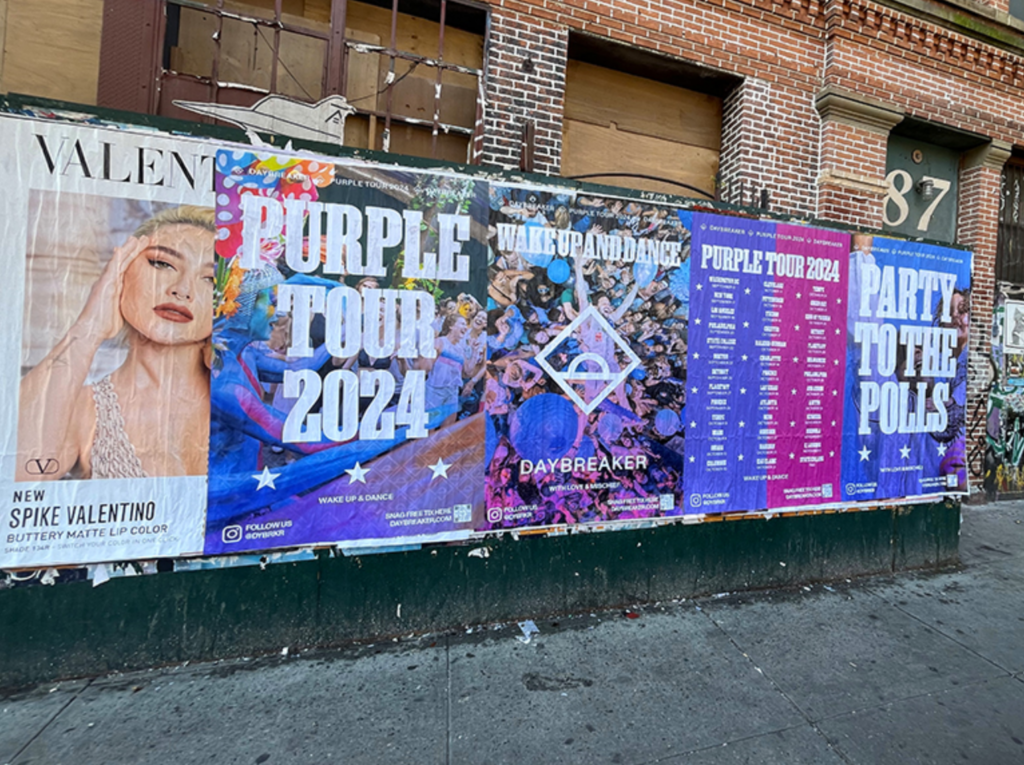
There are two fundamental approaches to wheatpaste campaign strategy. One floods the city. The other finds the right pocket. Both work — in the right context. Neither is universally correct, and choosing the wrong one wastes budget on the wrong kind of coverage.
American Guerrilla Marketing field operators have run both formats across every major media market over the past decade. We’ve seen city takeover campaigns that generated massive organic social amplification and cultural buzz. We’ve also seen targeted placement campaigns that hit a specific audience with surgical precision at a fraction of the city takeover investment. The question isn’t which format is better. It’s which one fits what you need.
This article breaks down the two strategies head to head — what each does, when each works best, what each costs in terms of scale and complexity, and how to make the decision for your specific situation.
A city takeover wheatpaste campaign deploys high-volume poster placements across a media market’s full geographic range — typically 8 to 20 neighborhoods, 250 to 600+ placements, executed in a compressed 24-to-72-hour window. The goal is saturation. You want the target audience to encounter the campaign no matter where they go in the city. The effect is the feeling that your brand is everywhere.
City takeover campaigns maximize reach within a market and generate the strongest perception-of-ubiquity effect. They’re the format of choice when cultural legitimacy, broad market awareness, and launch-moment impact are the campaign’s primary objectives.
A targeted placement campaign identifies the specific neighborhoods, blocks, or micro-zones where the target audience concentrates and places a smaller volume of high-quality placements in those precise locations. Instead of covering the whole city, you cover the right parts of it deeply.
Targeted placement maximizes precision and efficiency. A 60-placement campaign concentrated in Williamsburg and Bushwick will reach Brooklyn’s music audience more efficiently than the same 60 placements scattered across 12 neighborhoods. The trade-off is narrower reach — if your audience moves outside those zones, the campaign doesn’t follow them.
Every decision between these two strategies comes down to the same trade-off: reach versus precision.
| Factor | City Takeover | Targeted Placement |
|---|---|---|
| Geographic reach | Full media market | Selected zones only |
| Audience coverage | Broad — anyone in the city | Precise — core audience zones |
| Saturation effect | City-wide ubiquity | Neighborhood-level dominance |
| Campaign size | 200-600+ placements | 40-150 placements |
| Execution complexity | High — multi-crew, multi-night | Moderate — 1-2 crews |
| Best for | Major launches, new market entry, cultural moment campaigns | Niche audiences, test campaigns, sustained presence in key zones |
Understanding where you sit on this trade-off determines which format is right for the campaign.
When a brand, album, film, or platform is launching and the objective is to make the launch feel like a cultural event, city takeover is the format. A targeted placement campaign creates presence in a neighborhood. A city takeover creates the feeling that the launch is inescapable. For a streaming platform releasing a new series, an artist dropping an album, or a brand entering a market with serious intent, that inescapability is the message.
We’ve run case studies from our nationwide portfolio showing that city takeover campaigns for entertainment launches generate two to three times the organic social media documentation of targeted placement campaigns for comparable products. The organic amplification is driven by the saturation effect — when something appears everywhere, people feel compelled to document and share it because it seems significant.
A brand entering a city for the first time doesn’t have the luxury of knowing exactly where their audience concentrates. They have assumptions. They have research. But they haven’t run campaigns in this market, and the on-the-ground reality of audience concentration may differ from what the data suggests.
City takeover solves this uncertainty by covering the full market. The campaign reaches the audience wherever they actually are, not just where the brief predicted they’d be. It also generates the kind of broad-market first impression that signals a brand is entering with commitment, not just testing.
Some cities are visually contested — the walls are competitive, there’s a lot of existing visual noise, and standing out requires genuine saturation rather than precision placement. New York is the classic example. The Lower East Side alone has enough visual competition that a targeted placement campaign in that neighborhood alone might get lost entirely. A city takeover that covers LES as one of twelve neighborhoods, at the right density, cuts through in a way that a smaller campaign in the same zone can’t.
When the campaign itself is part of the press story — when you want journalists, bloggers, and culture writers to notice and write about the street presence — city takeover is the format that generates that coverage. Targeted placement in two neighborhoods generates blog posts from those neighborhoods. A city takeover generates “did you see these posters everywhere?” pieces that describe the experience of a city-wide saturation.
When the target audience is tightly defined and geographically concentrated, targeted placement can achieve the same effective reach as a city takeover at significantly lower volume. A streetwear brand targeting sneaker culture enthusiasts in Los Angeles knows that the Fairfax District, Highland Park, and parts of Venice are where that audience lives and shops. A 60-placement targeted campaign in those three zones reaches the core audience as effectively as a 250-placement city takeover — and allows the remaining budget to go toward other campaign elements.
City takeovers are launch-moment strategies. They generate high impact over a 2-to-4-week window. For brands that need sustained street presence over multiple months, a series of targeted placement campaigns — refreshing specific high-value zones every four to six weeks — is often more effective than a single city takeover followed by nothing.
We’ve placed campaigns in Echo Park in Los Angeles for a brand that maintained consistent street presence in that single neighborhood for eight consecutive months. Each deployment was modest in volume. The cumulative effect of sustained presence in one zone built brand recognition among that neighborhood’s community far more deeply than a one-time city takeover would have.
Brands running wheatpaste campaigns in a new market for the first time often benefit from starting with targeted placement before scaling to a city takeover. The targeted campaign generates real-world data on how the audience in specific neighborhoods responds to the brand’s visual presence — what gets photographed, what generates social engagement, which surfaces perform. That firsthand data informs the city takeover plan for the next campaign with precision that no amount of pre-campaign research can replicate.
When the campaign is tied to a specific venue, neighborhood, or local event, targeted placement matches the campaign’s geographic logic. A concert at a venue in Brooklyn’s Williamsburg neighborhood benefits from heavy coverage in the neighborhoods the venue’s audience comes from — not city-wide saturation. Targeted placement in Williamsburg, Bushwick, and Crown Heights is both more efficient and more contextually appropriate than a full city takeover.
The city takeover vs. targeted placement decision isn’t always binary. Hybrid campaigns combine the logic of both: city takeover volume in the primary target neighborhoods (full saturation where the audience concentrates most densely) with targeted placement coverage in secondary markets or specific micro-zones (efficiency plays in areas with lower audience density).
“For a music artist launching an album, we ran a city takeover in Brooklyn and lower Manhattan — the core audience zones — with 200 placements across 8 neighborhoods. We added targeted placement in Astoria and the Bronx, 20 placements each, for reach into secondary audience zones that didn’t justify full city takeover density. The hybrid approach captured both the saturation effect in the core market and the efficient reach extension in the secondary zones.”
Hybrid campaigns require more complex planning than either pure format, but when the audience distribution matches the hybrid logic, they consistently outperform either format alone.
Here’s the framework we use with clients who are deciding between formats:
Most campaigns can be categorized clearly by working through these three questions. When the answers are mixed or the campaign has multiple simultaneous objectives, that’s when the hybrid approach earns its complexity.
We don’t have a default recommendation. Our job is to match the campaign format to the client’s actual objectives, and those vary. What we will say, from firsthand experience running campaigns across our nationwide portfolio:
Brands underestimate the reach they need more often than they overestimate it. The temptation to save budget by narrowing to targeted placement is real, but if the campaign’s objective is to make a launch feel significant — to create the cultural moment — targeted placement almost never delivers that effect, regardless of how good the creative is. Saturation creates significance. Precision creates reach. Know which one you need.
The other common error is running a city takeover without the follow-through that converts the initial saturation into durable brand awareness. A city takeover that runs for three weeks and then disappears builds an impression that fades. City takeover campaigns that are followed by targeted refresh placements in the highest-performing neighborhoods produce lasting brand presence rather than a single event.
The best campaigns — the ones in our case studies that produced the clearest, most measurable results — treated the city takeover as the opening move in a longer-term strategy, not the whole strategy. The initial blitz creates the cultural moment. The follow-through sustains the presence. Both matter.
American Guerrilla Marketing coordinates city takeover wheatpaste campaigns across the US from a single New York contact.
A city takeover saturates an entire media market across many neighborhoods simultaneously. Targeted placement focuses on specific high-value zones where the intended audience concentrates. City takeover maximizes reach and cultural presence. Targeted placement maximizes precision and cost efficiency per impression.
For a brand entering a new market where cultural legitimacy matters, city takeover typically outperforms targeted placement because the saturation creates a broader awareness signal. For established brands with a clearly defined niche audience, targeted placement can be more efficient.
Yes. A hybrid approach uses city takeover volume in the primary target neighborhoods and targeted placement in secondary markets or specific micro-zones. AGM designs hybrid campaigns regularly for clients with complex geographic objectives.
Contact AGM for specific pricing. Generally, targeted placement campaigns can achieve strong results at smaller investment levels, while city takeover campaigns scale from there based on the number of neighborhoods and total poster count required for saturation.
Targeted placement works well for music campaigns with a tightly defined audience concentrated in specific neighborhoods. City takeover is better for artists attempting to break into mainstream awareness or establish presence across a full media market for a major release.
Talk to an AGM campaign architect about coverage, timing, and what a city takeover would look like for your brand.
Millie Phillips
Campaign Architect — American Guerrilla Marketing
Email: [email protected]
Office: (646) 776-2770
Ready to Run Your Campaign?
Call us or email us. We’ll tell you exactly what we can do in your market and what it costs.
American Guerrilla Marketing — Los Angeles
Street-level campaigns in Los Angeles and nationwide. Wheatpasting, LED trucks, street teams, and more.
(646) 776-2770
July 13, 2026
July 13, 2026
July 13, 2026
July 13, 2026
July 13, 2026
