
July 13, 2026
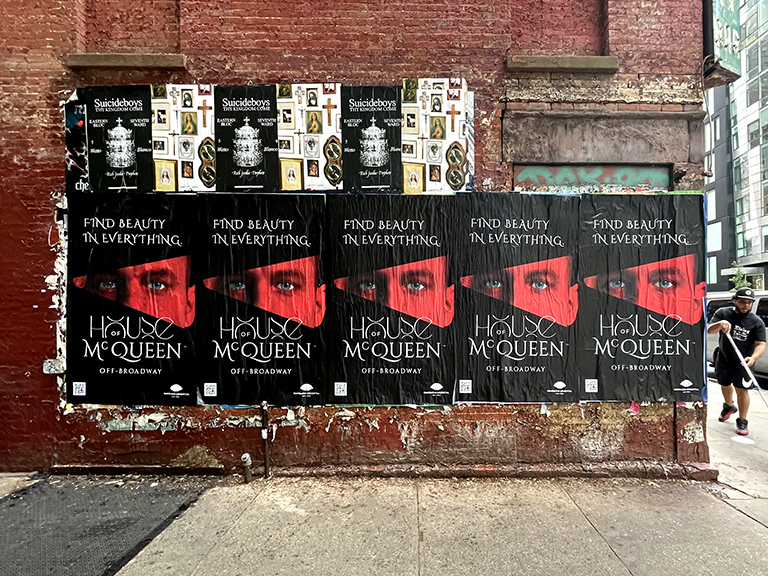
New York City is the most demanding wheatpaste media market in the country. It’s also the most rewarding. When a campaign lands right here — across the right neighborhoods, in the right format, at the right moment — it spreads faster than almost any other city in the world. The density, the foot traffic, the content creators, the fashion accounts watching every block: they all work in your favor when your execution is tight.
We’ve run city takeover wheatpaste campaigns in New York for over a decade. American Guerrilla Marketing field operators have walked these streets at 4am, mapped the walls, navigated the compliance requirements, and watched campaigns catch fire on social before the morning commute. This guide is built from that firsthand experience. It is not a general overview. It is a zone-by-zone operational breakdown of what a real NYC city takeover requires.
NYC is a walking city, which means your poster placement works completely differently here than it does in Los Angeles or Chicago. People move through neighborhoods on foot, by subway, and on bike. They see walls at eye level, repeatedly, across multiple blocks. A well-placed 24×36 on Bedford Avenue gets seen by the same person three times in a week — once going to work, once at the weekend market, once on a Saturday afternoon walk. That repetition is part of what makes NYC wheatpaste campaigns work so well when coverage is dense enough.
But NYC also has the country’s most active code enforcement environment. The Department of Sanitation (DSNY) and the Department of Buildings (DOB) both have jurisdiction over signage on private property. The Parks Department controls anything near a park perimeter. The MTA takes transit-adjacent surfaces extremely seriously. None of this is reason to avoid NYC — it’s reason to work with an operator who knows the permissioned inventory and understands the compliance layer cold.
American Guerrilla Marketing maintains a nationwide portfolio of licensed wall inventory, and our NYC holdings are the deepest in any market we serve. Every surface in our New York inventory is documented, GPS-tagged, and cleared for placement with written permission from the property owner. That’s not a talking point. That’s the guarantee we offer every client who runs a campaign here.
Brooklyn is the gravitational center of any New York City wheatpaste campaign. It has the highest concentration of content creators, street photographers, fashion accounts, and culturally active residents of any borough. It also has the highest density of permissioned wall inventory in our NYC portfolio. When we plan a city takeover, Brooklyn is almost always where Night 1 starts.
Bedford Avenue is the spine of Williamsburg’s commercial strip. From North 12th Street down to Metropolitan Avenue, this corridor has constant foot traffic seven days a week. The blocks around North 7th Street — where Bedford crosses the L train at the Lorimer/Metropolitan stop — are among the highest-foot-traffic intersections in Brooklyn. We’ve placed on walls here that have appeared in over a dozen editorial shoots without us prompting a single photographer.
The walls along this corridor are a mix of building facades, ground-floor retail spaces, and construction hoarding. Format recommendation: 24×36 works everywhere; 27×40 fits select walls with clearance above door frames. The inventory is competitive, so early booking matters here more than anywhere else in the borough.
Bushwick has evolved from a purely residential neighborhood to one of the most watched art-and-culture destinations in Brooklyn. The Myrtle Avenue corridor, running from Broadway to Central Avenue, has a mix of galleries, music venues, and late-night food spots that keep foot traffic active until 2am and restart around 8am. This is one of the few NYC neighborhoods where installation windows run early — we recommend 3am-5am here.
The street photography culture in Bushwick is strong. Campaigns placed along the Myrtle corridor or near the Bogart Street area reliably pick up organic social documentation within the first morning. Heavy urban mural culture means your wheatpaste campaign will be seen by people who are paying attention to what’s on the walls — which is exactly the audience most brand campaigns are targeting.
Crown Heights is an underused zone in most city takeover plans, and that’s a mistake. Franklin Avenue and Nostrand Avenue are two of the busiest pedestrian corridors in central Brooklyn, and the neighborhood skews toward a slightly older, more established creative demographic than Williamsburg or Bushwick. Placement density here can be lower than the core Williamsburg strip — 15 to 20 well-chosen placements per corridor is more effective than trying to saturate every block.
Greenpoint sits at the northern tip of Brooklyn, directly above Williamsburg. Manhattan Avenue is the main commercial artery, and the blocks around the Greenpoint Avenue G train stop see consistent foot traffic from a demographic that overlaps heavily with the Williamsburg audience. Greenpoint is a secondary zone for most campaigns — it adds breadth to a Brooklyn takeover without requiring a separate crew run if you sequence routes efficiently.
Lower Manhattan is where NYC wheatpaste campaigns get taken seriously by the press, the industry, and the platforms. A poster in SoHo or the Lower East Side carries a different weight than the same poster two miles away. Location signals intent — and in the fashion, entertainment, and CPG worlds, being visible in Lower Manhattan tells the industry that your campaign is real.
The LES has been a wheatpaste destination for over 30 years. The walls between Delancey and Houston — along Orchard Street, Ludlow Street, Rivington Street, and Essex Street — are some of the most documented surfaces in New York. Street photographers from all over the world come through this zone. The challenge is that because it’s been a destination for so long, the competition for wall space is high and the audience has a trained eye for campaigns that feel off-brand for the neighborhood.
Format choice matters here more than almost anywhere else. Oversized formats in the LES can feel forced. A clean 24×36 placed at eye level on Ludlow Street, well-printed with strong graphic work, will outperform a cluttered 48×72 every time. The LES audience is sophisticated. Treat the walls accordingly.
SoHo is the most photographed retail corridor in New York. The stretch of Broadway between Prince and Spring is where fashion brands, retailers, and entertainment companies have historically announced themselves through street presence. Wheatpaste placements on the construction hoarding around SoHo development sites, on the side walls of cast-iron buildings with ground-floor retail, and on approved surfaces along the Prince and Spring corridors get photographed by everyone — tourists, fashion editors, influencers passing through for showroom appointments.
Coverage in SoHo is about precision, not volume. Eight to twelve placements in the right locations will do more for a campaign than forty placements in a lower-traffic zone.
The East Village connects the LES to the NYU/Union Square corridor and brings a slightly younger, more student-influenced demographic into your reach. St. Marks Place and the surrounding blocks are still among the most-walked streets in Manhattan for anyone between 18 and 30. Second Avenue and Avenue A have solid wall inventory with strong pedestrian flow. The East Village is often the third stop in a Lower Manhattan installation run after the LES and SoHo, and it rounds out lower-Manhattan coverage effectively.
Upper Manhattan is where city takeover campaigns often fall short. Agencies plan strong Brooklyn and Lower Manhattan runs, then either skip Uptown entirely or send one crew to put up a handful of posters and call it done. That misses the point. Upper Manhattan is a distinct media market within New York City, with its own influencer networks, its own photography community, and an audience that is actively underserved by most national campaign work.
125th Street is the most commercially dense corridor in Harlem and one of the most heavily trafficked streets in all of Manhattan north of 59th Street. The intersection of 125th and Adam Clayton Powell Jr. Boulevard (Seventh Avenue) is a cultural anchor — this is where you place your highest-impact pieces. Construction hoarding along 125th Street between Malcolm X Boulevard (Lenox Ave) and Frederick Douglass Boulevard (Eighth Ave) provides significant legal, permissioned surface area for large-format placements.
Harlem street media gets documented differently than Brooklyn — the amplification here runs through community accounts, local news outlets, and neighborhood-specific Instagram pages that have deep geographic loyalty. Organic pick-up in Harlem often reaches audiences that a Brooklyn-focused campaign won’t touch at all.
Washington Heights — roughly from 155th Street to 200th Street along Broadway and St. Nicholas Avenue — is one of the most densely populated residential neighborhoods in New York. Broadway is the main commercial artery, and the blocks around 181st Street are the commercial heart of the neighborhood. This is a high-foot-traffic corridor that very few national wheatpaste campaigns ever reach. For brands targeting a Latino audience, this zone is not optional — it’s where that audience actually lives.
Queens is the most diverse borough in New York and the least consistently covered in city takeover plans. The challenge is that Queens doesn’t have one dominant cultural corridor the way Brooklyn has Williamsburg or Manhattan has SoHo. It has several, and they serve different audiences.
Steinway Street is the main commercial strip of Astoria and one of the busiest pedestrian shopping corridors in Queens. The intersection with 31st Avenue is a natural anchor point. Astoria skews toward a slightly older demographic than Brooklyn’s creative neighborhoods, with strong Greek, Middle Eastern, and South American community presence. It’s a solid inclusion in a full five-borough takeover but typically serves as a secondary zone rather than a launch anchor.
Long Island City has changed significantly over the past decade. Jackson Avenue, running from the Queensboro Bridge approach down through the LIC arts corridor, now sits adjacent to one of the densest new residential developments in New York. The creative community that used to occupy LIC’s warehouse buildings has partly moved on, but the audience coming through the MoMA PS1 block and the Hunters Point waterfront is highly relevant for entertainment, fashion, and lifestyle brands. LIC is worth 15-20 placements in a full-city run.
The Bronx is the zone most city takeover campaigns skip entirely. That is a mistake for any brand whose audience includes anyone north of 138th Street in Manhattan or across the bridge. The Bronx has two corridors that matter for wheatpaste campaigns.
Fordham Road — especially the stretch around the Grand Concourse intersection — is one of the busiest pedestrian commercial corridors in New York City, outside of Midtown Manhattan. The foot traffic numbers here rival anything in Brooklyn. This is not a boutique-brand audience; this is a broad, high-volume urban consumer corridor that works exceptionally well for mass-market entertainment, CPG, and event campaigns.
The Grand Concourse arts corridor, running along the Grand Concourse boulevard from 161st Street northward, carries a different character — cultural institutions, historic Art Deco architecture, and a Bronx-specific creative community that is slowly gaining national attention. For campaigns positioning themselves as culturally invested rather than just commercially present, placement along the Grand Concourse tells a real story.
This is the question every client asks, and the honest answer is: it depends on how you define “full coverage” and which zones you’re targeting. Here’s a working framework based on our on-the-ground experience running campaigns in each of these zones.
| Zone | Sub-zones | Minimum Placements | Full Saturation |
|---|---|---|---|
| Brooklyn | Williamsburg, Bushwick, Crown Heights, Greenpoint | 80 | 150-180 |
| Lower Manhattan | LES, SoHo, East Village | 50 | 80-100 |
| Upper Manhattan | Harlem, Washington Heights | 40 | 70-90 |
| Queens | Astoria, Long Island City | 30 | 50-60 |
| The Bronx | Fordham Road, Grand Concourse | 25 | 40-50 |
| Full City Total | All five zones | 225 | 390-480 |
Most campaigns we run in NYC target two or three zones rather than all five simultaneously. A focused Brooklyn-plus-Lower Manhattan run at 200-250 placements achieves stronger visual impact than a thin five-borough spread at 200 placements. The right choice depends on where your audience actually is and where organic social amplification is most likely to happen.
Format is not just a production decision — it’s a placement strategy. The wrong format for a given wall or neighborhood can cost you impact even when placement count is high.
24×36 standard: The workhorse format for NYC. Fits the widest range of surfaces, from doorway-adjacent walls to construction hoarding panels. Photographs cleanly. Stacks well — three 24×36 posters in a vertical column create a strong visual block without needing a premium-size surface. This is the right default for any neighborhood where you haven’t previously scouted the exact walls.
27×40: The movie-poster format. Taller than standard, which means it reads as a “bigger” presence even without dramatically more surface area. This format works best in neighborhoods with walls that have clearance above doorframes or signage — SoHo, Williamsburg, select Harlem blocks. It’s the right choice for campaigns where the vertical composition of the artwork benefits from extra height.
48×72: Reserve this for select building faces where the visual context demands scale. Williamsburg has a handful of walls that have been used for large-format wheatpaste for years — audiences there read a 48×72 as a statement. SoHo construction hoarding can accommodate panels at this size. The Bronx Grand Concourse has a few high-visibility locations where scale makes sense for event-level campaigns. Outside these specific contexts, 48×72 can feel out of proportion to the wall and to the neighborhood.
Every city has an installation window, and NYC’s is earlier than most people assume. Our American Guerrilla Marketing field operators start at 3am in most neighborhoods and aim to be finished before 6am. Here’s why that window matters:
By 6:30am, the early commuter wave starts moving through subway entrances, corner bodegas, and main corridors. These are the people who notice the new posters first and often document them — either for their own feeds or just by stopping to look and sending a photo to a friend. If your crew is still pasting at 6:45am, you’re working in full view of the morning rush, which draws attention of a different kind.
The 3am-6am window also gives paste adhesive the longest possible undisturbed drying time before the day’s pedestrian traffic and weather impact it. Paste needs to bond to the surface fully. A poster that’s been up for three hours before anyone touches it or brushes past it will outlast one that gets bumped at 6am while still wet.
There are neighborhood-specific variations. In Bushwick, where nightlife runs late, we adjust to a 4am start to avoid late-night foot traffic. In the Financial District (if running adjacent walls in Lower Manhattan), 3am is actually slightly early — the area is so quiet that a 4am install is fine. In Washington Heights and Harlem, crews that start at 3am have reported few issues; these neighborhoods have early morning activity (restaurant supply deliveries, early-shift workers) but the commercial corridors are quiet enough to work efficiently.
NYC’s construction boom has created one of the best on-the-ground inventory environments for legal, permissioned wheatpaste placement in the country. Construction hoarding — the plywood or metal panel barriers that surround development sites — can be secured for poster campaigns through the property owner or general contractor with the appropriate permits. The DOB requires that any signage on construction hoarding be covered by a permit, and American Guerrilla Marketing handles this process for every campaign we run in the city. We are certified and licensed to operate in New York City across all five boroughs.
Street furniture placement in NYC — bus shelters, kiosks, newsstands — is controlled by JCDecaux and Outfront Media under contracts with the city. This inventory is not part of what we manage. Our NYC portfolio focuses on private walls and permitted construction hoarding, which gives campaigns a street-level, organic character that paid street furniture doesn’t replicate.
The two agencies most relevant to NYC wheatpaste compliance are the Department of Buildings (DOB) and the Department of Sanitation (DSNY). The DOB oversees signage permits on buildings and construction sites. The DSNY handles enforcement of anti-graffiti and unauthorized posting statutes under Administrative Code § 10-119, which prohibits posting on public property without permission.
The key compliance point is simple: everything we place is on private property with written permission from the property owner. That’s the line. Our placements are not on city property, transit infrastructure, utility poles, tree guards, or any surface owned or managed by a city agency. We don’t work in gray zones.
For brands running campaigns in NYC, this matters for two reasons. First, DSNY and the DOB do conduct enforcement sweeps, and campaigns placed without permission can result in fines attached to the brand, not just the contractor. Second, permissioned placements stay up longer — property owners who have agreed to hosting a campaign are not going to remove it the next morning. Unpermissioned placements in NYC can be gone within 24 hours.
New York City has a larger population of street photographers, fashion content creators, and city-documentation accounts than any other US city. This is not a minor variable. It is one of the primary reasons brands pay a premium to run NYC wheatpaste campaigns, and understanding how organic amplification works changes how you plan the campaign.
The first wave of social documentation happens in the early morning hours after installation. Street photographers who are out early in Williamsburg, the LES, or SoHo routinely document new posters on their regular routes. By 9am on installation day, a well-executed campaign will typically appear in 5-15 organic Instagram posts from people who weren’t paid to document it. By noon, if the campaign is strong visually, it may have been shared or reposted by larger accounts.
Fashion account reposts are the second wave. Accounts that aggregate NYC street style and street art will pick up images from the morning photographers. These accounts often have 50,000-500,000 followers, and a single repost from one of them can reach more people than the entire paid media budget of many smaller brands.
The role of the installation crew in this process is to document the campaign from the moment posters go up. GPS-tagged photos, taken by the crew at each placement, serve two purposes: client reporting (proof-of-placement documentation) and seed content for the brand’s own social channels. When a brand posts their own GPS-tagged documentation at 7am, they signal to their audience that something real is happening in the streets — and they give media accounts something to share.
American Guerrilla Marketing coordinates city takeover wheatpaste campaigns across the US from a single New York contact.
The 48 hours after installation are the highest-return period of any NYC wheatpaste campaign. This is when organic social documentation peaks, when media pick-up is most likely, and when the brand’s own amplification efforts can multiply the real-world placement into a much larger digital footprint.
Here’s what we’ve seen happen consistently across case studies in our decade-plus of running NYC campaigns: the brands that maximize the 48-hour window treat installation day as a launch event, not just a logistics operation. They have social posts ready to go at 7am. Their PR contacts know the campaign is live. Their paid social may be geo-targeted to Brooklyn and Lower Manhattan to reach people who are physically near the placements. The poster campaign becomes a proof point for everything else they’re doing — and the combination is what creates moments that get written about.
Brands that treat installation day as the end of the process — send the crew, get the photos, post them a week later — leave most of the value on the table. The poster is the spark. What you do in the first 48 hours determines how far the fire spreads.
In the spring of one recent campaign cycle, a streaming platform with a major series launching approached American Guerrilla Marketing about a full South Brooklyn and Lower Manhattan wheatpaste push to be executed the week before the series dropped. The brief: create enough street presence that people in the target neighborhoods felt like they couldn’t avoid the campaign. The audience profile was exactly what you’d expect — 18-35, urban, culturally active, the kind of person who goes to Williamsburg bars on Friday night and brunches in the LES on Sunday.
We ran a two-night installation across six neighborhoods: Williamsburg, Bushwick, Crown Heights, the Lower East Side, SoHo, and the East Village. Total placements: 280, across 24×36 and 27×40 formats. Night 1 covered Brooklyn. Night 2 covered Lower Manhattan. Both nights ran from 3am to 6am with four crews of two operators each.
By noon on the first day, the campaign had appeared in organic social posts from street photographers in Williamsburg and Bushwick. By the second day, a fashion account with 180,000 followers had reposted a shot of three stacked 24×36 panels on Bedford Avenue. The streaming platform’s social team posted their own GPS-tagged documentation at 8am both mornings. By the time the series launched, the campaign had generated several hundred pieces of organic social content that the client had not paid for, from accounts they had not contracted.
The client’s own internal metric was “neighborhood saturation feel” — the sense that their core audience, going about their normal lives in these neighborhoods, couldn’t avoid knowing about the launch. Firsthand reports from their community management team, who lived in Williamsburg and the LES, confirmed that the campaign hit that threshold. That’s what a well-executed NYC city takeover actually delivers: not just poster placements, but the feeling of presence.
If you’re approaching an NYC city takeover for the first time, the most common mistakes come from underestimating the planning timeline, overestimating how much ground a single crew can cover in one night, and underinvesting in pre-production photo documentation and social strategy.
A realistic planning timeline for a two-zone NYC campaign (Brooklyn + Lower Manhattan) is three to four weeks from brief to installation. Wall inventory needs to be secured and confirmed before printing begins. Print production for 200+ posters takes four to seven business days depending on format. Crew logistics, route mapping, and permitting for any construction hoarding need to be handled before installation week.
American Guerrilla Marketing handles the entire stack — wall inventory, permitting, print production, certified and licensed crews, GPS-tagged photo documentation, and client reporting. Brands come to us with a brief and a launch date. We bring the infrastructure.
Our boots on the ground in New York have run this process hundreds of times across every campaign type: music releases, retail openings, entertainment launches, CPG brand activations, political campaigns, cause marketing. The process is the same. The wall inventory, the crews, the documentation protocol, the compliance framework — that’s all built and ready. What changes is the creative and the strategic zone selection based on your audience.
We don’t treat NYC wheatpaste campaigns as a commodity print-and-paste operation. Every campaign gets a zone plan built from current, on-the-ground inventory data. That’s the difference between a campaign that lands and a campaign that just happened.
A genuine full-city NYC takeover — covering all five primary zones across Brooklyn, Lower Manhattan, Upper Manhattan, Queens, and the Bronx — typically requires between 400 and 600 poster placements depending on format size and neighborhood density. A focused two-zone campaign can achieve strong saturation with 150-200 placements. The right number depends on your audience’s geographic concentration and how much visual repetition you need to generate the “everywhere” feeling that drives organic conversation.
The core installation window in NYC is 3am to 6am. Most neighborhoods are quiet enough by 3am, and you want placements up before the early commuter wave at 6:30am. In some residential areas of Bushwick or Crown Heights, crews can start as late as 4am without issue. Lower Manhattan near the Financial District runs later — 4am or later. Our field operators know the rhythm of every zone in the city and adjust start times based on current street activity patterns.
Wheatpasting on private property with written permission from the property owner is legal. American Guerrilla Marketing works exclusively with permissioned, licensed wall inventory. We do not paste on public property, city-owned surfaces, or transit authority infrastructure. All placements in our NYC portfolio are on privately owned walls, construction hoarding, and approved surfaces. Every campaign we run is covered by proper documentation and we are certified and licensed to operate in all five boroughs.
24×36 inch is the standard workhorse format for NYC — it fits almost every surface, photographs well, and can be stacked or tiled for larger visual impact. 27×40 works for premium walls with more vertical clearance. For select building faces in areas like Williamsburg or SoHo, 48×72 panels create billboard-scale impact. Your American Guerrilla Marketing rep will recommend formats based on your specific wall inventory and campaign creative.
New York City has a large population of street photographers, fashion account operators, and content creators who actively document new street art and poster campaigns. In neighborhoods like Williamsburg, the Lower East Side, and SoHo, a striking campaign placed at 4am can appear in Instagram posts by 9am. The 48-hour window after installation is when most organic social amplification happens — which is why GPS-tagged photo documentation from the installation crew is critical for seeding the brand’s own channels and giving media accounts something to repost.
American Guerrilla Marketing coordinates city takeover wheatpaste campaigns across the US from a single New York contact.
Millie Phillips
Campaign Architect — American Guerrilla Marketing
Email: [email protected]
Office: (646) 776-2770
Ready to Run Your Campaign?
Call us or email us. We’ll tell you exactly what we can do in your market and what it costs.
American Guerrilla Marketing — Los Angeles
Street-level campaigns in Los Angeles and nationwide. Wheatpasting, LED trucks, street teams, and more.
(646) 776-2770
July 13, 2026
July 13, 2026
July 13, 2026
July 13, 2026
July 13, 2026
