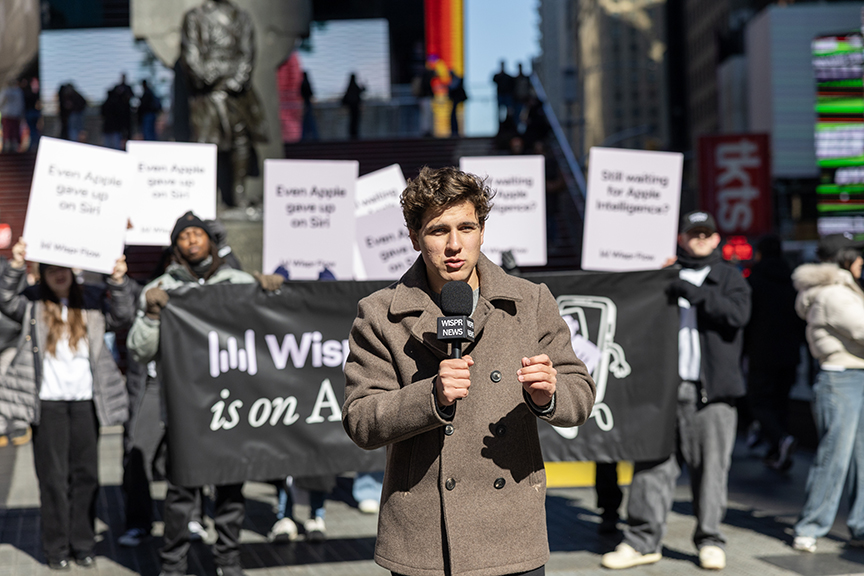
New York is the most demanding experiential marketing environment in the country. The city has more brands competing for street-level attention than anywhere else in the U.S., the most sophisticated consumer audience in any domestic market, and a media saturation level that makes average execution invisible. Brands that succeed with experiential work in New York do so because they plan with precision, execute with discipline, and design moments that are specific enough to register with a city that has seen everything.
Generic activations do not work here. A pop-up with no clear audience fit, a street team that cannot articulate why the brand is relevant, or a visual placement that does not account for New York’s sightline dynamics and pedestrian flow will produce weak results regardless of the budget behind it. The city rewards brands that understand how it actually works, neighborhood by neighborhood, block by block, time of day by time of day.
Our team at American Guerrilla Marketing is based in Industry City, Brooklyn. We have spent years building campaigns across all five boroughs, learning which corridors deliver, which neighborhoods respond to which types of creative, and what operational discipline is required to execute street-level work in New York without encountering the compliance issues, crew problems, and placement failures that derail campaigns run by teams without local experience. This guide explains how we approach experiential marketing in NYC and what actually works.
Why New York Experiential Work Is Different
The density argument is obvious but incomplete. Yes, New York concentrates more potential impressions per block than almost any other U.S. city. But density without targeting is just expensive noise. The real advantage of NYC experiential work is the ability to reach specific audiences in their actual environment, whether that is the morning commute at Atlantic-Pacific, the lunch hour in Midtown South, or the Saturday afternoon shopping pattern in SoHo.
What separates strong NYC experiential campaigns from weak ones is not scale, it is specificity. A campaign that owns a single corridor, creates a distinct visual moment, and reaches the right audience at the right time will outperform a sprawling campaign that is technically present in ten neighborhoods but genuinely owning none of them.
The Audience Has High Standards
New York consumers are accustomed to being marketed to. They have developed strong filters that allow them to tune out standard advertising formats without conscious effort. Breaking through those filters requires work that is visually distinctive, contextually relevant, or participatory in a way that creates genuine engagement rather than passive exposure.
That does not mean every activation needs to be a spectacle. Sometimes the right move is a perfectly executed poster campaign in a corridor where the audience pauses and waits. Sometimes it is a street team with a compelling reason to stop and talk. The question is always whether the format and the execution meet the standard of a city that expects quality.
The Media Environment Is Competitive
Major brands with major budgets are running street-level campaigns in New York continuously. Premium surfaces are contested. High-footfall locations are saturated during peak seasons. Standing out requires either superior creative, superior placement logic, or superior timing. Usually all three.
We build campaigns around that competitive reality by identifying the specific moments and locations where our client’s audience can be reached with less competition. That might mean an early-morning street team deployment before competing brands are active, a neighborhood that is underserved by standard OOH buys despite strong audience concentration, or a creative format that is distinctive enough to read clearly in a cluttered visual environment.
How We Approach Neighborhood-Level Planning in NYC
New York is not one market. It is dozens of distinct neighborhoods with different demographics, different pedestrian patterns, different tolerance for different types of street-level marketing, and different competitive environments. A campaign that works in Williamsburg will not necessarily translate to the Upper East Side, even if both neighborhoods technically have the same income demographics.
Matching Neighborhood Character to Brand Identity
We start every NYC campaign by mapping the brand’s identity against the neighborhood character of potential deployment zones. A fashion brand with an independent-label identity belongs in Williamsburg, Greenpoint, or the Lower East Side rather than in Midtown, not because Midtown lacks foot traffic but because the audience-brand fit is weaker there. A financial services brand targeting working professionals belongs in the corridors around Penn Station, Grand Central, and the Financial District because that is where its audience spends concentrated time.
Neighborhood fit is not optional in New York. The city’s residents are territorial about their neighborhoods in ways that make misaligned campaigns feel intrusive rather than welcoming. When the campaign belongs in the neighborhood, it gets received differently than when it feels imported from somewhere else.
Time-of-Day Optimization
Pedestrian patterns in New York change dramatically by time of day, and those changes affect campaign performance significantly. The morning commute concentrates professionals in transit corridors between 7:30 and 9:30 AM. The lunch hour distributes office workers across a three-to-five block radius around their building. The after-work hour concentrates the same audience back in transit corridors between 5:00 and 7:00 PM. Evening and weekend patterns differ entirely.
Our street team deployments are scheduled around the time-of-day patterns that match the campaign’s audience and objectives. A morning commute deployment for a productivity app is different from a Saturday afternoon deployment for a consumer beverage brand, even if both happen in the same general neighborhood.
Formats We Deploy for NYC Experiential Campaigns
Our NYC toolkit draws from the full range of street-level formats, and we select based on the specific campaign objectives rather than defaulting to a standard package. Here is how the primary formats work in the New York context.
Street Teams and Brand Ambassador Activations
Our brand ambassador program deploys trained crews who represent the brand with the knowledge, energy, and interpersonal skills required to earn genuine engagement in a city where everyone is in a hurry. We staff based on brand fit, train on product and messaging before any deployment day, and manage crews centrally to maintain quality across multi-day or multi-location activations.
Street teams work best in NYC when they have a clear reason for the interaction: a sample to give, an event to promote, a compelling offer to present, or a visual prop that creates a natural conversation starter. Crews with no clear hook will generate polite brushoffs from New Yorkers who are experienced at deflecting unwanted interruptions.
Poster Campaigns and Wheatpasting
High-quality poster and wheatpaste placements remain one of the most effective formats for building brand presence in New York’s visual environment. The right placement in the right corridor, with a visual that is genuinely strong, creates an impression that street-savvy New Yorkers actually notice and remember.
Surface selection matters more in New York than in most markets because the visual environment is crowded with both commercial advertising and organic street art. A poster that does not read clearly at distance, or that is placed on a surface with weak sightlines, will be invisible. We scout surfaces in advance and select based on sightline quality, pedestrian traffic patterns, and neighborhood fit before recommending a placement list.
Sidewalk Stencils
Sidewalk stencil campaigns create branded moments at eye level on the actual path the audience walks. New York’s dense pedestrian footfall means a well-placed stencil campaign in the right corridor can accumulate thousands of impressions per day from a single deployment. The format is particularly effective for directional messaging, event promotion, and creating a sense of brand ubiquity across a defined geographic zone.
LED Billboard Trucks
For campaigns that need to move with the audience rather than waiting for the audience to come to them, LED billboard trucks offer a level of flexibility that static formats cannot match. We route trucks through target neighborhoods based on audience concentration and time-of-day patterns, which means the campaign can follow the audience from the morning commute zone to the lunch corridor to the after-work destination.
In New York’s traffic environment, LED trucks also function as attention anchors at intersections, where vehicles and pedestrians are stationary for meaningful dwell windows. A truck positioned at a key intersection during peak hours can accumulate a significant impression count across a relatively small footprint.
Projection Advertising
Projection campaigns create the kind of large-format visual impact in New York that earns social sharing and media coverage. A brand image projected at scale on a notable building facade creates a moment that is hard to ignore and easy to photograph. We handle the technical logistics of projection campaigns, including equipment positioning, content formatting, and operating window compliance.
Compliance and Operational Execution in New York
New York’s regulatory environment for street-level marketing is complex. Different formats have different permit requirements. Different neighborhoods have different enforcement environments. Different event periods trigger different city management responses. Brands that try to run New York campaigns without understanding those constraints encounter compliance problems that can shut down the campaign, generate negative coverage, or create liability exposure.
Our team navigates those requirements as part of standard planning. We know which formats require advance city permits, which surfaces require property owner authorization, and what the operational boundaries are for each type of deployment. That knowledge protects the client’s campaign and their brand.
Production Standards That Hold Up in the Field
New York’s physical environment is hard on materials. Weather, traffic, foot traffic, and the city’s fast-moving visual landscape all put pressure on printed materials, installed surfaces, and crew operations. We build campaigns with that reality in mind: production specs that hold up to field conditions, installation standards that maintain quality through the campaign duration, and refresh protocols that keep the work looking intentional through the end of the flight.
Measuring NYC Experiential Campaigns
Every campaign we run in New York includes GPS-tagged photo documentation, crew activity logs, route records, and a formatted post-campaign recap. Those materials serve as proof of execution for internal stakeholders and as the data foundation for optimizing subsequent campaigns.
Beyond documentation, we work with clients to build measurement frameworks that connect street-level activity to downstream performance. When campaigns include QR codes, branded URLs, or offer redemption mechanisms, those digital connections create a measurable signal of street-to-digital conversion. Social listening around campaign-specific hashtags or geographic areas adds another layer of qualitative performance data.
What the Recap Should Tell Your Team
A strong campaign recap answers the questions a CMO will ask: what ran, where, when, how many crew hours, what documentation exists, and what downstream signals are attributable to the campaign. We build recaps to that standard, which means our clients can use the documentation to justify the investment and to brief the next campaign more effectively.
Choosing the Right Experiential Agency for NYC Work
There are a number of agencies that will sell you an NYC experiential campaign. The differentiating questions are about operational depth: Does the agency have established crew relationships in the specific neighborhoods where your audience lives? Do they have a compliance track record in New York’s regulatory environment? Can they produce documentation that holds up to internal scrutiny?
Our team brings all of that. We are based in Brooklyn, we deploy in New York constantly, and we have built our operational systems around the specific demands of a market that punishes half-measures. When you work with AGM, you get a campaign that has been planned for New York specifically, not adapted from a playbook designed for a simpler market.
We also deploy across 50-plus U.S. markets, which means brands that are running multi-city campaigns can work with a single agency that maintains consistent documentation standards and creative quality across every market. Call us at (646) 776-2770 to talk through your NYC campaign objectives.
Frequently Asked Questions
What makes an experiential marketing agency valuable in NYC?
New York’s density, neighborhood diversity, and media saturation make street-level experiential work both more valuable and harder to execute well. An agency with local route knowledge, established vendor relationships, and strong crew infrastructure can reach audiences that digital-only campaigns cannot touch. Without that local depth, campaigns either miss the audience, encounter compliance problems, or underperform on execution quality.
What neighborhoods in NYC work best for experiential activations?
The right neighborhood depends entirely on the target audience. SoHo, Williamsburg, and the Meatpacking District work for fashion and lifestyle brands. Midtown and the Financial District work for B2B campaigns. Astoria, the Bronx, and Harlem offer access to communities that are underserved by standard OOH media buys. We scout based on audience profile, not geography preferences.
Do experiential NYC activations need to be large-scale to succeed?
No. Precision outperforms scale in most New York campaigns. A well-placed, high-quality activation in the right corridor for the right audience outperforms a generic large-scale event that tries to be everything to everyone. New York crowds are experienced enough to ignore average activations but genuinely responsive to brand moments that feel considered and specific.
What formats does AGM use for experiential campaigns in NYC?
Our standard NYC toolkit includes street teams and brand ambassadors, poster campaigns, sidewalk stencils, LED billboard trucks, and projection advertising. We select formats based on campaign objectives, neighborhood fit, and production timeline rather than defaulting to a standard package.
How does AGM document NYC experiential campaigns?
Every campaign includes GPS-tagged photo documentation, route logs, installation timestamps, and a formatted campaign recap. We treat proof of execution as a deliverable, not a courtesy, because our clients need to show the work to internal stakeholders who approved the budget.
How far in advance should a brand plan an NYC experiential activation?
For standard campaigns, 4-6 weeks of lead time allows for proper permitting, production, and crew scheduling. Event-adjacent activations around major NYC events should start planning 8-12 weeks out. Rush timelines are possible but typically compromise on format quality or placement selection. Contact our team early to lock in the best options.