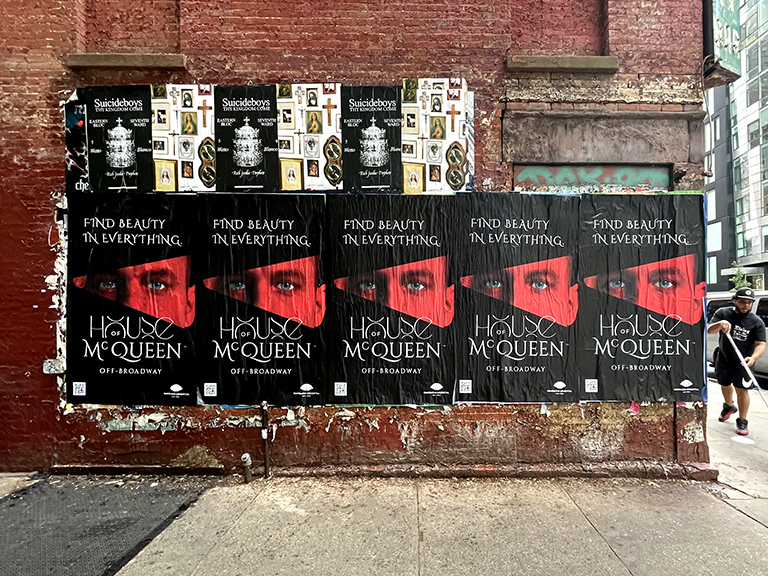
Walk down Shaftesbury Avenue on any given evening and the theater district announces itself long before you see the marquees. Posters are everywhere — on construction hoardings, on approved walls, layered onto surfaces in Soho’s side streets in ways that tube advertising simply can’t replicate. West End marketing is a layered discipline, and wheatpaste campaigns are one of the layers that productions use to build the ambient awareness that eventually converts into ticket sales.
Why Theater Marketing Still Uses Street Campaigns
The London theater audience is not a passive one. People who go to the West End regularly — and there’s a large base of Londoners who attend multiple times per year — are aware of what’s playing. They follow productions on social media, read reviews in The Guardian and Time Out, listen to word of mouth from their networks. They’re not waiting to be served an algorithmic ad to find out a show exists.
The Tube Advertising Complement
Most West End shows buy tube card advertising through Transport for London’s commercial advertising program. Those placements are expensive, well-trafficked, and essential for reaching commuters. But tube ads are controlled environments — standard sizes, standard placements, same inventory available to every production. Street wheatpasting is the irregular texture that makes a campaign feel like it’s taken over the city rather than purchased a slot in it.
The combination of tube advertising and targeted wheatpaste campaigns in specific neighborhoods creates a surround effect. Audiences see the show in the underground, then walk out of the Tottenham Court Road exit and see it again on a hoarding in Soho. That frequency, across different physical contexts, is what builds genuine pre-opening awareness.
Where to Post: The Theater-Going Neighborhoods
Not all of London is theater country. The West End audience has geography. Understanding it is the difference between a campaign that finds its demographic and one that generates impressions from people who will never buy a ticket.
Soho and Covent Garden
These are the core zones. Soho’s streets — Wardour Street, Dean Street, Old Compton Street, Berwick Street — are walked daily by exactly the kind of media-literate, culturally engaged Londoner who buys West End tickets. Covent Garden’s pedestrian activity is among the highest in central London. Both neighborhoods have approved postering surfaces that productions have used for years. The challenge is that everyone wants to be here, so placements need to be in good positions to stand out rather than disappear into a layered surface.
South Bank and Waterloo
The South Bank — from Waterloo Bridge past the National Theatre, the BFI, and the Tate Modern toward Bermondsey — draws an audience that is already in a cultural frame of mind. These are people visiting galleries, eating at restaurants along the riverside, and often considering what to do with an evening in London. A production targeting this foot traffic is pitching to exactly the right crowd.
Islington and Upper Street
Islington has long been London’s theater neighborhood outside the West End — the Almeida, the King’s Head, the Sadler’s Wells. Upper Street is heavily trafficked by the kind of professional Londoner aged 30-55 who makes up the core of the West End audience. For shows that have Islington-area roots or are targeting audiences from north and east of the center, postering up Upper Street and through Angel is worth prioritizing.
Shoreditch for Younger Demographics
Productions targeting younger audiences — 18-35, first-time West End theatergoers, shows with a contemporary or popular music angle — should extend their campaign into Shoreditch. The Boxpark area, Rivington Street, and Curtain Road have surfaces that reach exactly this demographic. A campaign for a jukebox musical, a comedy transfer, or a production with a recognizable pop culture angle will find traction here that it won’t in more traditional theater marketing zones.
The West End generates approximately £800 million annually in direct ticket revenue. Shows that open without strong advance sales in weeks one through three of the run face pressure to close early — which makes pre-opening street presence not just a marketing choice but a commercial one.
Timing a Theater Wheatpaste Campaign
Theater marketing timing is not the same as retail timing. The goal is not to create an immediate purchase impulse but to build awareness early enough that the show is already on the audience’s radar when reviews land and word of mouth begins.
Six to Eight Weeks Out: The Awareness Phase
For shows without established name recognition — a new play, a writer-director pairing that isn’t widely famous, a transfer from a regional venue — you need awareness infrastructure before reviews arrive. Wheatpasting in this phase is about establishing that the show exists and looks worth paying attention to. The visual design at this stage should be distinctive enough to register on a first pass.
Two to Four Weeks Out: The Pressure Phase
This is when most productions concentrate their street campaign spend. Press night is approaching, reviews will follow, and the goal is to ensure that when those reviews break, audiences already have a mental file open for this production. The wheatpasting in this phase should concentrate in higher-density placements in the most relevant neighborhoods — not spread thin across London but heavy where it counts.
Opening Week: Maintenance and Opportunistic Placement
Some productions choose to refresh or extend placements during opening week. If reviews are strong, this makes sense — doubling down on visibility at the moment when ticket intent is highest. If the show opens to mixed notices, a quick assessment of which placements are still intact and whether refreshing makes financial sense is the right call.
Design Principles for Theater Wheatpaste Artwork
Theater poster design has conventions that have developed for good reason. The show title, the lead performers, the production credits, the venue, the booking information — these elements have a hierarchy that audiences are used to reading from a distance. Breaking that convention needs a specific reason, not just a desire to be different.
For street-scale wheatpasting, the key adaptations from print-optimized theater artwork are:
- Title and lead image need to read clearly at five meters without squinting
- Booking information should include the venue name and a short URL or QR code — not a full date range, which will be illegible at scale
- High contrast is mandatory — dark backgrounds with bright text or vice versa. Pastel or mid-tone designs disappear against London’s brick surfaces
- Photography works better than illustration in most cases because faces register faster at scale
Productions that adapt their key art for street scale rather than simply scaling up their print artwork get measurably better results. The wall is not a giant magazine page.
What Makes a Theater Campaign Different From Other Categories
That friction makes early and consistent awareness more important for theater than for almost any other entertainment category. The wheatpaste campaign is doing work over weeks, not days. A poster that goes up six weeks before opening isn’t just advertising — it’s seeding a consideration process that might not convert to a ticket purchase until after reviews are published.
“Theater audiences don’t buy on impulse. They book when they’re ready, which might be weeks after they first saw the show’s name on a wall. The street campaign is planting the seed, not closing the sale.”
What West End Theatre Searchers Usually Need Beyond Awareness
Searchers using this phrase are typically show marketers or producers looking for a specific street-poster playbook, not a generic article about theatre promotion. Search-adjacent results put heavy weight on iconic imagery, sustained visual presence, and campaign timing around previews, reviews, and ticket pushes. That should shape the article structure.
Useful search results-aligned subtopics include where West End posters should cluster, what creative systems hold up best at street level, how to support venue catchment beyond the immediate theatre frontage, and why repetition matters for shows competing in a crowded central market. London-specific intent matters here because the West End is both a theatre district and a tourist machine. Campaigns need to catch planned audiences, spontaneous buyers, and culturally engaged residents all at once.
The page performs best when it emphasizes show outcomes: awareness before opening, reinforcement during the run, and stronger recall around booking windows. A clean title pattern with West End theatre, London, and a practical payoff like planning or strategy matches what searchers expect. The closer the content stays to the realities of show marketing, the more likely it is to meet the intent behind the query.
Frequently Asked Questions
West End Theater’s Street Advertising Ecosystem
The West End theater market is one of the most competitive in the world for audience attention. In any given season, 40-plus productions are competing for an audience that, while large in absolute terms (15 million theater visits annually), allocates a limited number of evenings and pounds per year. Street advertising in this context is not supplementary — for many productions, it’s the street presence that tips a potential audience member from awareness to ticket purchase.
We’ve run campaigns for West End productions at every scale, from major commercial productions to independent companies bringing transfers from regional theaters. The campaigns that work hardest are the ones that treat wheatpasting as a tactical layer integrated with the broader campaign, not a standalone effort.
The Decision Journey for West End Audiences
West End theater audiences make purchase decisions in stages. Awareness (seeing a show exists), consideration (deciding it might be worth seeing), and conversion (buying tickets) can happen over days or weeks. Street-level wheatpasting operates primarily at the awareness and consideration stages — a strong poster in Soho or Seven Dials puts a production in front of the right audience repeatedly, building familiarity that converts when the audience encounters a booking prompt via social, email, or direct search.
Research from the Society of London Theatre indicates that word-of-mouth and physical awareness (seeing posters, seeing a venue) are consistently in the top five drivers of ticket purchase decisions for West End theater. Street presence directly supports these channels.
Neighborhoods That Reach West End Theater Audiences
Where do West End theater audiences live? The data from TfL journey patterns and SOLT audience research consistently points to the same neighborhoods: North London (Islington, Camden, Highgate), West London (Chiswick, Richmond, Hammersmith), and Inner South London (Clapham, Battersea). Campaigns that reach these residential neighborhoods — not just the theater district itself — intercept the decision-making process earlier, before the audience is already out for the evening.
Islington and Angel (N1)
The N1 postal area around Upper Street is one of the most arts-active neighborhoods in London. The Almeida Theatre on Almeida Street is the anchor, but the broader neighborhood has a high concentration of theater-going professionals and families. Walls on Upper Street and the side streets between Angel and Highbury Corner give theater campaigns access to an audience that is already predisposed to attend live performance.
Clapham and Battersea (SW4, SW11)
South London’s professional demographic — younger, with disposable income and cultural engagement — responds strongly to theater campaigns. Clapham’s Northcote Road and the Battersea Power Station development area are emerging campaign zones that have become more important as south London’s arts infrastructure (the Young Vic in SE1, the Battersea Arts Centre) has grown.
How AGM Executes West End Theater Campaigns
Our standard West End theater campaign package covers three geographic zones: the immediate theater district (Seven Dials, Soho, Covent Garden), the adjacent arts neighborhoods (South Bank, Bloomsbury, Fitzrovia), and one residential neighborhood from the target audience’s demographic profile. That three-zone approach ensures the campaign is building awareness where the decision gets made, not just where the ticket is redeemed.
Print production for West End campaigns typically runs at A0 (841mm x 1189mm) for neighborhood placements and Quad Crown (1016mm x 762mm) for hoarding locations. We recommend 150gsm coated stock for West End campaigns specifically because the audience is sophisticated enough to notice poor print quality — and print quality is a proxy for production quality in the minds of a discerning theater audience.
AGM’s crews have worked West End theater campaigns across Shaftesbury Avenue, Soho, and Seven Dials for multiple seasons. The productions that brief us early — six weeks before opening night — get the best surface placements. The ones that call three weeks out get whatever’s left.
Measuring Street Campaign Performance for Theater
Theater productions are increasingly sophisticated about measuring the ROI of all their marketing spend, and street campaigns are no exception. The metrics that matter for wheatpaste in the West End context are not the same as digital metrics, but they are measurable.
Documentation reports from AGM’s campaigns give productions the raw data: number of placements, verified locations, photos, GPS coordinates. Overlay that with ticket sales data segmented by postcode and you can identify whether sales in neighborhoods where the campaign ran are tracking higher than baseline. Productions that have done this analysis consistently find that street campaign neighborhoods show 15-25% higher conversion in the weeks immediately following posting.
Social amplification is a secondary metric but a real one. Campaigns in Seven Dials and Soho consistently generate organic social sharing — audience members, tourists, and passersby photograph and post the placements without any incentive to do so. Track campaign-tagged posts in the two weeks following a posting run and the organic reach numbers are typically significant relative to the campaign’s total media investment.
Do West End shows use wheatpaste campaigns?
Yes. West End productions regularly use wheatpaste campaigns alongside tube advertising and press coverage. Street-level poster campaigns in Soho, Covent Garden, Shoreditch, and South Bank are a standard part of the theater marketing playbook in London. The format is particularly effective for building ambient awareness in the weeks before press night.
When should a theater production launch a wheatpaste campaign?
Most effective campaigns launch two to four weeks before opening night or a major press night. Campaigns targeting advance ticket sales benefit from a longer lead — six to eight weeks — especially for shows without established name recognition. The goal in the early phase is awareness, not conversion. Conversion follows when reviews land.
Which neighborhoods work best for West End theater wheatpasting?
Soho, Covent Garden, South Bank, Shoreditch, and Islington are the most effective neighborhoods for reaching London’s theater-going demographic. These areas have high concentrations of arts-engaged adults who regularly attend West End productions. Shoreditch is particularly useful for productions targeting younger, first-time West End audiences.
How big should posters be for a theater wheatpaste campaign?
A0 (841mm x 1189mm) and Quad Crown formats are the standard for theater campaigns. These sizes replicate the scale audiences associate with show artwork from tube stations and hoardings. The familiar large format adds credibility to new productions and reads clearly at the distances typical of London street viewing.
Can American productions run wheatpaste campaigns for London runs?
Yes. American Guerrilla Marketing has coordinated London wheatpaste campaigns for Broadway transfers and US co-productions running in the West End. We handle UK-side coordination including surface access, local printing, crew scheduling, and GPS photo documentation — with full campaign reporting delivered to US-based producers.