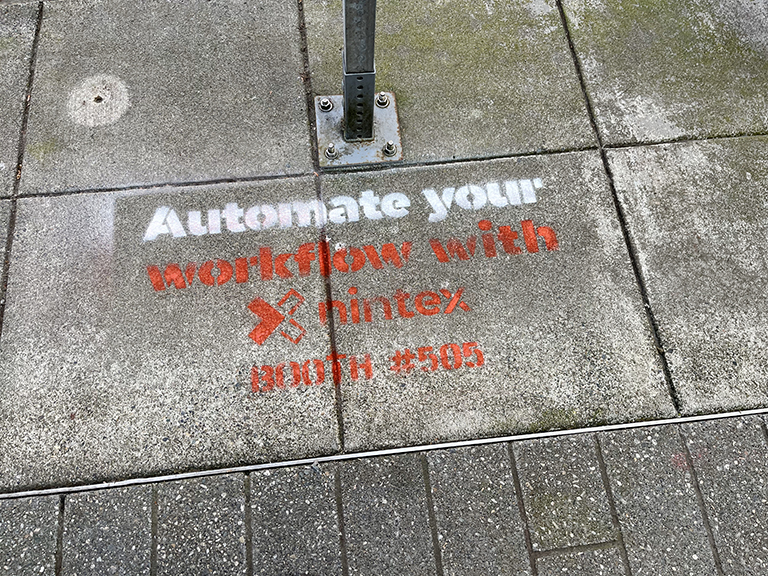
Short answer: sidewalk stencil pricing depends on format, city count, crew size, surface count, and whether you are using chalk, paint, reverse graffiti, or vinyl. For AGM campaigns, official sidewalk stencil pricing starts at $2,855 for 5 placements and runs to $22,112 for 200 placements.
Most people asking about sidewalk stencil advertising cost are really asking a broader question: is this format cheap, or does it just look cheap from the outside? The answer is that sidewalk stencils are usually cost-efficient, but only when the campaign goal matches the format. If you want fast-turn street visibility around stores, concerts, launches, nightlife corridors, or event routes, stencils can be one of the smartest ways to buy physical attention. If you want month-plus durability, they stop being the right tool and you should probably look at decals instead.
The mistake brands make is treating stencil cost as if it were just a printing cost. It’s not. You’re buying planning, route logic, surface selection, install labor, visibility timing, and the kind of repetition that turns a sidewalk into directional media. A cheap stencil in the wrong zone is still wasted money. A well-timed stencil program near stadium gates, retail corridors, or festival footpaths can outperform more expensive media because it intercepts people at walking speed.
The Short Budget Answer
For AGM, official sidewalk stencil pricing is fixed and should be used exactly as published:
| Placements |
Official Sidewalk Stencil Price |
| 5 |
$2,855 |
| 10 |
$3,231 |
| 15 |
$3,608 |
| 20 |
$3,989 |
| 30 |
$4,976 |
| 40 |
$5,795 |
| 50 |
$6,982 |
| 60 |
$7,957 |
| 70 |
$8,946 |
| 80 |
$9,935 |
| 90 |
$10,924 |
| 100 |
$11,999 |
| 150 |
$16,944 |
| 200 |
$22,112 |
Rush production inside 72 hours is +50%. That matters because this format is often bought late, after a tour date gets announced, after a launch party gets locked, or after a pop-up permits finally clear. Last-minute planning is common. Last-minute pricing is real.
What Actually Drives Sidewalk Stencil Cost
Four things do most of the damage to a budget: quantity, route spread, surface condition, and timing. Quantity is obvious. Route spread is less obvious but just as important. Fifty placements within a compact nightlife district are operationally different from fifty placements scattered across four boroughs or three suburban retail clusters. Travel time and setup friction matter because this format is deployed by crews, not by a dashboard.
Surface condition matters because concrete isn’t one thing. Fresh sealed concrete, dirty older sidewalks, pitted downtown slabs, event-zone pavement, and recently cleaned pedestrian corridors all respond differently. The cleaner and more consistent the surface, the cleaner the visual result. Surfaces with heavy grit, moisture, or broken texture slow the crew down and reduce the margin for error.
Timing matters because most stencil campaigns aren’t meant to live forever. They are meant to peak during a window. If a music event is Friday night, you want the placements fresh Thursday night or Friday morning, not three days early with weather already working against you. Cost only makes sense when timing and objective line up.
Official AGM Sidewalk Stencil Pricing
Here is the practical way to read the official pricing table. The 5 to 20 placement range is typically for hyperlocal activations: one venue, one retail area, one event perimeter, one college district, one product drop. The 30 to 80 placement range is where regional campaigns start feeling visible at the neighborhood level. The 100 to 200 placement range is where a campaign starts behaving like a real citywide saturation move rather than a tactical stunt.
The reason this matters is strategic, not mathematical. A lot of brands buy too few placements and then judge the format unfairly. Five placements can be right if all five are on the exact path to an event or storefront. But if your goal is general awareness across a major metro, five is almost always too small to matter. The best stencil campaigns either own a route or own a district. Dribbling them around randomly is how brands convince themselves the medium underperformed.
Planning rule: buy sidewalk stencils like route media, not like isolated art objects. The format gets stronger when people see it more than once on the same walk.
Not every client asking for stencil pricing should buy stencil pricing. Chalk and chalk-spray stencils are ideal for short-lived bursts, launch windows, nightlife, and event footprints. Paint-based executions read bolder, but they also raise a different level of operational and legal scrutiny. Reverse graffiti, also called water-pressure stenciling or clean graffiti, works best when the contrast between cleaned and uncleaned pavement is doing the visual work. It’s not a copy-and-paste substitute for every stencil idea.
Then there are decals. Decals often cost more on a per-placement basis, but they stay up far longer. If the campaign needs a two-week run, a 30-day retail message, or a convention footprint that has to look identical from one placement to the next, decals usually beat classic stencil work. This is why smart buyers compare lifespan to objective instead of only comparing line-item cost.
How City and Density Change the Budget
New York, Miami, Chicago, Los Angeles, and Las Vegas all support sidewalk media, but they don’t reward the same route logic. In New York, compact foot traffic and block-by-block repetition make dense route planning incredibly effective. In Los Angeles, where pedestrian behavior is less uniform, the wrong route can waste money fast. In Miami, humidity and rain timing influence freshness. In Chicago, event calendars and neighborhood turnover matter more than marketers expect.
What this means for budgeting is simple: the placement count alone never tells you the whole story. Twenty placements in the right event perimeter can outperform fifty loose placements across disconnected blocks. Conversely, a citywide launch sometimes needs 100-plus placements before it starts to feel unavoidable. Good budgeting starts with the walking path, not the spreadsheet.
When Stencils Beat Other Street Formats
Stencils win when speed, route repetition, and physical immediacy matter more than long-term durability. They are excellent for album releases, bar openings, nightlife campaigns, product drops, sports events, concerts, conventions, and street-level directional messaging. They are especially strong when people are already moving toward something and the message helps convert that motion into awareness or attendance.
They are weaker when your message needs to survive weather for weeks, when creative precision is critical across every placement, or when the legal environment makes classic stencil execution too exposed. In those cases, decals or permission-based wall media often make more sense.
The best sidewalk stencil budget isn’t the smallest number you can get approved. It’s the number that gives the route enough repetition to actually feel intentional.
Sample Budget Scenarios
Small event perimeter: 10 placements at $3,231. Good for one venue district or one nightlife corridor when the goal is directional repetition.
Neighborhood launch: 30 placements at $4,976. Strong for one concentrated retail or entertainment zone.
Multi-neighborhood city push: 60 placements at $7,957. This is where a campaign starts to feel distributed rather than isolated.
Citywide awareness build: 100 placements at $11,999. Best when route planning is tied to multiple high-foot-traffic districts.
Large market blitz: 200 placements at $22,112. This is serious saturation and should be bought only when the launch window and geography justify it.
How Brands Should Buy This Format
Buy sidewalk stencils with a narrow objective. Store visits. Event attendance. Foot-traffic redirection. Launch-week awareness. If the objective is vague, the format will feel vague too. Decide whether the campaign needs 24 hours of freshness, 72 hours of relevance, or one solid week of carry. That one choice changes everything from copy to route to format selection.
The second rule is to buy placements where people actually walk, not where marketers assume they walk. A mediocre location map kills stencil performance faster than almost anything else. Good street media always looks creative after the logistics are right. It never works the other way around.
If you need help deciding whether sidewalk stencils, decals, or a broader street mix makes more sense, AGM’s sidewalk stencil team can build the route around the real objective instead of reverse-engineering justification after the fact.
Field Notes That Actually Help Planning
Related AGM resources
These live internal links connect the post to AGM service pages and adjacent campaign formats that a reader would naturally want next.
How to define the campaign objective clearly
A cleaner version of Sidewalk Stencil Advertising Cost: What Brands Should Budget in 2026 starts with one business objective that can be described in a sentence. That objective might be walk-ins, event attendance, trial, signups, retail support, or launch awareness, but it needs to be specific enough that the rest of the campaign can organize itself around it. When the objective is vague, the route plan gets fuzzy, the creative tries to do too many jobs at once, and the post-campaign review turns into guesswork.
Once the objective is specific, the rest of the planning process becomes easier to evaluate. The team can judge whether the market is concentrated enough, whether the format is doing the right kind of work, and whether the response path is realistic for the audience being targeted. That discipline usually creates better performance than simply making the campaign louder.
Why market selection changes the outcome
Street-level campaigns perform differently depending on density, route flow, timing, and neighborhood behavior. A tactic that works beautifully in a high-footfall district can feel wasted in a market where the audience is too dispersed or where the timing window is poorly matched to the campaign. That is why market selection should be treated like a strategic choice, not just a backdrop for the creative.
Good planning usually narrows the map before it widens the budget. By choosing the strongest routes, pinch points, venue zones, or commuter corridors first, the team gives the campaign a better chance to create repetition and recall. That kind of focus often matters more than adding extra territory that the media cannot realistically dominate.
How route logic improves performance
A campaign route is not just a list of placements. It is the sequence in which the audience encounters the message and the environment around each encounter. Strong route logic accounts for where people start, where they pause, what else competes for their attention, and whether the creative has enough time to register. When those factors line up, the audience experiences the campaign as a coordinated presence rather than a random scattering of media.
That same route logic also helps with reporting. Instead of treating the campaign as one vague visibility effort, the brand can compare how different segments of the route performed. That makes it easier to adjust geography, timing, staffing, and media mix the next time the campaign goes live.
What creative has to do in public space
Creative for street campaigns has to communicate faster than most digital creative because the audience is often moving. The message needs to read quickly, the hierarchy needs to be obvious, and the visual needs to hold up against the clutter of the surrounding environment. Campaigns that work in a mockup but ignore those realities usually lose their edge once they are out in the real world.
That does not mean public-space creative has to be boring. It means the concept has to respect the way people actually encounter it. Cleaner copy, stronger contrast, and one clear next step usually outperform crowded layouts that ask too much from a passerby in two seconds.
How the response path should be built
A strong campaign gives the audience a next move that matches the objective. If the goal is attendance, the response path should help people register or show up. If the goal is store traffic, the message should support that behavior directly. If the goal is lead capture, the handoff needs to be light enough that a person can complete it while standing, walking, or deciding quickly in a noisy environment.
The response path also makes the campaign easier to measure. QR codes, short URLs, market-specific offers, event prompts, and other simple mechanics can create usable signals without overcomplicating the creative. The key is choosing one path that belongs to the campaign instead of adding several competing asks.
Why operational planning matters so much
Execution quality can change the result even when the concept is solid. Production timing, field coordination, installation logic, documentation, maintenance expectations, and removal planning all shape whether the campaign feels intentional or sloppy. A good strategy can still underperform if the operation behind it is rushed or loosely managed.
That is why operational planning should happen alongside the creative, not after it. When the build, route, and documentation plans are aligned early, the team can avoid unnecessary surprises and protect the parts of the campaign that actually create value in market.
How to measure results without forcing the wrong model
Not every street campaign should be judged by the same scoreboard. Some are built for traffic, some for trial, some for visibility, and some for awareness that supports a larger launch. The useful question is not whether every campaign creates the same metric, but whether the campaign created the metric that was appropriate for its job.
That perspective gives the brand a much better post-campaign review. It becomes possible to compare response behavior, route strength, timing windows, and creative performance instead of flattening everything into one simplistic success measure. Better measurement usually leads to better planning on the next round.
What documentation should capture
Documentation is more than proof that the work went live. It is the record that lets the team learn from the campaign after the field work is over. Good documentation captures route coverage, timestamps, placement condition, local context, response behavior, and any surprises that changed the execution once the work met the street.
That kind of record is especially useful when the campaign needs to be repeated or expanded. It helps future planners see which decisions were strong, which ones need to be revised, and which parts of the market created the best return relative to effort and spend.
How a stronger brief prevents weak execution
The best campaigns usually begin with a brief that is narrow enough to force decisions. It should define the audience, market, timing, objective, response path, and the practical limits of the tactic. When those basics are clear, the campaign team is less likely to waste money on the wrong placements, the wrong message length, or a response mechanic that does not fit the setting.
A better brief also improves collaboration. Designers, field teams, project managers, and clients are working from the same plan instead of separate assumptions. That alignment often matters more than one extra production flourish because it keeps the whole campaign pointed at the same outcome.
Why disciplined scope usually beats forced scale
Many campaigns weaken themselves by trying to cover too much ground too quickly. A scattered rollout can look ambitious, but it often leaves the audience with only a brief impression instead of the repeated contact that makes street media effective. Stronger planning usually chooses focus over sprawl and repetition over thin coverage.
That does not mean thinking small. It means concentrating enough visibility in the right places that the campaign has a chance to feel dominant for the audience that matters most. Once that works, expansion decisions become smarter because they are built on evidence rather than optimism.
How to turn one campaign into a repeatable playbook
The value of a campaign should not end when the photos are delivered. A good launch should leave the brand knowing more about which routes converted, which visuals held attention, which timing windows mattered, and what type of public interaction actually moved people to act. Those lessons are what make the next campaign better than the first one.
When a post helps readers think in those terms, it becomes more useful than a simple list of ideas. It becomes a planning asset that can guide budget allocation, field execution, creative revisions, and future market choices with much more confidence.
Frequently Asked Questions
How much does sidewalk stencil advertising cost?
AGM sidewalk stencil pricing starts at $2,855 for 5 placements and runs to $22,112 for 200 placements. The right budget depends on quantity, route density, timing, and whether the campaign is meant to dominate one zone or create repetition across several neighborhoods.
Is rush pricing available for sidewalk stencil campaigns?
Yes. Official AGM rush pricing inside 72 hours is +50%. That matters because stencil campaigns are often bought around short launch windows, event dates, and nightlife activations where timing is part of the value.
Are sidewalk stencils cheaper than sidewalk decals?
Usually, yes in upfront cost, but not always in total value. Stencils are better for short bursts and directional repetition. Decals usually make more sense when the message needs longer durability, more visual consistency, or a more controlled finish.
How many sidewalk stencil placements does a brand usually need?
That depends on the geography and the goal. Ten placements can work around one venue or event route. Thirty to sixty usually works better for neighborhood saturation. One hundred or more is where a campaign begins to feel citywide rather than local.
What makes a sidewalk stencil campaign worth the money?
Route logic. The format works when the placements are tied to real pedestrian movement. The strongest campaigns create repeated encounters on the same walk instead of scattering placements randomly and hoping people connect the dots.