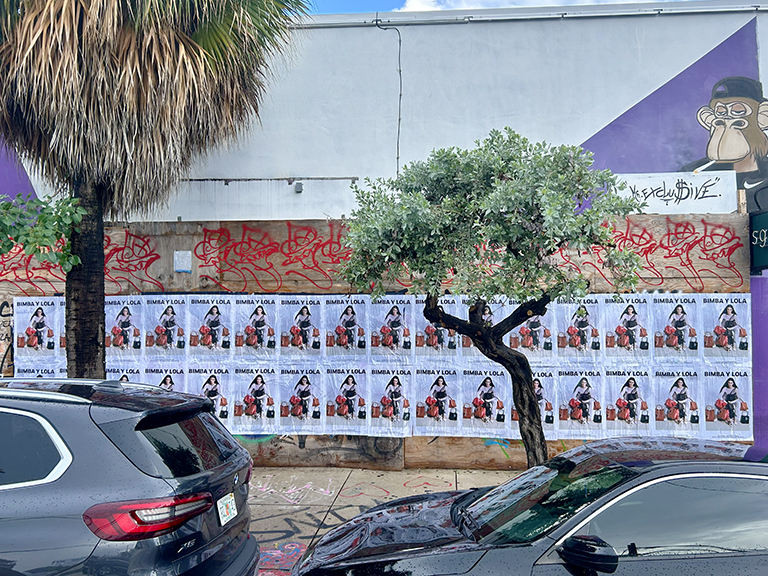
Most brands don’t start with a global wheatpaste strategy. They start with New York. Maybe New York and Los Angeles. They run a campaign, it works, and at some point someone asks: can we do this in London? In Mexico City? In more places at once?
The answer is yes — but the path from a successful US wheatpaste campaign to a repeatable global street marketing operation is not just a matter of finding operators in new cities. It requires building infrastructure, developing documentation standards, establishing operator relationships, and creating systems that let a US-based brand team manage multi-market campaigns without rebuilding from scratch every time.
American Guerrilla Marketing has run wheatpaste campaigns across every major US media market and into international markets. Over more than a decade of field operations, we’ve seen how brands make this transition — what works, what creates problems, and what the four stages of scaling actually look like in practice. This piece is a map of that path.
Stage 1: US-Only Campaigns — What to Build Before Going International
The foundation of any global wheatpaste program is built in the US. Brands that move to international markets with poorly defined US campaign systems spend enormous time on the phone trying to explain standards that were never written down. Brands that have documented their US campaigns thoroughly find that first international market far easier to manage.
What a Successful US Campaign Looks Like at the Systems Level
American Guerrilla Marketing field operators run US wheatpaste campaigns across New York, Los Angeles, Chicago, and dozens of additional media markets. In that process, we’ve identified the elements that need to be codified before any campaign — domestic or international — can be handed off to a field execution team effectively.
The first is format specification. Poster sizes, resolution requirements, bleed specifications, file format for print — these need to be documented and consistent across campaigns. A brand running its third US wheatpaste campaign with three different creative teams and three different file format histories is going to have format problems the moment they add an international market with different standard print dimensions.
The second is documentation standards. What does proof of performance look like? GPS-tagged photos? How many per location? Timestamped? In what format? Submitted in what timeframe after installation? These standards need to be locked down in the US stage, because they become the baseline for every operator brief that goes to every international market.
The third is targeting logic. How do you decide which neighborhoods to brief? What’s the decision framework — audience demographics, cultural affinity, foot traffic volume, competitive brand presence? Having this logic written down means it can be adapted for a London brief or a Mexico City brief without starting from scratch. Without it, every new market requires a full targeting brief rebuild.
The fourth is the reporting format that goes to the brand’s internal stakeholders. Whatever format the marketing team presents to their leadership after a US wheatpaste campaign — coverage maps, photo galleries, impression estimates, placement counts — that format needs to be reproducible for international markets. If the international campaign can’t be reported in the same structure as the US campaign, multi-market reporting becomes a custom-build project every time.
New York, Los Angeles, Chicago as the Template
These three US media markets are where most national wheatpaste programs are developed. They’re large, they have established street postering cultures, and they’re different enough from each other that running all three forces a brand to develop systems that travel. A campaign that works in New York and also works in Chicago and also works in Los Angeles is a campaign whose systems are portable to international markets.
New York’s scale and density require one approach to neighborhood selection and documentation logistics. Los Angeles’s geographic spread — Silver Lake to Fairfax to West Hollywood — requires a different approach. Chicago’s concentrated market areas require another. A brand that has run all three with consistent documentation standards and reporting formats has already built the core of a global campaign infrastructure.
Stage 2: The First International Market — What London Teaches
Most US brands choose London as their first international wheatpaste market. The reasons are practical: English-language creative works without translation, the street poster culture in neighborhoods like Shoreditch and Brixton is well-established and audience-receptive, and the overlap between London’s cultural scene and the US creative-brand world means the campaign context is familiar even though the market is new.
But the operational lessons from a first London campaign are what matter here, because they apply to every market after it.
Format Conversion
The first operational surprise for most US brands running their first London campaign is format. UK standard poster sizes differ from US standard sizes. A campaign built around US sheet dimensions needs to be reformatted for UK printing, and the reformatting needs to be designed — not just resized — to maintain creative integrity. This is a problem that surfaces in London and then resurfaces in every subsequent international market, because standard poster dimensions are not globally uniform. Having a format conversion library after the first London campaign means the second market doesn’t require the same design sprint.
Operator Relationship Standards
The London campaign is where a brand first learns what a good international operator relationship looks like and what a poor one looks like. The distinction comes down to: does the operator have genuine wall relationships in the neighborhoods specified in the brief, or are they working off a list of walls they’ve never personally secured? Are they delivering GPS-tagged documentation on the timeline specified, or is documentation arriving days late in an unusable format? Can they communicate clearly with a US-based account team across time zones, or does every exchange require extensive back-and-forth?
American Guerrilla Marketing has built operator relationships across our operating markets over more than a decade. The vetting criteria we apply to operators — certified installers, licensed wall agreements, GPS documentation capability, track record of on-time delivery — were developed from firsthand experience with what operator failures look like in a live campaign. The London market taught us most of what we know about what international operator quality standards need to be.
Time Zone Management
A London installation window runs during UK working hours — typically 5 AM to 10 AM for early-morning installations. That’s midnight to 5 AM New York time. A US brand team that hasn’t prepared for this finds itself either missing the installation window or burning out team members who are checking phones at 3 AM. The solution is a clear chain of command that doesn’t require US team approvals during UK installation hours. The operator brief needs to be complete enough that the installation team doesn’t need to reach the US client mid-install.
This time zone management protocol — established in London — becomes the template for every subsequent international market. Whether the campaign is in Mexico City (one hour behind New York, more manageable) or in a future European or Asian market (five to fifteen hours ahead), the principle is the same: the brief travels, the approvals happen in advance, and the installation team operates independently within a defined set of parameters.
Documentation and Reporting Infrastructure
Getting field documentation from London to New York in a format that works in the brand’s reporting system requires a file transfer and processing workflow that doesn’t exist until the first campaign forces it to be built. After London, that workflow exists. It needs adjustment for each subsequent market — different mobile network conditions affect upload reliability, different file naming conventions affect processing — but the London campaign is where the bones of the international documentation workflow are built.
Stage 3: Building a Multi-Market Cadence — Three to Six Markets
The move from one international market to three to six markets is where the infrastructure built in Stages 1 and 2 either holds or breaks down. This stage requires the development of a master brief template that can be adapted to multiple markets without a full rebuild, and the beginning of consolidated reporting across markets.
The Master Brief Template
By the time a brand has run US campaigns in New York, Los Angeles, and Chicago plus a first international campaign in London, they have enough campaign history to build a master brief template. This is a document that contains all the consistent elements of every campaign — creative asset specifications, documentation standards, reporting format, contact chain, targeting framework — in a modular structure where market-specific elements are populated as variables.
For a campaign adding Mexico City to the program: the master brief covers everything universal. The market-specific section covers Mexico City neighborhood targeting (Roma Norte, Condesa as primary; additional colonias based on brief), local format specifications, time zone management, operator contact, and any market-specific documentation requirements. The campaign team in New York doesn’t rebuild the brief from scratch — they populate a template they’ve already built and refined across four previous campaigns.
This template is what makes multi-market cadence manageable. Without it, each new market is a full planning exercise. With it, adding a new market to a running program is a matter of hours, not weeks.
Staggered Installation Windows
Running wheatpaste campaigns in three to six markets simultaneously — or in a coordinated rolling launch — requires installation windows that can be managed by a US account team without creating a monitoring bottleneck. Staggered installation windows, where markets install on different days within a shared campaign launch window, allow a single account team to monitor documentation delivery and address issues without being overwhelmed by simultaneous field activity across multiple time zones.
American Guerrilla Marketing manages this staggering as part of standard multi-market campaign planning. The brand team doesn’t manage individual market timelines — they receive a consolidated schedule and then receive documentation as each market’s installation completes.
Format Conversion Library
By Stage 3, a brand should have a format conversion library: a master set of poster files adapted for the standard print dimensions in each market they operate in. US standard, UK standard, and if adding European markets, EU standard formats. This library means that adding a new market doesn’t require a new round of design work — it requires selecting the right variant from an already-built library.
The brands that scale international wheatpaste programs most effectively are the ones that invest in systems documentation after their first two or three campaigns — not after ten. The systems work compounds: each new market is easier than the last because the infrastructure already exists.
Stage 4: The Ongoing Global Program — Eight to Fifteen Markets
At eight to fifteen markets, the wheatpaste program is infrastructure, not a series of individual campaigns. Major entertainment, fashion, and consumer brands running programs at this scale are not planning each market as a standalone project — they’re running a program with established operators, established documentation workflows, established reporting formats, and a coordinating partner who manages the execution layer so the brand team can focus on creative and strategy.
What Changes at Scale
The complexity shift at this stage is not additive — it’s not just “eight times the work of one market.” With the right systems in place, moving from six markets to twelve is less than double the operational complexity, because the systems are doing the work that previously required custom planning. The master brief template, the format library, the operator network, the documentation workflow — all of these are in place. Adding a new market means activating a new operator from the network and populating the template, not building from scratch.
What does increase at scale is the coordination requirement. Eight to fifteen markets running in a coordinated global launch means managing documentation delivery across multiple time zones, consolidating reporting from multiple operators into a single client-facing report, and handling the variability that comes with more operators — different documentation quality, different communication patterns, different local variables in each market.
This is where the value of a coordinating partner like American Guerrilla Marketing is most apparent. The brand team doesn’t manage operators directly. They don’t receive fifteen separate documentation packages in fifteen different formats. They receive a single consolidated report from AGM that presents all market documentation in a unified format, with any operator performance issues resolved before the report reaches the client.
Global Operator Network
The foundation of a global program is a vetted operator network — certified, licensed installers in each operating market who have been evaluated on documentation quality, property relationship depth, installation reliability, and communication standards. This network is not something a brand builds directly. It’s built through years of operational engagement in each market, and it requires ongoing maintenance — operators change, relationships evolve, market conditions shift.
American Guerrilla Marketing maintains this network as a core operational capability. Our nationwide portfolio in the US — across every major media market — is backed by the same standards we apply to international operators. Brands that work with AGM on global programs access a network that has been built and maintained through firsthand field operations, not sourced fresh for each campaign.
Consolidated Reporting at Scale
Reporting at the eight-to-fifteen-market scale needs to serve multiple internal audiences: the campaign team that needs placement-level detail, the marketing leadership that needs program-level summary, and often a client that needs something formatted for their own reporting system. Consolidated reporting infrastructure — documentation processing workflows, coverage map generation, impression estimate methodology — needs to be built and maintained as a program asset, not recreated for each campaign cycle.
Creative Localization Protocols
At global program scale, some markets will require creative localization — not just format conversion, but adaptation of messaging for local cultural contexts. A campaign running across the US, UK, and Latin America may need to manage multiple language variants, culturally adapted messaging, or market-specific creative executions while maintaining a consistent global identity. Protocols for how localization decisions are made, who approves local variants, and how localized creative flows through the print and distribution chain need to be codified as program standards.
| Stage |
Markets |
Key Infrastructure Needed |
AGM’s Role |
| Stage 1: US-Only |
NY, LA, Chicago |
Format specs, documentation standards, reporting format, targeting logic |
US campaign execution across nationwide portfolio |
| Stage 2: First International |
+ London |
Format conversion, operator relationship standards, time zone management |
Operator brief, London operator coordination, consolidated reporting |
| Stage 3: Multi-Market |
3-6 markets |
Master brief template, format library, staggered install windows |
Multi-market coordination, template management, documentation consolidation |
| Stage 4: Global Program |
8-15 markets |
Global operator network, consolidated reporting system, localization protocols |
Global coordinating partner, operator network maintenance, unified client reporting |
What AGM Does as a Global Coordinating Partner
At each stage of the scaling path, American Guerrilla Marketing’s role is the same in principle: we are the layer between the brand team and the field execution. What changes is the scale and complexity of that layer.
In Stage 1, we run US campaigns across the nationwide portfolio — New York, Los Angeles, Chicago, and every major media market in between. Our certified, licensed field operators provide the GPS-tagged documentation and standardized reporting that builds the US campaign history a brand needs before going international.
In Stage 2, we extend that execution capability to the first international market. We write the operator brief, select the operator from our international network, manage documentation delivery, and consolidate the international campaign report into the same format the brand team receives from US campaigns.
In Stage 3, we manage the multi-market brief template, stagger installation windows across time zones, and deliver consolidated documentation that lets the brand team report on three to six markets as a unified program rather than a series of individual campaigns.
In Stage 4, we function as the brand’s global street marketing infrastructure — maintaining the operator network, managing format libraries, handling creative localization workflows, and delivering a single global program report to the brand team regardless of how many markets are running simultaneously.
The brand team’s job, at every stage, is to control the creative, define the strategy, and hold the campaign objectives. Our job is to execute those objectives across whichever markets the program covers, with the same standards of certified installation, GPS documentation, and verified proof of performance that we apply to every campaign in our nationwide US portfolio.
Brands that have built successful global wheatpaste programs — in fashion, entertainment, consumer goods, and beyond — did it by treating the scaling path as an infrastructure project, not just a series of campaign additions. They documented their US campaigns. They learned from their first international market. They built systems that made each subsequent market more manageable than the last. And they worked with a coordinating partner who had already built the operator network and execution infrastructure those systems depended on.
That path is replicable. It’s what AGM helps brands build, one stage at a time.
Frequently Asked Questions
Why do most US brands choose London as their first international wheatpaste market?
London is chosen first because of English-language creative compatibility, a well-established street poster culture in neighborhoods like Shoreditch and Brixton, and a creative audience that responds to physical street presence. It also gives US brand teams a market where they can evaluate international campaign performance without navigating language or significant cultural translation gaps.
What should a brand document from their US wheatpaste campaigns before going international?
Brands should document their format specifications for different poster sizes, their documentation standards and what proof-of-performance looks like, their targeting logic for neighborhood selection, the creative approval process timeline, and the client reporting format. These elements need to be codified before going international because they become the foundation of every operator brief.
How does AGM help brands scale from one international market to multiple?
AGM functions as the global coordinating partner — maintaining the operator network across markets, managing format conversion for different poster standards, adapting the master brief template for each market, consolidating documentation into unified reporting, and serving as the single US-based contact regardless of how many markets are running simultaneously.
What infrastructure is required to run a wheatpaste program across 8 to 15 international markets?
A global wheatpaste program requires: a vetted operator network with certified installers in each market, a consolidated documentation and reporting system, a format conversion library that covers standard poster sizes in each country, market-specific creative localization protocols, and a coordinating partner who maintains all operator relationships from a single point of contact.
What does a master brief template for global wheatpaste campaigns contain?
A master brief template contains the campaign’s core objectives, creative asset specifications, targeting logic framework, documentation standards, reporting format, and timeline structure — in a modular form where market-specific elements (neighborhoods, format specs, local timing, operator contacts) can be populated without rebuilding the brief from scratch for each market.