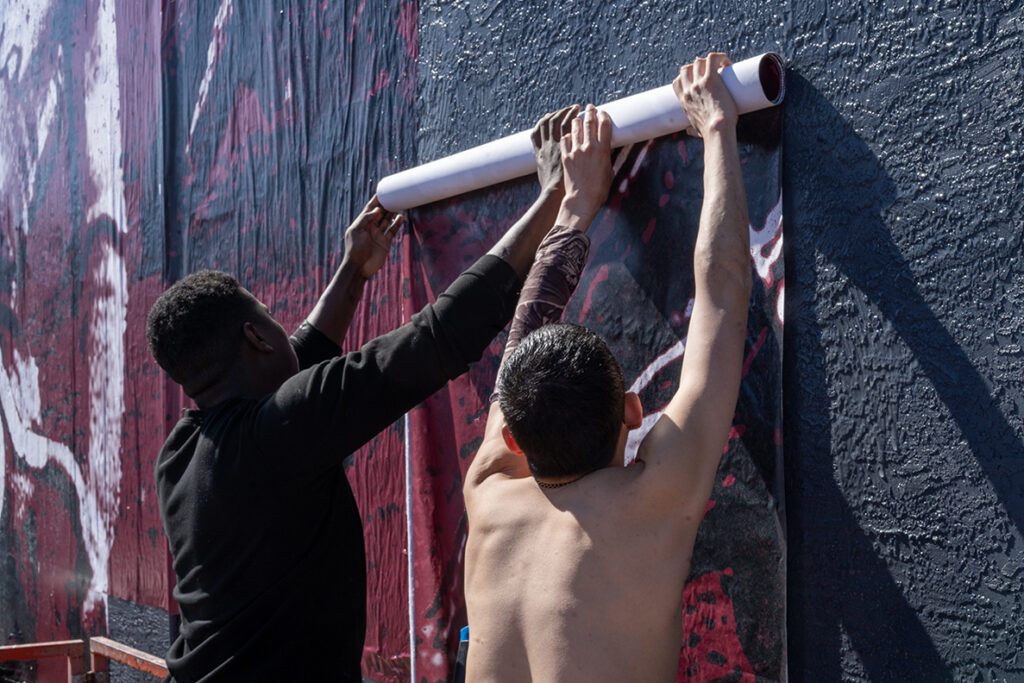
When a US brand team decides to run a wheatpaste campaign in London, Mexico City, Berlin, or São Paulo, the instinct is to manage it the same way they manage campaigns at home. Send the files. Specify the walls. Set the install dates. Check the photos. The problem is that this approach treats international wheatpasting like a domestic media buy — and it isn’t. The variables that determine campaign success abroad are almost entirely local, and almost entirely beyond what any US-based team can manage from a desk in New York.
American Guerrilla Marketing field operators have run wheatpaste campaigns across multiple continents. Over a decade of international execution, we’ve seen exactly where the boundary sits between what a US brand team should control and what must be left to the people on the ground. That boundary is not negotiable, and the brands that learn it early run better campaigns. The ones that never learn it spend their campaign window fighting logistics instead of generating results.
This piece is a practical guide to that division of responsibility — what it looks like in real campaigns, why it exists, and what happens when brand teams cross it.
The Core Problem: Distance Creates a Knowledge Gap That Doesn’t Close
There’s a particular kind of confidence that comes from Google Maps satellite view. A brand team sits in a conference room in Manhattan, pulls up a map of Shoreditch, and starts clicking around. They can see the streets. They can see the buildings. They can even see some of the walls. It feels like enough information to make decisions — which block, which building, which stretch of corridor between Brick Lane and Bethnal Green.
It isn’t enough. Not even close.
What satellite imagery cannot show you: the structural condition of a wall and whether it will hold paste in wet weather. Which direction the wall faces and what that means for drying time in November. Whether the building owner granted permission three years ago and still does, or whether the relationship ended badly and that wall is now off-limits. Whether the foot traffic at 9 AM on a Tuesday reflects anything like the foot traffic on a Thursday evening. Which competing postering crews have already hit that wall this week. Whether the paste mix that works in Los Angeles in August will fail on a damp London brick surface in October.
These are not details. They are the campaign. A wheatpaste installation that goes up on the wrong wall, in the wrong mix, at the wrong time, on a surface that’s been compromised by a previous crew — that installation either fails to stick or gets painted over before anyone sees it. The documentation arrives late or doesn’t arrive. The brand team gets photos of their poster in a location that doesn’t actually serve the brief.
The knowledge gap between a US desk and a London wall is not bridgeable by more briefing calls. It closes when you hire an operator who already has it.
What Only the Local Operator Can Determine
Wall Selection
This is the single most consequential decision in any wheatpaste campaign, and it is impossible to make correctly from New York. A legitimate international operator — one with certified, licensed relationships across a market — does not select walls from a map. They walk the locations. They check surface condition, assess adhesion history, confirm property owner status, and verify pedestrian flow in person.
In Shoreditch, some walls look identical from a satellite view but perform completely differently in the field. A wall on Redchurch Street facing southeast dries in three to four hours on a clear morning. The same wall type facing northwest on a nearby block can take twelve hours and may peel if the temperature drops overnight. This is not something you learn from a brief. It’s something you learn from walking the block, touching the surface, and having placed paste on similar surfaces dozens of times.
In Roma Norte, the same logic applies. Álvaro Obregón has walls with a long tolerance history for poster campaigns. Other blocks in the colonia — visually similar — have building owners who paint over within 24 to 48 hours. An operator who has worked that neighborhood for years knows which is which. An operator working from a US-provided wall list does not.
Paste Adhesion Protocols
Paste mix is not universal. The standard wheat flour and water formula that works in New York in spring will behave differently in London in autumn, differently still in Mexico City at altitude, and differently again in a humid coastal market. Professional local operators adjust mix viscosity, application temperature, and layering technique based on surface type, ambient humidity, and expected weather in the installation window.
American Guerrilla Marketing field operators have developed paste protocols for specific surface types across our operating markets over more than a decade. We know which surfaces need a primer coat. We know which benefit from a thicker mix and longer press time. We know which surfaces that appear solid are actually porous enough to absorb paste before it bonds. These protocols are operational knowledge — they live in the hands of experienced installers, not in a document that can be emailed to a new crew.
When a brand team specifies installation technique from New York — “apply two coats, let dry 30 minutes between” — without knowledge of the local surface and weather conditions, they are giving instructions that may be actively counterproductive. A local operator who knows their surfaces needs to be trusted to make that call.
Installation Timing Windows
Every city has enforcement rhythms. Every neighborhood inside that city has its own pattern. When local authorities or property owners are most active, when they are least active, when competing crews are working, when the light is right for documentation — these are all variables that determine the quality and longevity of an installation, and they are all locally specific.
In Brixton, there are timing windows that an operator with boots on the ground has calibrated through direct experience. The optimal installation window is not the same as in Brick Lane, which is not the same as in Soho. In Mexico City, the rhythms in Condesa differ from those in Roma Norte, which differ from those in Colonia Juárez. A US brand team setting installation times from New York is essentially guessing. A local operator with years in that market is working from real data.
Property Owner Relationships
Permissioned wheatpasting requires relationships. For most high-quality walls in any market — the walls on pedestrian corridors, on the sides of buildings with real foot traffic, in neighborhoods where the audience actually lives — those relationships took years to build and require ongoing maintenance.
Which building owner answers the phone at 5 AM when an installation crew is standing in front of their building and needs a last-minute confirmation? Which property management company has a standing agreement with a local operator that covers a portfolio of fifteen walls? Which building manager changed jobs six months ago and the new one hasn’t been brought into the relationship yet? None of this is knowable from New York. It’s the product of years of local operator presence, and it’s one of the primary reasons why working with the right operator in a market is worth far more than the installation fee.
Documentation Logistics
GPS-tagged, timestamped, high-resolution documentation is the proof-of-performance standard for any serious wheatpaste campaign. Getting that documentation out of the field and into a client report requires a logistics chain that runs from the installer to the documentation coordinator to the campaign manager. In international markets, that chain has its own local requirements: file transfer protocols that work on local mobile networks, backup documentation procedures when primary documentation fails, time-zone-aware delivery windows that ensure the US brand team receives documentation during their working day rather than overnight.
A local operator who has run international campaigns with US clients before has this chain established. One who hasn’t may deliver documentation late, in the wrong format, or without the GPS data that a client requires for verification. The brand team cannot fix this from New York once the campaign has run. It needs to be built into the operator relationship before the installation window opens.
What the US Brand Team Must Always Control
The fact that execution decisions belong to the local operator does not mean the brand team abdicates authority. There are elements of the campaign that must remain entirely under US control — not because the operator can’t be trusted, but because these decisions define what the campaign is and what it’s for.
Creative Assets
The brand controls the creative. Period. The local operator does not modify artwork, adjust format beyond what’s necessary for the specified poster size, or make visual decisions that affect brand presentation. The operator executes the creative as provided. If format adjustments are required for specific wall dimensions, those adjustments are made by the brand team or by a coordinating agency like AGM — never unilaterally by an installer in the field.
Campaign Intent and Targeting Brief
Why the campaign is running, what it’s trying to accomplish, and who it’s trying to reach — these are brand decisions. The US team owns the targeting brief entirely. If the brief says Shoreditch and Brixton to reach a music-adjacent creative audience in London, that brief is not open for the operator to reinterpret as a neighborhood they find more convenient. The operator’s job is to find the best walls for that brief, not to negotiate the brief itself.
Documentation Standards
The client gets to decide what proof-of-performance looks like. GPS coordinates, timestamp, resolution requirements, number of photos per location, format of the final report — these are brand-side requirements that the operator must meet. AGM communicates these standards clearly in every operator brief, with specific deliverable formats and submission deadlines. The operator does not set these standards. They execute to them.
Client Reporting
Everything the brand team sees comes through a single reporting layer — AGM, in the case of campaigns we coordinate. The brand team does not have direct communication with field installers, does not make last-minute changes to installation plans through direct operator contact, and does not receive raw unprocessed documentation. All of this is filtered, verified, and packaged before it reaches the client. This protects everyone: the brand from receiving confusing raw field data, the operator from receiving conflicting instructions from multiple contacts, and the campaign from the chaos that results when the chain of command becomes unclear.
The Danger of Micromanaging from New York
We’ve seen it enough times to recognize the pattern. A brand team — usually one with a strong internal campaign operations culture, used to managing every detail of their US campaigns — begins an international wheatpaste engagement with the best intentions. They want to be involved. They want to know what’s happening. They send detailed wall specifications. They send installation technique notes. They send timezone-confused messages at 2 AM London time asking for installation status updates. They request changes to the wall list two days before the installation window opens.
Each of these interventions, individually, seems reasonable. Together, they create a situation where the local operator is spending more time managing US-side communications than planning the installation. Installation windows get delayed while the operator waits for US approvals on decisions that should have been delegated. The operator’s local relationships — the building owner who agreed to a specific installation time, the documentation crew who was booked for a specific morning — start to strain under the uncertainty.
The worst-case version of this: a brand team insists on a specific wall that the operator has flagged as unsuitable for the current weather conditions. The brand team, working from a photo they liked in a previous campaign, overrides the operator’s judgment. The installation goes up, fails to bond properly in a rain event that the operator anticipated and the brand team didn’t, and the documentation shows posters in poor condition within 48 hours. The campaign is compromised, and it’s compromised by an intervention that was entirely avoidable.
The right operator relationship is built on trust that goes in both directions. The brand team trusts the operator with execution decisions. The operator trusts the brand team to define the campaign and accept the results. When that trust breaks down — usually because the brand team starts making execution decisions they’re not equipped to make — the campaign suffers.
In over a decade of international wheatpaste coordination, American Guerrilla Marketing field operators have found that the campaigns with the fewest execution problems are consistently the ones where the brand team provided a clear brief and then trusted the operator to execute it — not the ones where the brand team was most involved in field decisions.
How AGM Structures the US-to-Operator Relationship
American Guerrilla Marketing operates as the coordinating layer between a US brand team and the field operators who execute in international markets. This structure exists specifically to solve the problem described above: the brand team has authority over creative and strategy, the operator has authority over execution, and AGM manages the interface between them.
In practice, this means a US brand team communicates exclusively with their AGM contact in New York. They brief us on campaign objectives, creative assets, target markets, timing, and documentation requirements. We translate that brief into a field-executable operator brief. We select the operators. We communicate documentation standards. We receive field documentation, verify it, and package it into client-ready reporting.
The brand team never writes directly to a local installer. They never need to manage time zones to check installation status. They never have to manage the logistics of getting documentation out of a market they’ve never operated in. They get the results of a correctly executed international wheatpaste campaign — location documentation, GPS tags, condition reports, market-specific performance notes — without the operational burden of running it themselves.
This structure also protects the operator relationship. Experienced local operators with genuine market access — the kind of operators who have real permissioned wall networks in Shoreditch or Brick Lane, who have property relationships in Roma Norte and Condesa — are selective about who they work with. They work with partners who respect the operator’s expertise and don’t attempt to micromanage field decisions from thousands of miles away. AGM’s role as intermediary ensures that the brand team’s natural desire for visibility and control is met at the reporting level, not at the execution level where it causes problems.
What a Professional Operator Brief Contains
The operator brief is the document that transfers what the brand team controls to the operator in a form they can execute. A well-constructed brief contains everything the operator needs and nothing they don’t.
| Brief Element |
Controlled By |
Details Required |
| Creative assets |
Brand team |
Final print files, size specifications, bleed requirements, any surface-specific variants |
| Targeting neighborhoods |
Brand team / AGM |
Priority areas, secondary areas, specific exclusions if any |
| Audience description |
Brand team |
Who the campaign is targeting — used to inform wall selection within the brief |
| Volume targets |
Brand team / AGM |
Number of locations, minimum coverage per neighborhood |
| Installation window |
Brand team / AGM |
Date range, not specific installation hours — operator determines optimal timing |
| Documentation requirements |
Brand team / AGM |
Photo count per location, GPS requirement, format, submission deadline |
| Contact chain |
AGM |
Single AGM contact for all operator questions — no direct brand team contact |
What the brief does not contain: specific wall addresses selected from satellite view, paste application techniques, installation hour specifications, or instructions that second-guess the operator’s local expertise. Those items are absent by design.
When we see an operator brief that runs to fifteen pages and includes GPS coordinates of specific walls, paste viscosity ratios, and hour-by-hour installation schedules, we know we’re looking at a brief written by someone who doesn’t trust operators — and the campaign will perform accordingly. A good brief is tight. It defines the campaign without dictating execution.
Real Scenarios: What Can Only Be Decided on the Ground
Which Wall Faces East and Dries Faster
A November installation in London means working with cold, damp air and surfaces that hold moisture. An east-facing wall in Shoreditch gets morning sun from roughly 8 AM — enough to dry a fresh paste application within three hours on a clear day. A west-facing wall nearby will stay damp until early afternoon and may not dry fully before temperatures drop again. An operator who has worked these streets through multiple November campaigns knows this without being told. A brand team reviewing a wall list in New York does not — and they cannot learn it from a satellite photo or a weather API.
Which Building Owner Answers at 5 AM
The best installation windows are often early morning — before foot traffic builds, before other crews are working, in conditions that allow for quality documentation in natural light as the day starts. Access to specific walls at 5 AM requires property owner relationships that allow for early-morning contact without complaint. Some building owners in Brick Lane have standing relationships with local operators that permit early-morning installations with no advance notice. Others require 48-hour notice. Others have changed ownership in the past year and the new owner’s tolerance is unknown. Only an operator with active local relationships can manage this in real time.
Which Surface Material Needs Heavier Paste Mix
London’s older building stock includes brick surfaces with varying degrees of porosity, painted surfaces of different ages and thicknesses, rendered surfaces that behave completely differently from bare brick, and metal surfaces that require a different application approach entirely. Mexico City’s building stock includes surfaces ranging from smooth painted concrete in Roma Norte to rougher masonry in other colonias. Each surface type requires a different approach to paste mix and application pressure. The operator making the paste that morning knows what they’re working with. The brand team in New York does not.
The Competing Crew Variable
Street-level postering markets in major cities are active. Shoreditch sees multiple postering crews operating weekly. A wall that was clean when it was scouted on Monday may have received a full coverage of other posters by Thursday. An operator with field presence monitors this in real time and adjusts wall selection accordingly — moving to secondary walls, shifting to locations that haven’t been hit recently, or timing installations to follow cleanup cycles that keep prime walls available. This kind of reactive decision-making is invisible from New York, but it directly affects whether the campaign documentation shows clean, prominent poster placements or cluttered walls where the client’s creative is buried under three other layers.
Why the Operator Relationship Is the Single Biggest Variable in International Campaign Quality
We’ve run enough international campaigns to say this with confidence: the single largest determinant of international wheatpaste campaign quality is not the creative, not the budget, and not the neighborhoods selected. It’s the quality of the local operator relationship.
An excellent creative running on walls selected by a poor operator — walls without pedestrian traffic, walls in neighborhoods that don’t match the brief, walls with adhesion problems — will produce documentation that looks underwhelming and campaign performance that doesn’t justify the investment.
The same creative, placed by an operator with genuine field intelligence and years of established property relationships in Shoreditch and Brixton, will produce documentation that represents the campaign at its best: prominent placements on high-traffic walls, in the right neighborhoods, with clean installs that hold through the campaign window.
The operator relationship is built over time. American Guerrilla Marketing has spent more than a decade identifying, vetting, and working with operators across international markets. Our nationwide portfolio of domestic US campaigns — across every major media market in the country — provides the case studies and proof of performance that serious international operators recognize when they evaluate whether to work with a coordinating agency. International operators who know we run at this volume and standard in the US know what we expect from field execution. That shared understanding of quality standards is what makes the international operator relationship function at the level that produces the campaigns we guarantee to our clients.
When a brand team asks us how to find a good local operator for an international market, our honest answer is: you probably can’t do it quickly. Operator evaluation requires direct engagement, campaign history review, and firsthand assessment of their wall network quality. We’ve done that work over years. Brands that work with AGM on international campaigns access that network directly — without having to build it from scratch.
The Brief That Protects Everyone
The right operator brief is not just a communication tool — it’s a protection mechanism for both the brand team and the operator. When campaign intent, creative requirements, targeting specifications, documentation standards, and the chain of command are clearly defined before the installation window opens, there are no ambiguous decisions left to be made in the field. The operator knows exactly what they’re executing. The brand team knows exactly what they’ll receive. There’s no gap where a well-meaning brand team intervention can derail an installation in progress.
That clarity is what American Guerrilla Marketing builds into every international campaign brief. It’s what separates a campaign that runs smoothly from one that generates a week of back-and-forth emails while the installation window closes. It’s the product of ten-plus years of firsthand experience managing the relationship between US brand teams and international field operators — and it’s the reason our clients consistently report that international campaigns coordinated through AGM run with less friction than international campaigns they’ve attempted to manage independently.
Leave field decisions to the field. Control what you can actually control from New York. Work with an operator — or a coordinator with an established operator network — who knows the difference. That’s how international wheatpaste campaigns work when they work.
Frequently Asked Questions
What does a local operator actually do in an international wheatpaste campaign?
A local operator handles wall selection, paste adhesion protocols, installation timing, property owner relationships, and on-the-ground documentation. These are things that cannot be managed remotely — they require presence, local knowledge, and relationships built over years of working in a specific market.
What should the US brand team always control in an international wheatpaste campaign?
The US brand team retains full control of creative assets, campaign intent, targeting brief, documentation standards, and client reporting. These elements define what the campaign is — the operator’s job is to execute it correctly in the field within those parameters.
What happens when a brand team tries to micromanage international wheatpaste installation?
Micromanagement from New York typically results in delayed installations, friction with local operators who know their market better than any remote team can, and documentation that arrives incomplete or late. In the worst cases, brand teams override operator judgment on surface conditions, leading to installations that fail or get removed before the campaign window closes.
How does AGM structure the relationship between US brand teams and international operators?
AGM acts as the coordinating layer between the US brand team and field operators. We write and deliver the operator brief, set documentation standards, translate campaign intent into field-executable instructions, and manage all reporting back to the client — so the brand team gets results without managing operators directly.
Can satellite imagery substitute for local operator wall knowledge?
No. Satellite imagery shows geometry, not surface condition, adhesion history, pedestrian flow patterns, or property owner tolerance. Wall selection for a wheatpaste campaign requires walking the location — which is something only a field operator on the ground can do. No remote tool replaces that.