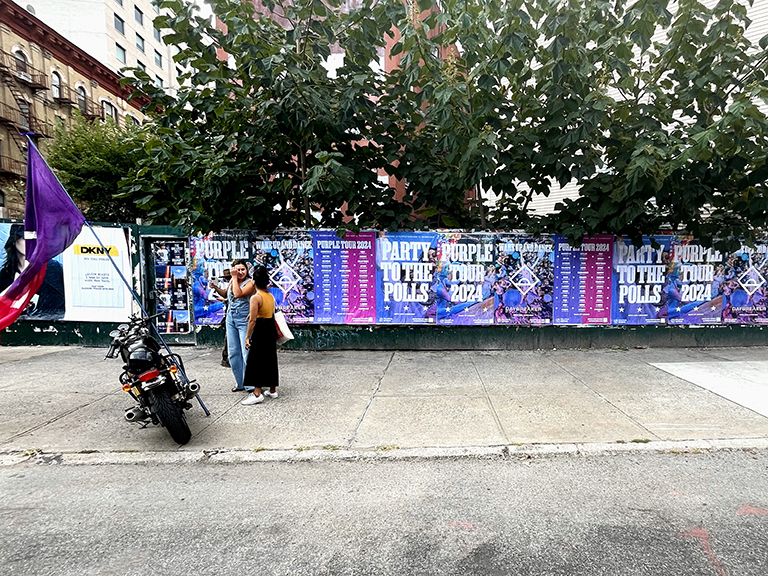
Fall wheatpasting requires adjusting paste formulation and application technique for dropping temperatures and increasing moisture, campaigns executed in October and November with the right material specifications hold surfaces through winter and deliver months of compounding impressions.
The efficiency argument for street-level advertising is most compelling when campaigns are built around audience geography rather than broad geographic reach. Concentrating spend in the specific neighborhoods, corridors, and venue adjacencies where the target audience is most dense consistently outperforms spreading the same budget across a broader area with lower audience concentration. American Guerrilla Marketing builds every campaign around that precision logic.
What makes wheatpasting worth understanding in depth is the gap between campaigns that generate impressions and campaigns that generate results. The best campaigns are built around audience movement patterns, not just surface availability, they place messages where the right people walk, dwell, and return repeatedly, which drives the frequency that builds real brand memory. The format also benefits from organic amplification: quality street-level work in high-visibility environments gets photographed and shared, multiplying the original media investment without additional spend.
This article covers the tactical and strategic fundamentals of wheatpasting, how campaigns are structured, what execution looks like in practice, how to evaluate format options against objectives and budget, and what distinguishes campaigns that move the needle from campaigns that just spend money. Whether you’re planning a first activation or optimizing an existing street-level program, the information below gives you a grounded framework for making smart decisions and getting measurable outcomes.
Why Fall Is a High-Impact Season for Wheatpasting
Fall creates something marketers care about more than almost anything else: routine. In summer, movement patterns are noisy. Travel, vacations, school breaks, and irregular schedules can dilute the repeat exposure that makes poster campaigns powerful. In fall, that chaos settles. Office commuters take familiar routes. Students settle into class schedules. Concert calendars fill up. Sports, nightlife, and retail all begin stacking demand into the same districts. When the same audience keeps passing the same walls, the campaign starts doing real work.
That repeat exposure is the whole game. A poster campaign rarely succeeds because someone saw it once. It succeeds because they saw it Monday on the way to class, Wednesday before dinner, Friday going to a show, and Saturday while moving through the same neighborhood again. By the fourth or fifth encounter, the message no longer feels random. It feels established.
Fall is also deadline season. Brands are pushing tour dates, product launches, app drops, retail promotions, film releases, nightlife concepts, campus recruitment, and Q4 awareness campaigns. The season compresses attention and budgets into a shorter runway, which makes street-level media especially valuable. A poster wall can go live quickly, feel immediate, and signal energy in a way polished digital placements often cannot.
That urgency is why fall Wheat Paste Posting rewards deliberate strategy more than casual execution. The market is active, but the season is moving fast. The teams that treat every placement as part of a designed sequence outperform the teams that treat the city like a random canvas.
How City Movement Changes After Summer
One of the biggest mistakes in fall poster planning is assuming every neighborhood behaves the same way all year. They do not. Once summer fades, traffic concentrates differently. Some daytime leisure corridors cool off. Some campus districts explode. Some nightlife zones get stronger because people return to local routines. Good fall strategy starts by reading those shifts correctly.
In New York, for example, Union Square, the Lower East Side, Williamsburg, Bushwick, SoHo, and downtown Brooklyn all carry different forms of repeat traffic in fall. Union Square and downtown commuter routes matter because people pause there every day. Williamsburg and Bushwick matter for music, culture, and nightlife cycles that intensify when event calendars fully restart. Near NYU, Columbia, and The New School, campus-adjacent movement becomes much more dependable once the semester locks in.
In Chicago, the Loop gives you commuter repetition, but neighborhoods like Wicker Park, Logan Square, Lakeview, and West Loop can outperform for cultural visibility, restaurant launches, and entertainment-driven frequency. In Boston, Kenmore, Fenway, Allston, Back Bay, and the streets around major campuses gain power because students, hospital workers, and young professionals all move through overlapping corridors. In Philadelphia, Center City, Fishtown, University City, and corridors around Temple and Drexel become reliable repetition engines once school and event traffic normalize.
The same principle shows up on the West Coast, just with different timing and weather concerns. In Los Angeles, Silver Lake, Echo Park, Hollywood, DTLA, West Hollywood, and Fairfax tend to work because culture, nightlife, and local commercial movement overlap. In Seattle, Capitol Hill, Belltown, the U-District, and Pioneer Square carry strong fall circulation, while in Portland the highest-value visibility often tightens around the Pearl, Hawthorne, Division, Alberta, and downtown event corridors. Austin shifts hard toward West Campus, South Congress, Red River, East Austin, and Rainey when student movement and nightlife stack together.
The lesson is simple. Fall does not reward generic citywide thinking. It rewards neighborhood intelligence. If you know where people resume habits, where they linger, and where they repeat their paths, you can build frequency quickly. If you guess, the campaign may still get impressions, but it will not build the sense of local dominance that makes poster advertising memorable.
Weather Planning, Timing, and Route Discipline
Weather is where a lot of fall campaigns quietly lose money. Not because the concept was wrong, but because the install plan did not respect the forecast. Fall poster work lives inside tighter weather windows than summer. Shorter days reduce flexibility. Overnight temperatures matter more. Rain patterns become less forgiving. Wind turns exposed corners into weak points. If your route is bloated or your backup plan is nonexistent, the campaign can start underperforming before the audience ever really sees it.
That is why scheduling is not an admin task. It is strategic control. High-level crews build around the weather the same way media buyers build around audience delivery. They think in install windows, not wishful dates. They stage alternates. They know which walls can survive light moisture and which ones need a cleaner, drier run. They know where daylight matters, where speed matters, and where a delay is cheaper than a bad deployment.
In the Northeast and Midwest, early fall can still be generous, but late October and November punish sloppy timing. In the Pacific Northwest, moisture planning is a constant variable, which means route design and surface selection matter even more. In Southern markets, the install window stays open longer, but surprise weather events and humidity can still affect bond quality if teams treat the season casually.
Strong fall route design has a few common traits. The route is tight, not sprawling. Travel dead time is minimized. Priority walls are sequenced first. Backup locations are nearby. Materials are staged in advance. Crews are not improvising the city in real time. They are executing a prebuilt map.
This is where brands often confuse scale with impact. Bigger route maps look impressive in a spreadsheet, but fall usually rewards concentration. If a budget can dominate six important blocks instead of lightly touching twenty, the concentrated option wins more often because people actually feel the campaign.
Materials, Surfaces, and Install Technique in Cooler Months
Cooler months expose weak materials fast. Thin paper, poor prep, inconsistent paste, and rushed edge work all become more obvious once rain and temperature swings show up. Fall does not necessarily require exotic materials. It requires a crew that understands the relationship between paper, paste, wall condition, and forecast.
The first issue is the surface itself. A wall that looks usable in summer may become a bad choice in fall if it traps moisture, sheds layers, or collects grime that prevents proper adhesion. Surface prep matters more as the season cools because any weakness gets amplified once the weather turns. Dirty or unstable surfaces shorten life. Protected, flatter, more consistent surfaces extend it.
The second issue is paste control. When the air is cooler, crews often need a tighter, more deliberate application process. Too loose, and the paper over-saturates or fails to set cleanly. Too aggressive, and the finish can wrinkle or create avoidable bubbling. Strong field teams are constantly adjusting, not applying the same formula blindly from August into November.
Paper stock matters too. Cheap thin sheets can save money on the front end and destroy campaign quality on the back end. Heavier uncoated stock generally performs better in poster work because it accepts paste cleanly and gives installers more control during smoothing. That does not mean every campaign needs the same substrate. It means fall is not the moment to cut the quality variable that holds the creative together.
Edge discipline is where professional installs separate themselves from casual installs. A lot of poster failures begin at the edges. In windy or wet conditions, the edge is not cosmetic, it is structural. If the edge work is rushed, water intrusion and peel start there. If it is done right, the poster has a fighting chance to hold shape long enough to do the job it was purchased to do.
Location Strategy and Real Neighborhood Intelligence
The best fall location strategy usually comes down to one idea: own repeated paths. Not random visibility, repeated visibility. People remember a campaign when it seems to follow them through their week. That does not happen because you technically covered a city. It happens because you selected the right corridors with enough density to create the feeling that the campaign is everywhere, even though it is actually concentrated.
High-performing fall corridor types
Campaign Strategy & Market Considerations
Every fall Wheat Paste Posting campaign should start with one practical question: what does success need to look like in this specific market? Not in theory, not in a deck, and not in a generic national case study. In this market. A music release in Brooklyn needs a different corridor plan than a retail opening in Austin, a student push in Boston, or a nightlife concept in Chicago. The audience, schedule, climate, and wall ecosystem all change the build.
That is why American Guerrilla Marketing treats campaign planning as market design. The goal is not simply to place posters. The goal is to create a pattern of public familiarity. That means selecting the right route density, matching the campaign length to the season, choosing message hierarchy that works at street speed, and deciding where repetition matters most. Sometimes the smart move is a smaller footprint with heavier saturation. Sometimes it is a layered rollout around a launch moment, followed by maintenance to preserve the highest-value placements.
Budget strategy matters here. Fall campaigns usually perform best when money is concentrated around quality prints, tight routes, strong neighborhoods, and follow-up checks, instead of being diluted into too many mediocre walls. Brands that want the city to feel their message need enough density for that feeling to happen. One poster in a good neighborhood is a sighting. A sequence of posters across the same movement path is a campaign.
Creative strategy matters too. Fall streets are visually busy. There is more retail messaging, more entertainment promotion, more event clutter, and more pedestrian distraction. The answer is not to make a louder mess. The answer is to make a clearer statement. Strong color contrast, one dominant visual idea, a readable headline, and a simple action beat overdesigned creative every time in street environments.
Market timing is the other big lever. The best fall campaigns are anchored to moments: semester starts, tour weeks, launch weekends, local festivals, sports surges, back-to-office rhythms, holiday shopping ramps, and cultural calendar spikes. When the campaign goes live just before the audience enters that behavior cycle, poster repetition can compound very fast. When it goes live too late, the city has already moved on.
Maintenance, Measurement, and Fall Campaign Longevity
Fall campaigns should never be judged only on install night. They should be judged on how well they hold up through the next weather cycle and whether they keep delivering visibility long enough for the city to absorb them. That is why maintenance is part of performance, not an afterthought.
The most valuable placements should always be checked first after rain or wind. Not every poster deserves the same response. High-value corridors, key launch blocks, and repetition anchors deserve active maintenance because they carry more of the campaign’s recall load. If those fail, the city feels the drop-off immediately. If lower-priority walls fail, the campaign may still retain its shape.
Documentation matters for the same reason. Good field photography is not just proof of completion. It is intelligence. It helps brands see coverage quality, compare neighborhoods, understand what kinds of surfaces held up best, and decide which corridors deserve reinvestment next time. Over multiple campaigns, that photo archive becomes a real performance map.
Measurement should combine street evidence and business evidence. Street evidence includes placement verification, quality checks, poster condition over time, and density by corridor. Business evidence includes branded search lift, QR or vanity URL response, promo code use, audience mentions on social, and changes in demand from the targeted geography. OOH campaigns get underrated when people only measure them with one tool. The clearer read comes from combining visibility and response.
For seasonal campaigns especially, longevity is not about making every poster live forever. It is about protecting the core exposure window. If the posters remain visible, readable, and well-placed through the weeks when the audience is moving through those same routes repeatedly, the campaign has done what it needed to do. Fall success comes from durability aligned to timing, not permanence for its own sake.
Frequently Asked Questions
Why is fall such a strong season for wheatpasting?
Because routine returns. Commuters, students, shoppers, and nightlife audiences start repeating the same paths again, which helps poster campaigns build familiarity much faster than they do in the fragmented rhythm of summer.
What changes in execution once the weather cools down?
Timing, route tightness, surface prep, paste control, and maintenance all become more important. Cooler temperatures and more moisture make weak installs fail faster, so fall demands more discipline in both planning and fieldwork.
Which locations usually perform best in fall?
Commuter corridors, nightlife districts, campus edges, retail streets, and event approach routes usually perform best because they generate repeat exposure. The key is choosing places where people pass the same walls multiple times each week.
How should brands think about budget in the fall?
Most brands get better results by concentrating budget into fewer, stronger neighborhoods with enough density to feel present. High-quality print, efficient routes, and maintenance on priority walls usually beat broad but shallow citywide coverage.