A restaurant’s market is not the city. It is the three-to-six-block radius around its front door. The customer who decides to eat at your restaurant tonight almost certainly lives, works, or walks through that radius on a daily or weekly basis. They are already in your neighborhood. The question is whether they know you exist, whether they have a reason to try you, and whether your brand occupies any real estate in their mental shortlist when the dinner question comes up.
Guerrilla marketing answers all three of those questions simultaneously. A poster on the wall of the building at the corner of their daily commute, a stencil at the subway exit they use every morning, a brand ambassador who hands them a menu and a free dessert offer at the lunch rush — these are the touchpoints that build awareness, create trial intent, and establish your restaurant in the neighborhood’s mental map. No other format delivers that level of geographic precision at a cost structure that a restaurant-scale marketing budget can sustain.
This guide covers the specific tactics, placement strategies, and campaign structures that drive foot traffic for restaurants at every stage: pre-opening launches, first-year awareness building, and established restaurant campaigns targeting specific promotions. Our team at American Guerrilla Marketing is based in Industry City, Brooklyn, NY and executes campaigns for restaurants and food brands across 50+ U.S. markets.
Why Guerrilla Marketing Works for Restaurants
Restaurants have a targeting problem that digital advertising partially solves but cannot fully address. The vast majority of digital platforms optimize for demographic and behavioral targeting — reaching the right person at scale. But for a restaurant, the most important targeting criterion is not who the person is. It is where the person is. Digital platforms cannot reliably target by the three-block radius around a physical location with the precision that a stencil on the sidewalk outside the subway exit achieves.
Guerrilla marketing is inherently geographic. Where you place the poster or the stencil determines exactly which pedestrian corridor the campaign reaches. That precision is the format’s native advantage for restaurant marketing — you are not approximating geographic targeting through demographic proxies. You are placing the campaign in the exact physical space where your target customer exists.
Decision-Moment Targeting
A restaurant customer makes their dining decision at a specific moment: on the walk from transit to the office, during the 11:45am hunger impulse at their desk, standing outside a venue after an event. Guerrilla placements at the transit exit, in the lunch-hour pedestrian corridor, and near the evening entertainment venues in the neighborhood reach potential customers at those exact decision moments. A well-placed stencil or poster is marketing that arrives at the right time because it is always there — it is present at every version of the decision moment across every person in the catchment area.
Specific Street-Level Tactics for Restaurant Campaigns
Sidewalk Stencils at Transit Exits
Sidewalk stencils at the exits of subway or bus stops within a half-mile of the restaurant create brand impressions at the commuter moment — when people are transitioning from transit to their next destination and making decisions about where to go. A stencil that appears on the path they walk every morning and evening builds frequency that no other format achieves at this cost. The message should be minimal: restaurant name, neighborhood, and one hook — a signature dish, an opening date, a specific offer.
Wheatpaste in the Neighborhood
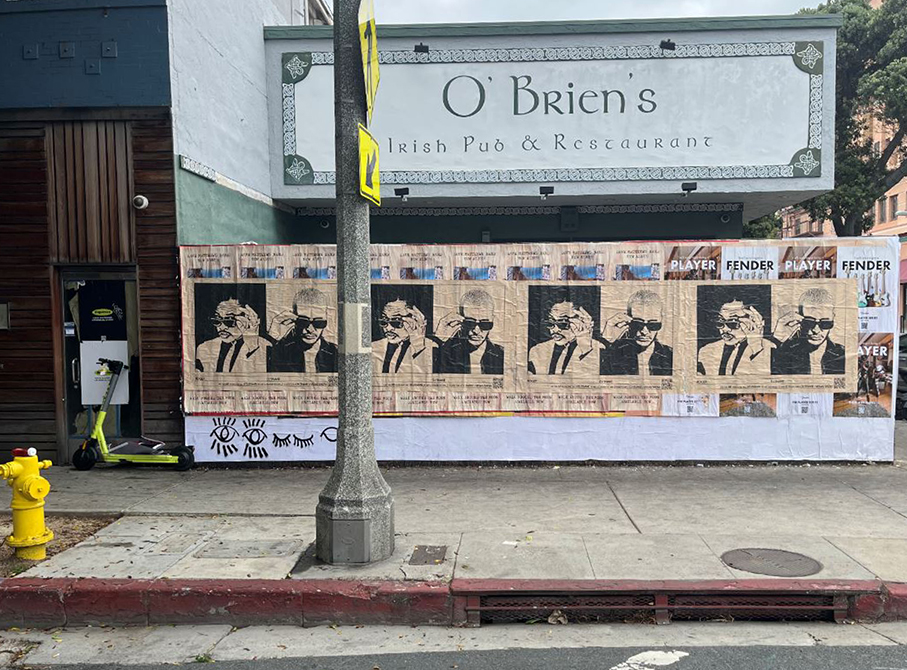
Wheatpaste campaigns covering construction fencing, permitted walls, and available surfaces in the restaurant’s catchment area create visual presence that reads as cultural presence. A restaurant whose name is on five walls in the neighborhood has the same kind of mental real estate that a long-established neighborhood institution has. For a new restaurant trying to establish itself quickly, that presence is genuinely accelerating the timeline of local recognition.
Brand Ambassadors at the Lunch Rush
Our brand ambassador teams deployed at the lunch rush in the restaurant’s surrounding area distribute physical menus, offer a specific discount or free item with first visit, and have brief conversations that create human brand connection before the customer ever walks through the door. The ambassador removes the friction of trying something new — “I heard about this place but wasn’t sure” becomes “I talked to someone who works there and they gave me a free dessert offer.” That conversion from hesitant interest to reservation is what the ambassador program achieves.
LED Trucks for Special Events and Launches
An LED billboard truck circling the restaurant’s neighborhood and nearby high-traffic areas on opening night, for a major event, or for a new menu launch creates a large-format video moment that the neighborhood cannot miss. The truck can carry video creative — a chef at work, signature dish close-ups, a direct invitation from the owner — that communicates the restaurant’s identity and offer in a way that a static poster cannot.
Neighborhood Mapping for Restaurant Campaigns
The placement strategy should be built from a neighborhood map that identifies the highest-value pedestrian corridors in the restaurant’s catchment area. For most urban restaurants, the map has three zones.
The Three-Block Guerrilla Zone
The first zone is the immediate three-block radius around the restaurant. Every available permitted surface in this zone should be considered for placement. Stencils on approach sidewalks. Wheatpaste on adjacent construction fencing. Snipe advertising on utility poles and surfaces in the immediate visual field of pedestrians approaching from every direction. This zone builds recognition among the people who are already physically proximate to the restaurant and just need a reason to come in.
Transit Exit Positioning
The second zone covers the transit exits that serve the neighborhood. For subway-dense cities like New York, Chicago, and Boston, the transit exit is where the daily foot traffic pattern originates. Stencils and snipes at every transit exit within a half-mile radius of the restaurant reach the commuter population that flows through the neighborhood twice daily. These placements work on a frequency model — seen twice a day on every commute day, the restaurant name becomes embedded in the commuter’s neighborhood mental map.
City-Specific High-Value Neighborhoods
Williamsburg, Brooklyn and Bedford Avenue corridor — dense with pedestrian traffic, high social media documentation rate, culturally engaged audience that is highly receptive to new restaurant discovery. Wicker Park in Chicago along Milwaukee Avenue — similar pedestrian density and cultural profile to Williamsburg. Wynwood in Miami along NW 2nd Avenue — gallery and bar culture creates evening foot traffic that is primed for restaurant discovery. The Mission in San Francisco near 16th Street BART — the commute and evening pedestrian concentration makes this one of the highest-value restaurant marketing zones in the Bay Area.
Campaign Structure for a Restaurant Opening
The pre-opening period is the highest-impact window for guerrilla marketing for restaurants. Building awareness before opening day ensures that opening week has built-in momentum rather than starting from zero.
Weeks 3-4 Before Opening: Teaser Phase
Deploy teaser creative in the neighborhood — a visual that reveals the restaurant’s name and concept without full detail, with an opening date. A strong teaser poster with a compelling food visual, the restaurant name, and “Opening [date]” creates anticipation among the neighborhood’s existing pedestrian population. The QR code on the teaser can link to an email signup for opening week offers, converting neighborhood awareness directly into a marketing list.
Opening Week: Full Saturation
Full creative across the neighborhood covering the restaurant’s identity, menu highlights, and a specific opening offer. Brand ambassadors distributing menus and discount cards at transit exits and on the lunch-rush pedestrian corridors. The campaign density should be the highest of the entire campaign cycle — this is the moment that first impressions are made and the word-of-mouth begins.
Months 2 and 3: Sustaining Presence
After the opening burst, a sustaining campaign at lower intensity maintains neighborhood awareness and continues recruiting trial from the portion of the catchment area that has not yet visited. Rotating creative — new menu items, seasonal offers, event programming — keeps the placements fresh for repeat pedestrians who have already seen the opening campaign.
Word of Mouth Acceleration: How Guerrilla Marketing Creates Conversations
Word of mouth is the most powerful marketing channel for restaurants. A recommendation from a friend or neighbor converts at rates that no advertising format can approach. Guerrilla marketing accelerates word of mouth by giving the neighborhood something to talk about — a striking poster, an unexpected stencil, a memorable brand ambassador encounter — before the word-of-mouth recommendation cycle has had time to develop organically.
A new restaurant that opens without any street-level presence relies entirely on the organic discovery rate of its neighborhood pedestrian audience. Those discovery conversations start slowly — someone walks past, notices the restaurant, mentions it to a friend, the friend visits, the friend tells two more people. The word-of-mouth network builds gradually over three to six months.
A new restaurant that opens with an active guerrilla campaign accelerates that timeline significantly. The poster that catches a neighborhood resident’s eye creates the first awareness impression. The brand ambassador who hands them a free dessert offer creates the conversation starter. The stencil near their transit exit reminds them on their next commute. Each of these encounters gives the resident something to mention to the people they know — “I keep seeing signs for that new place on Bedford, have you been?” That question is the beginning of the word-of-mouth cycle, triggered by the campaign rather than waiting to emerge organically.
Restaurant Group Campaigns: Multi-Location Coordination
Restaurant groups operating multiple locations in one city or across multiple cities face a different guerrilla marketing challenge than single-location operators: creating campaigns that drive location-specific foot traffic while maintaining consistent brand identity across all locations. The temptation is to run a generic brand campaign that treats all locations interchangeably. The more effective approach is location-specific campaigns with shared brand creative elements.
Each location in a restaurant group serves a distinct neighborhood with a distinct pedestrian profile. The Upper West Side location of a restaurant group serves a different demographic than the Williamsburg location, which serves a different demographic than the Flatiron location. The campaign creative can share a brand visual identity and campaign theme while adapting the neighborhood-specific elements — the local references, the address, the nearest transit, the specific offer — for each location’s immediate catchment area.
Our team executes multi-location restaurant group campaigns with a centralized brief and decentralized placement strategy. The brand creative is developed once; the neighborhood-specific placements are sourced, negotiated, and installed by our local teams in each area. The result is a campaign that feels locally relevant to each neighborhood while maintaining the visual consistency that builds the restaurant group’s unified brand identity across markets.
What Restaurant Guerrilla Marketing Creative Should Look Like
Restaurant campaign creative has specific requirements that differ from general brand advertising. The audience is making a decision — where to eat — that is driven by appetite, time of day, and social context. The creative needs to work with those drivers, not against them. A poster that makes someone hungry is doing its job. A poster that communicates brand values without connecting to the sensory experience of food is wasting wall space.
Food Photography vs. Text-Dominant Creative
For most restaurant categories, food photography outperforms text-dominant creative as the primary visual element on street-level placements. A close-up of a signature dish at the right angle and lighting communicates more about the restaurant’s quality and identity in a fraction of a second than any headline can. The photograph should be shot specifically for outdoor scale — food photography optimized for a print ad or a social post often does not translate to a 24×36 poster at distance. Commission outdoor-specific food photography if budget allows.
Single Clear Message
The street-level placement should carry one message. Not a list of dishes. Not a menu. Not a paragraph about the restaurant’s sourcing philosophy. One thing: the name and a reason to come in. That reason can be a specific dish, an opening date, a happy hour time, a price point. It should be specific enough that the pedestrian knows exactly what they are being invited to do. “New York’s best Italian” is not a specific invitation. “House-made pasta, Williamsburg” is.
Handling the Pre-Opening Silence: What to Do Before You Open
The period between lease signing and opening day is typically 3 to 6 months — a window that most restaurants leave entirely dark from a marketing perspective because they have nothing to sell yet. That silence is a missed opportunity. The neighborhood knows a new restaurant is coming (they can see the construction or the signage) but has no information about what it will be.
A guerrilla campaign that starts building awareness before opening fills that silence productively. Teaser creative on the construction hoarding and on surrounding walls in the first weeks after lease signing establishes the restaurant’s presence in the neighborhood’s consciousness before a single table is set. The teaser campaign does not need to reveal the full menu or identity — a name, a cuisine type, an opening season, and a QR code to an early access email signup is sufficient to begin building the first-day audience.
Building an Email List Before Opening
A QR code on pre-opening street placements that links to an email signup — “Join the list for first access and opening week offers” — converts neighborhood curiosity into a marketing list. The people who sign up are the most engaged potential customers: they encountered the campaign, were interested enough to scan, and took the action of providing their email. That list, however small, represents the highest-intent audience available for opening-week marketing and is worth more than any paid digital list of comparable size.
Seasonal and Ongoing Restaurant Guerrilla Campaigns
Guerrilla marketing for restaurants is not only a launch tool. Established restaurants benefit from periodic campaigns that reinforce neighborhood awareness, announce new menu seasons, promote specific dayparts (brunch, late night, happy hour), and recruit trial from the portion of the catchment area that has not yet visited despite knowing the restaurant exists.
A seasonal campaign tied to a menu refresh — new fall menu, summer cocktails, holiday dinner reservations — gives the creative a specific hook and gives the neighborhood a specific reason to reconsider the restaurant if they have not been recently. Seasonal guerrilla campaigns typically run for 3 to 4 weeks at the start of the menu period and include updated creative that visually signals the change from prior campaigns.
Measuring Restaurant Guerrilla Campaign Results
Include a trackable element on every campaign piece: a QR code that links to a campaign landing page with a reservation widget or a specific offer, a promo code redeemable at first visit, or a specific mention that staff can log at point of service. Compare foot traffic counts and revenue for the campaign period against baseline periods. For new openings, compare actual first-month performance against comparable opening benchmarks.
The simplest and most reliable measurement method for restaurants is direct customer conversation: where did you hear about us? A staff training that prompts this question at first visit, with answers logged consistently, gives you qualitative attribution data that supplements any digital tracking. Over a campaign window, the pattern of “I saw the poster on the way to the subway” or “someone gave me a flyer at lunch” tells you which campaign elements are driving discovery.
Frequently Asked Questions
Why does guerrilla marketing work well for restaurants?
Restaurants need local foot traffic from a defined geographic radius. Guerrilla marketing is inherently hyperlocal — placements target the specific neighborhood streets where your potential customers walk. A stencil at a transit exit three blocks from your restaurant reaches people at the exact moment and location where a dining decision is being made.
What guerrilla marketing tactics work best for restaurant openings?
Wheatpaste campaigns covering the surrounding neighborhood 2-3 weeks before opening, sidewalk stencils at transit exits in the immediate area, brand ambassadors distributing menus at the lunch rush in opening week, and teaser campaigns that build anticipation before the opening date.
How much does guerrilla marketing for a restaurant cost?
A neighborhood-scale campaign runs $3,000 to $12,000 depending on formats and market. A wheatpaste campaign covering 15-20 walls runs $3,000 to $7,000. Adding stencils at nearby transit exits and brand ambassadors distributing menus adds $2,000 to $5,000.
How close to the restaurant should street marketing placements be?
The primary zone is within a 3-block radius. A secondary zone extends to transit exits serving the neighborhood. Placements beyond 5 to 6 blocks from the restaurant typically have declining impact on foot traffic conversion.
Can guerrilla marketing help an existing restaurant struggling to build traffic?
Yes. A campaign with a specific offer — a new menu item, a happy hour promotion, a weekend brunch deal — can produce measurable lift in foot traffic within the campaign window. Include a promo code or QR code to track which customers came as a direct result of the campaign.
What is the best time to run a restaurant guerrilla campaign?
Pre-opening campaigns should start 2 to 3 weeks before opening and run through the first 30 days. For established restaurants, campaigns timed around a new menu launch, seasonal promotion, or neighborhood event generate the strongest response.