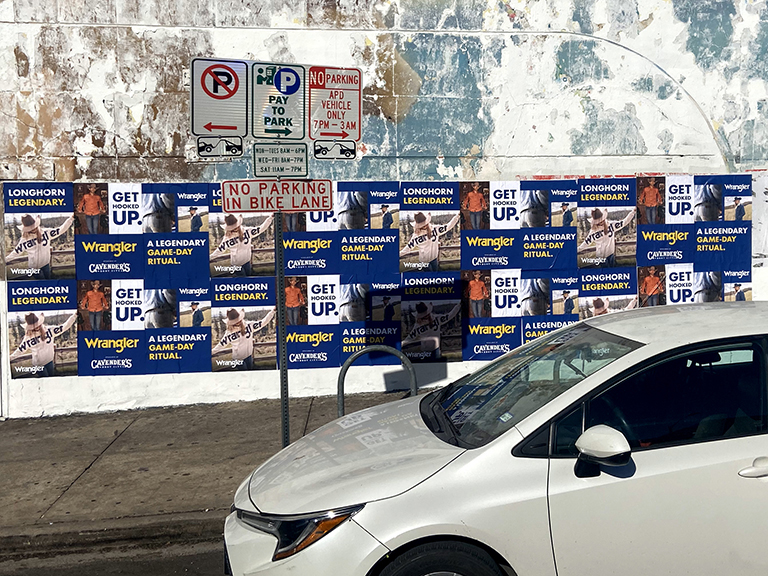
Chicago is the most structurally logical city in the country for a wheatpaste takeover. Its neighborhood grid is clear. Its commercial arterials run predictably north-south. Its L train lines connect zones in ways that create natural audience corridors between neighborhoods. If you understand how the city is built, you can design a multi-neighborhood campaign that follows the same logic its residents already use to move through it.
American Guerrilla Marketing field operators have run campaigns in Chicago for a decade. We’ve walked Milwaukee Avenue at midnight mapping wall inventory, placed on 18th Street in Pilsen before sunrise, and watched campaigns roll out across the North Side in coordinated overnight runs. This guide comes from that boots on the ground experience — specific streets, specific neighborhoods, specific strategic decisions that determine whether a Chicago campaign achieves genuine city takeover status or just puts posters on a handful of North Side blocks.
Chicago’s neighborhood grid is the most takeover-friendly street layout of any major US city — north-south arterials connect multiple neighborhoods in a single corridor, allowing a campaign to build sequential coverage more efficiently than in NYC or LA.
Why Chicago’s Grid Works in Your Favor
Walk a city block in Manhattan and you’re in a neighborhood. Walk a mile on Milwaukee Avenue in Chicago and you’ve passed through Wicker Park, touched the edge of Bucktown, and approached Ukrainian Village. Chicago’s arterial streets are long, continuous corridors that connect neighborhoods without breaking character. That means a crew placing posters along Milwaukee Avenue from Division Street to North Avenue covers ground that belongs to two distinct neighborhoods, hits the foot traffic of both, and does it in a single contiguous route.
This is the structural advantage that no other US city offers at the same scale. NYC has long avenues, but neighborhoods change character quickly and the audience segmentation is sharper. LA has long boulevards, but driving culture means those corridors work differently. In Chicago, the grid creates a sequencing efficiency that experienced operators can exploit to cover more neighborhoods per crew per night than anywhere else in the country.
The L train adds another layer. Chicago’s elevated rail network creates above-street visibility corridors that don’t exist in LA and work differently than NYC’s subway. On certain blocks where the L runs above ground — along the Blue Line through Wicker Park, along the Red Line through Lincoln Park and Lakeview — posters placed on walls adjacent to the elevated structure are seen by train passengers at near eye level. This is a specific inventory category that experienced Chicago operators know how to target.
North Side Zones
Wicker Park and Bucktown — Milwaukee Ave, Division St
Wicker Park is Chicago’s cultural anchor for creative, fashion, and music audiences. The intersection of Milwaukee, Damen, and North Avenues — locally known as “the Six Corners” — is one of the most heavily foot-trafficked intersections on the North Side and the natural epicenter for any wheatpaste campaign targeting Chicago’s creative class. Milwaukee Avenue north and south of this intersection is the primary placement corridor, with Division Street serving as a secondary east-west axis.
We’ve placed campaigns on this corridor that were picked up by Chicago street photography accounts within hours of installation. The neighborhood has an active content creator population — bands, designers, photographers, and food bloggers who live and work here and document what they see. A strong campaign placed on Milwaukee Avenue between North and Division will get organic social coverage before noon on installation day.
Bucktown, just north of Wicker Park along Milwaukee Avenue, shares the same audience profile but has a slightly higher concentration of 30-40 year-old creative professionals who are past the early-adopter phase. Both neighborhoods together cover the North Side creative corridor comprehensively.
Lincoln Park — Armitage Ave and Clark St
Lincoln Park is where Chicago’s young professional and post-collegiate demographic concentrates. Armitage Avenue and Clark Street are the two main commercial corridors, and they serve a slightly more mainstream demographic than Wicker Park — think the audience for a major consumer brand, entertainment launch, or lifestyle product rather than a niche independent label or boutique brand.
The density of upscale retail, restaurants, and coffee shops on Armitage and Clark means consistent foot traffic from 8am to 10pm. Wall inventory along these corridors has good clearance and visibility. Clark Street’s length — running from Lincoln Park north through Lakeview into Andersonville — creates an opportunity for sequential placement that follows the commute pattern of a large portion of Chicago’s North Side population.
Lakeview — Broadway and Belmont
Lakeview covers the neighborhood that runs east and west of the Belmont Red Line station. Broadway Avenue from Belmont north to Addison is the entertainment-dense corridor — music venues, comedy clubs, bars, and restaurants that generate heavy evening and weekend foot traffic. Belmont Avenue itself, running from the L station westward into Roscoe Village, adds a more residential-shopping character.
For entertainment campaigns — music releases, venue promotions, film launches — Lakeview is one of the most important zones in Chicago. The audience here comes out specifically for entertainment and is primed to notice, talk about, and share campaign content that’s relevant to what they came out to see.
Andersonville — Clark Street and Foster Ave
Andersonville sits at the north end of Clark Street and serves a distinct audience from the rest of the North Side — slightly older, highly literate, neighborhood-loyal, and disproportionately engaged with independent media and local culture. The Foster Avenue intersection is the neighborhood’s commercial heart. Andersonville is not a primary anchor zone for most campaigns, but for brands whose audience includes established creative professionals in the 30-50 range, it adds depth that the southern North Side zones don’t cover.
Central Zones
River North — Ohio/Ontario Gallery District
River North is Chicago’s gallery district — the blocks around Ohio Street and Ontario Street host the highest concentration of contemporary art galleries in the Midwest. The gallery audience is distinct from the bar-and-restaurant audience of the North Side neighborhoods: it’s art-industry professionals, collectors, and the culturally engaged higher-income demographic that attends openings and follows the art market. For luxury brands, art-adjacent campaigns, and entertainment properties with prestige positioning, River North is not optional.
The Ohio/Ontario corridor also sits adjacent to the Merchandise Mart and the broader River North business district, which adds a daytime professional audience to the evening gallery crowd. This is one of the few Chicago zones where you get meaningful daytime foot traffic from people who aren’t there specifically for entertainment or shopping.
The Loop — Michigan Avenue Perimeter and Wacker Drive
The Loop is Chicago’s downtown commercial core, and it functions differently from every other zone in the city. It is not a neighborhood where people live, hang out, or develop cultural identity. It is a through-traffic zone — people come to the Loop to work, to attend events at the United Center or Grant Park, and to transit between neighborhoods. Wheatpaste placement in the Loop is about volume and visibility rather than neighborhood resonance.
The Michigan Avenue perimeter — the walls adjacent to, but not on, the Magnificent Mile shopping corridor — has good foot traffic from both office workers and event attendees. Wacker Drive approaches near the river have solid construction hoarding inventory given the volume of development along the riverfront. A campaign that includes Loop placements alongside North Side neighborhood placements signals full-city presence, even if the Loop placements alone wouldn’t justify the spend.
Near South Side
Pilsen — 18th Street: The Most Mural-Dense Street in Chicago
Pilsen is one of the most important zones in the city for any brand that takes cultural authenticity seriously. 18th Street from Halsted to Western Avenue is the most mural-dense corridor in Chicago and one of the most heavily documented streets in the Midwest by photographers, bloggers, and journalists covering art and culture. The neighborhood has a deep Latino cultural foundation and a growing creative community that has attracted attention from both national media and international street art observers.
We’ve run campaigns on 18th Street that generated press coverage in arts and culture publications that don’t typically cover commercial campaigns — because Pilsen commands a kind of respect from the arts media that few other Chicago neighborhoods receive. Placement here requires understanding the visual context. Pilsen’s walls are extraordinary. A wheatpaste campaign placed among world-class murals needs to hold its own visually. This is a zone where the quality of the creative matters as much as the strategic placement.
For brands targeting Latino audiences, Pilsen is the most direct and credible neighborhood in Chicago. Being present here — with genuine respect for the neighborhood’s visual culture — communicates something that no amount of targeted digital advertising can replicate.
Bridgeport
Bridgeport sits just south of Pilsen and shares some of the same characteristics — strong neighborhood identity, long-term residential community, and a growing creative presence. It’s not a primary anchor zone but rounds out Near South Side coverage when campaign objectives include reaching audiences south of the Loop.
West Side
Ukrainian Village
Ukrainian Village occupies the space between Wicker Park to the east and Humboldt Park to the west, centered on Chicago Avenue and the blocks around the Ukrainian Institute of Modern Art. The neighborhood has a character that’s distinct from anywhere else on the North Side — quieter than Wicker Park, more residential, but with a strong visual arts presence and a population of working artists who take street-level aesthetics seriously. Ukrainian Village is a secondary zone for most city takeover campaigns, but it’s worth including for brands whose creative work can hold up to a discerning audience.
Humboldt Park
Humboldt Park is one of the most densely populated neighborhoods on the West Side and has a strong Puerto Rican cultural identity centered on Division Street between California and Western Avenues — a stretch known as Paseo Boricua, anchored by the two large steel Puerto Rican flags that straddle the street. For campaigns targeting Latino audiences on the West Side, Division Street in Humboldt Park is the right zone. It’s a distinct audience from Pilsen and requires a distinct placement approach.
Chicago’s construction boom has produced some of the highest construction hoarding surface inventory of any US market — making it one of the best cities in the country for permissioned, large-surface wheatpaste placements in central and developing neighborhoods.
How the L Train Lines Create Natural Campaign Corridors
This is one of Chicago’s most useful strategic features for multi-neighborhood campaigns, and it’s specific to this city. Each L line connects a set of neighborhoods that share an audience — people who ride the same line every day, who live in one neighborhood and work or socialize in another neighborhood served by the same line. Here’s how that maps to a wheatpaste strategy:
| L Line |
Neighborhoods Connected |
Campaign Use |
| Blue Line |
Wicker Park, Bucktown, Ukrainian Village → downtown |
North Side creative corridor to Loop commuters |
| Red Line |
Lakeview, Lincoln Park, River North, Loop |
Entertainment and professional corridor, full North-to-Loop |
| Pink Line |
Pilsen, Little Village, Humboldt Park → Loop |
Southwest and West Side to downtown commute corridor |
| Brown Line |
Andersonville, Lincoln Square, Bucktown → downtown |
North Side professional to Loop, connects quieter neighborhoods |
| Green Line |
Pilsen adjacent, South Side → downtown |
South Side to downtown, adds Near South coverage |
A campaign that places in Wicker Park and then in the Loop is hitting the Blue Line audience twice. Someone who rides past the Milwaukee Avenue poster in the morning and walks by a Loop placement on their lunch break sees your campaign in two distinct contexts in the same day. That frequency effect, built into the city’s geography, is one of Chicago’s most underutilized campaign advantages.
Construction Hoarding Inventory
Chicago has one of the highest construction hoarding inventories in the country. Continued high-rise residential development on the North Side, major mixed-use projects along the Riverwalk and in the South Loop, and ongoing commercial development in River North and the West Loop create a consistent supply of legal, permissioned surface area for wheatpaste campaigns.
Our American Guerrilla Marketing field operators maintain current inventory maps of active construction hoarding in all primary Chicago zones. These surfaces are GPS-tagged, documented with property owner authorization, and available for campaign booking. Construction hoarding in Chicago offers some of the best large-format wheatpaste opportunities in any US market — panel widths are often sufficient for 48×72 or even wider multi-panel installations that create billboard-scale presence in the middle of pedestrian corridors.
The logistics of hoarding placement differ from wall placement. Panel dimensions vary by site. Access agreements with general contractors need to be in place before installation. And hoarding surfaces have a campaign lifespan tied to construction schedules — active hoarding inventory changes over time. Our team manages all of this, and we guarantee that any hoarding inventory we commit to a campaign will be available for the agreed run period.
Format Choices for Chicago
24×36 is the standard format for Chicago and works across the widest range of surfaces. It’s the right default for any neighborhood-level placement where you haven’t specifically scouted the exact wall. For premium North Side walls with good vertical clearance — certain walls in Wicker Park, Lincoln Park, and along the Milwaukee corridor — 27×40 fits well and reads as a slightly more elevated campaign presence.
For construction hoarding placements, 48×72 and multi-panel installations are genuinely viable in Chicago in a way that’s harder to achieve consistently in LA. The hoarding panel inventory in Chicago is large enough that large-format placements can be scattered across multiple zones without limiting the campaign to one or two premium spots. This is a real competitive advantage for brands who want large-format presence without the cost of billboard inventory.
Installation Timing in Chicago
Chicago crews start between 3am and 4am depending on neighborhood. The core window is 3am-6am, consistent with NYC. Weather is the main Chicago-specific variable. Chicago winters are real — below-freezing temperatures affect paste consistency, and crews need to adjust their paste formula for cold-weather installation. Our field operators have run winter campaigns in Chicago and know how to manage the paste-to-temperature calculation that keeps a poster from bubbling or failing to bond in cold conditions.
Summer campaigns in Chicago benefit from the city’s outdoor culture — people are out early, out late, and paying attention to their neighborhoods in a way that cold-weather months don’t encourage. June through September is when Chicago campaigns get the most organic social documentation, because the streets are alive in a way that simply doesn’t happen in January.
CDOT Compliance
The Chicago Department of Transportation (CDOT) and the city’s enforcement of Municipal Code Section 10-8-070 govern posting on public property in Chicago. Like NYC and LA, the law draws a clear line between public property (prohibited without a permit) and private property with owner permission (legal). American Guerrilla Marketing runs exclusively with permissioned, private-property inventory in Chicago. We are certified and licensed to operate in the Chicago media market, and our placements are covered by documentation at every location in our portfolio.
Chicago has historically had active enforcement of the anti-posting ordinance in certain neighborhoods — particularly in the Loop and along commercial corridors that have active business improvement district management. Our permissioned approach means clients never have to worry about enforcement actions or fines attached to their campaign.
Midwest Audience Characteristics
Chicago’s audience is different from NYC’s and LA’s in ways that matter for campaign design. The Chicago creative class is sophisticated but somewhat skeptical of campaigns that feel like they were designed for a coastal audience and simply dropped into the city. Neighborhood specificity matters here more than in any other major US market.
A campaign that clearly understands the character of Wicker Park — that shows in the wall choices, the format, the visual context — will be received differently than a campaign that could have been placed in any city in the country. Chicago residents are loyal to their neighborhoods and proud of their city’s culture. Campaigns that honor that specificity by doing the research and making neighborhood-appropriate placement decisions consistently outperform generic national rollouts.
This is partly why our boots on the ground approach matters as much in Chicago as it does in NYC or LA. We don’t plan Chicago campaigns from a desk in New York. Our field operators know which walls on Milwaukee Avenue photograph best, which 18th Street surfaces are adjacent to important murals, and which River North hoarding placements are at pedestrian eye level versus too high to read comfortably. That on-the-ground knowledge is what translates a good strategic plan into a campaign that actually lands.
Case Study: CPG Brand Covering Wicker Park, Lincoln Park, and River North in 72 Hours
A CPG brand with strong Chicago market distribution came to us with a specific brief: build street presence in the three North Side zones where their core 25-38 year-old urban consumer was concentrated, in a 72-hour window tied to a product launch. The campaign needed to feel organic to Chicago — not a national campaign that happened to be running here.
We ran a three-night installation across Wicker Park, Lincoln Park, and River North. Night 1 covered Wicker Park and Bucktown — Milwaukee Avenue from Division to North, plus Division Street east toward the Blue Line stop at Damen. Night 2 covered Lincoln Park — Armitage Avenue and Clark Street from Fullerton to Belmont. Night 3 covered River North — the Ohio/Ontario gallery district and the construction hoarding along the Riverwalk development corridor.
Total placements: 210, split across 24×36 (standard neighborhood surfaces) and 48×72 (River North hoarding panels). Every placement was GPS-tagged and documented by our field operators. Client received proof-of-placement documentation before 7am each morning.
By Day 2, the campaign had been documented by Chicago street photography accounts and appeared in several independent food and culture blogs that cover the North Side. The brand’s own social team amplified the GPS-tagged documentation across their channels, which generated additional organic sharing from Chicago-based followers who recognized the specific walls and intersections. That local recognition — “I walk past that wall every day” — is a Chicago-specific response that campaigns designed with genuine neighborhood knowledge can reliably generate.
Chicago rewards campaigns that understand the city. Generic national placement maps produce generic results. Campaigns built around Milwaukee Avenue, 18th Street, and the River North corridor produce Chicago-specific resonance — and that’s what actually moves product in this market.
Planning Your Chicago Campaign
A realistic planning timeline for a three-zone Chicago campaign (like the Wicker Park/Lincoln Park/River North example above) is three to four weeks from brief to installation. Wall inventory needs to be confirmed before print runs begin. Construction hoarding inventory in Chicago requires earlier confirmation than wall inventory because hoarding availability shifts with construction schedules.
Print production for 150-250 posters takes four to seven business days. For campaigns using 48×72 panels, production time is longer and unit costs are higher — factor this into your timeline and budget planning. Our team handles print vendor coordination as part of the full campaign management process.
American Guerrilla Marketing offers fully managed Chicago campaigns: certified and licensed crews, permissioned inventory from our nationwide portfolio’s Chicago holdings, GPS-tagged documentation, and guaranteed placement coverage. We’ve run campaigns in this market across every category — CPG, entertainment, fashion, retail, sports, and cause marketing — and the strategic framework is consistent even as the execution adapts to each campaign’s specific zones and objectives.
Frequently Asked Questions
What Chicago neighborhoods work best for a wheatpaste city takeover?
For creative and young professional audiences: Wicker Park (Milwaukee Ave, Division St), Lincoln Park (Armitage, Clark St), and Lakeview (Broadway, Belmont). For arts and culture depth: Pilsen (18th Street corridor). For central business and gallery reach: River North (Ohio/Ontario). For broad commercial coverage: the Loop (Michigan Avenue perimeter). The right combination depends on your audience profile and campaign objectives — our team works through zone selection in the initial planning process.
How does the L train affect Chicago wheatpaste strategy?
The L train lines create natural audience corridors that connect neighborhoods in ways that directly support a multi-zone wheatpaste strategy. The Blue Line connects Wicker Park and Bucktown to downtown. The Red Line connects Lakeview, Lincoln Park, and the Loop. The Pink Line connects Pilsen to the Loop. Placing in neighborhoods that share an L line means your audience may commute past posters in two different zones every day — which multiplies the frequency effect without requiring you to be in every neighborhood simultaneously.
Is there more construction hoarding inventory in Chicago than in other cities?
Yes. Chicago has one of the highest construction hoarding inventories of any US city, driven by continued high-rise and mixed-use development across the North Side, downtown, and the South Side. Construction hoarding is legal, permissioned surface area for wheatpaste campaigns when properly documented with property owner authorization. American Guerrilla Marketing maintains a significant Chicago hoarding inventory that is GPS-tagged, permissioned, and available for campaign booking.
Is wheatpasting legal in Chicago?
Wheatpasting on private property with written permission from the property owner is legal in Chicago. CDOT and city ordinance Section 10-8-070 prohibit posting on public property. American Guerrilla Marketing operates exclusively with permissioned surfaces — private walls and permitted construction hoarding — across Chicago. We are certified and licensed to run campaigns in the Chicago media market, and every placement in our portfolio is covered by proper written authorization documentation.
What’s different about Midwest audiences in Chicago compared to NYC or LA?
Chicago’s Midwest audience is culturally sophisticated but somewhat more skeptical of campaigns that feel artificially imported from coastal markets. Neighborhood specificity matters more here — a campaign that visibly understands the character of Wicker Park vs. Pilsen vs. River North will read as more credible than a generic national rollout. The Chicago audience rewards campaigns that show they know the city. Placement decisions that reflect genuine neighborhood knowledge — the right streets, the right walls, the right visual context — perform significantly better than default coverage mapping. Our firsthand knowledge of Chicago’s street geography is one of the main things we bring to campaigns in this market.