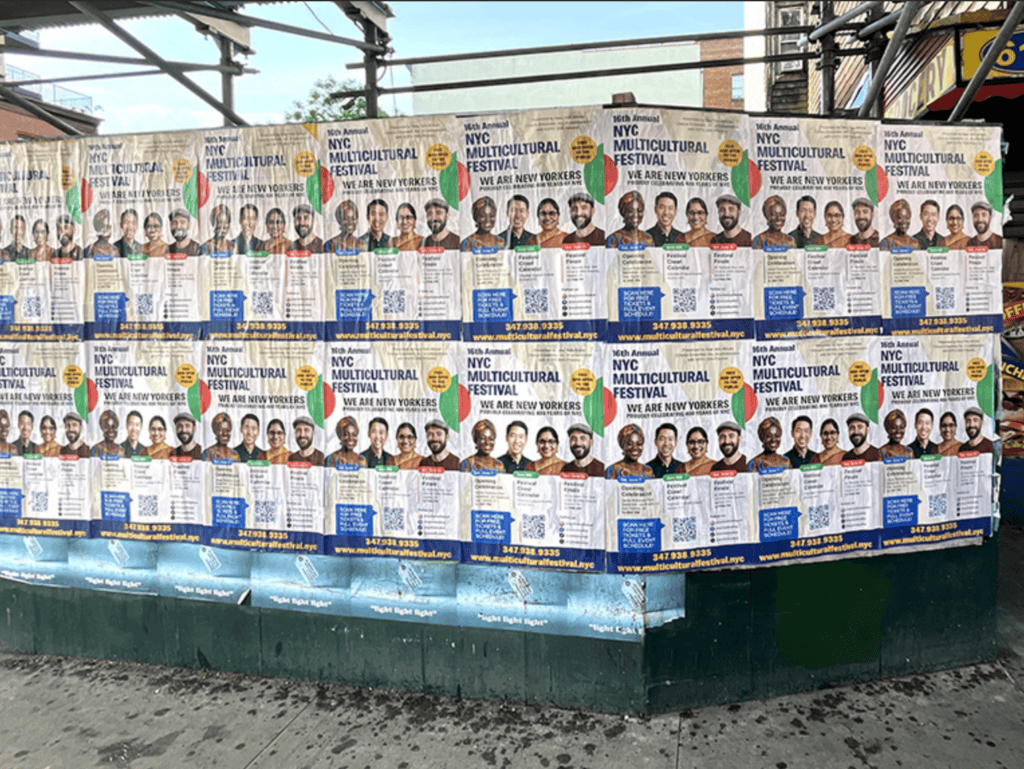
The brief comes in. The client wants to make a statement in the city. They want to be everywhere — or they want to own a neighborhood. Sometimes they’re not sure which. And that uncertainty is exactly where most city wheatpaste campaigns start to go sideways, because saturation and targeted activation are not two versions of the same thing. They are two fundamentally different strategies with different objectives, different cost structures, different audience realities, and different definitions of success.
Getting this choice right before the campaign goes up is the difference between a wheatpaste run that lands the way the brief intended and one that distributes a budget across a city without generating the specific kind of impact the campaign actually needed.
At American Guerrilla Marketing, we’ve executed city takeover wheatpaste campaigns at both ends of this spectrum — full-city saturation runs across multiple boroughs, and single-neighborhood targeted activations so concentrated that every relevant person in that demographic corridor saw the campaign multiple times in a single week. We’ve also run the hybrid in between. What we’ve learned from a decade of executed campaigns is that the choice between saturation and targeted activation is not about preference or scale — it’s about where your audience lives and what the campaign needs to accomplish.
Here is how to think about it.
City Saturation: What It Is
City saturation is exactly what it sounds like: a campaign that covers maximum geographic and demographic territory across a city to maximize total impression count and breadth of audience reach. In a saturation campaign, the placement strategy prioritizes coverage — putting the campaign’s creative in front of as many different people, in as many different neighborhoods, as possible within the campaign’s footprint.
In New York, a saturation campaign might place across Manhattan (Midtown, SoHo, Lower East Side, East Village), Brooklyn (Williamsburg, Bushwick, Crown Heights), and select Queens corridors — covering 10 to 15 distinct neighborhood clusters in a single run. In London, saturation might mean Shoreditch, Brick Lane, Brixton, Camden, Peckham, and parts of South Bank — enough coverage that a pedestrian moving through multiple neighborhoods over the course of a week encounters the campaign more than once in different contexts.
The defining characteristic of a saturation campaign is that breadth is the primary objective. The campaign is designed to reach a lot of people — ideally a lot of the right people — across a wide footprint. The success metric is total impressions and geographic reach, not depth of engagement with any specific segment.
Saturation campaigns require more placements, more logistics coordination, and more resources to execute than targeted activations. They also require more careful quality control to ensure that the campaign looks consistent and well-placed across a wide range of neighborhood types, not thin and scattered. A saturation campaign that goes up at full volume in three neighborhoods and then fades to a handful of mediocre placements in six others is worse than a well-executed targeted activation — it costs more and delivers less per placement.
When City Saturation Is Right
Saturation is the right approach when the campaign’s primary objective is breadth of awareness and the target audience is genuinely distributed across the city rather than concentrated in specific neighborhoods.
Product launches targeting broad consumer awareness. A beverage brand entering a new market for the first time. A consumer electronics launch aimed at a wide 18-to-40 demographic. A film or streaming release with general audience appeal. In each of these cases, the target audience isn’t concentrated in one neighborhood — they’re spread across the city, and the campaign needs to find them where they are rather than waiting for them to show up in one place.
Entertainment releases with general audience appeal. A major film opening, a streaming series launch, a music release targeting a broad demographic. When the creative is designed to generate mass awareness and the audience is the city’s general population, saturation is the tool for the job. The goal is impressions at scale, and targeted activation won’t get you there.
Brands establishing presence in a new market for the first time. When a brand is entering a city where they have no existing recognition, saturation creates the ambient presence that makes subsequent marketing more effective — people have seen the brand in multiple contexts, across multiple neighborhoods, before they encounter it in a retail setting or see a digital ad. That ambient familiarity is most efficiently built through coverage breadth.
Campaigns with a message that plays well across demographic contexts. Some creative is versatile enough that it generates genuine engagement regardless of the neighborhood where it appears. Saturation works better when the creative isn’t dependent on neighborhood-specific cultural resonance — when the message lands in Midtown the same way it lands in Williamsburg.
Saturation works best when: target audience is distributed broadly across the city, the campaign objective is maximum impression count and awareness breadth, the creative is versatile across neighborhood types, and the brand is entering a market for the first time.
Targeted Wheatpaste Activation: What It Is
Targeted activation concentrates the campaign’s entire presence in one neighborhood or venue type to maximize depth of impact with a specific audience. Where saturation spreads across a city, targeted activation goes deep in a specific territory — placing at every available high-quality surface in a defined zone, often enough times and in enough places that the campaign becomes a dominant visual presence in that neighborhood for the duration of the run.
In New York, a targeted activation for a streetwear brand might run exclusively in Williamsburg — placing on every relevant wall on Bedford Avenue and the surrounding blocks, on the building faces adjacent to the anchor venues in that neighborhood, and at the pedestrian corridors that the specific demographic target uses on Thursday through Saturday evenings. Nothing in Midtown. Nothing in SoHo. All of it in the one neighborhood where the audience the brand needs to reach is concentrated.
In Silver Lake in Los Angeles, a targeted activation for an independent record label might run across a six-block radius around Sunset Junction — dense enough that someone who frequents that area encounters the campaign from multiple directions, at multiple times of day, reinforcing the same message with the depth of exposure that saturation spread across a city can never achieve in any single location.
The defining characteristic of targeted activation is that depth is the primary objective. The campaign is designed to be inescapable for a specific audience in a specific geography — not to reach the broadest possible population, but to reach the right population intensely enough that the campaign registers and sticks.
When Targeted Activation Is Right
Targeted activation is the right approach when the campaign’s primary objective is depth of impact with a specific demographic and that demographic is geographically concentrated in the city.
Niche brand launches targeting a defined demographic. A streetwear brand running a launch campaign in New York that needs to land with the 18-to-28 creative and street culture demographic. That audience isn’t distributed evenly across the city — they’re concentrated in Williamsburg and parts of Lower East Side. Running across all of Manhattan dilutes the campaign’s presence in the neighborhoods where it matters and spends resources reaching audiences who aren’t the target. Concentrating in Williamsburg means the right people see the campaign multiple times in a single week, in their own environment, which is a fundamentally different kind of impression than a single exposure in a neighborhood they’re passing through.
Premium brands where breadth of visibility undermines credibility. A brand positioned at the premium end of its category can actually weaken its positioning by appearing too broadly across a city. Part of what makes a premium brand premium is the sense that it belongs to a specific context — that it’s present in the right places, not every place. Targeted activation in the neighborhoods that carry cultural authority for the brand’s positioning reinforces that. Saturation across the full city works against it.
Event marketing for a specific venue. If the campaign is driving attendance to an event or opening at a specific location, the most effective placements are the ones within walking and transit distance of that venue — saturating the area around the event rather than spreading coverage across the full city. A targeted activation centered on a Shoreditch gallery opening should concentrate in Shoreditch, Brick Lane, and the surrounding blocks, not split resources across Camden and Brixton where the audience is unlikely to change their plans for an event that isn’t in their neighborhood.
Campaigns where audience match rate matters more than total impressions. Some campaign objectives are better measured by the quality of the audience reached than by the total number of impressions. For a niche brand, a thousand high-quality impressions in front of the right demographic are worth more than ten thousand impressions spread across a broad population with low audience alignment. Targeted activation consistently outperforms saturation on audience match rate for campaigns with a defined demographic target that is concentrated in specific neighborhoods.
Targeted activation works best when: audience is concentrated in specific neighborhoods, depth of impact matters more than breadth of reach, premium or niche positioning would be diluted by overly broad visibility, or the campaign is anchored to a specific event or venue.
The Cost and Scale Difference
Saturation campaigns are larger, more logistically complex, and cost more to execute well than targeted activations of equivalent quality. That is not a reason to avoid saturation when it’s the right strategy — it’s a reason to understand what you’re choosing and why.
A city saturation run might require 300 to 600 pieces spread across 10 to 15 neighborhood clusters, with multiple installation crews running on coordinated schedules over two to three days. The logistics of quality control across that volume — ensuring that the campaign looks strong and well-placed in every neighborhood, not strong in three and thin in the rest — require more planning, more coordination, and more experienced field oversight than a targeted activation.
A targeted activation for the same city might run 150 to 250 pieces concentrated in one to two neighborhoods, with a tighter installation schedule and more placement density per block. The per-placement quality tends to be higher because operators can be more selective about surface and location when they’re not trying to cover the entire city. And the campaign’s visual impact in that specific territory is stronger because of the density of exposure — someone walking through Fairfax District or Williamsburg during a targeted activation runs into the campaign from multiple directions, at multiple points during their route, which creates a very different impression than a single exposure in a saturated citywide run.
The cost difference reflects these differences in scale and logistics. A saturation campaign costs more in absolute terms because it involves more pieces, more crews, more coordination, and more logistical complexity. A targeted activation can achieve higher quality per placement for less total spend, but it does not deliver the citywide coverage that saturation provides.
Neither is more cost-effective in the abstract. The cost-effectiveness of either approach depends entirely on whether it’s the right strategy for the campaign’s objectives.
How to Decide: The Two Questions
The choice between saturation and targeted activation comes down to two questions. Get clear answers to both, and the strategy choice follows logically.
Question 1: Where is your target audience physically concentrated in this city?
If your target audience is distributed broadly across the city — present in significant numbers in 8 to 12 different neighborhoods — saturation is the approach that reaches them where they are. If your target audience is concentrated in two to four specific neighborhoods — if you’re trying to reach the streetwear and street culture demographic that is dense in Williamsburg and not particularly dense in Midtown — targeted activation is the approach that reaches them with depth.
This question requires honest demographic specificity. “Young adults” are distributed across the city. “22-to-30, fashion-forward, culturally engaged, with spending habits aligned to premium streetwear” are concentrated in specific neighborhoods. The more specifically you can define your target demographic, the more clearly the geographic concentration question answers itself.
Question 2: What is the primary campaign objective — breadth of awareness or depth of impact?
Breadth of awareness means: as many relevant people as possible need to know this brand or product exists. The campaign is an introduction, not a conversation. Saturation is the tool for this objective.
Depth of impact means: the specific people who are most likely to act on this campaign need to see it multiple times, in their own environment, with enough frequency that it registers and creates genuine recall. Targeted activation is the tool for this objective.
Most campaign briefs contain elements of both. The discipline is in identifying which objective is primary — which one, if the campaign achieves it, counts as a success, and which one is secondary. The answer to that question determines the strategy.
The Hybrid Strategy: Anchored Activation
Between full saturation and single-neighborhood targeted activation, there is a hybrid approach that works well for brands with a defined primary demographic and some secondary reach goals. We call it anchored activation.
Anchored activation works like this: heavy placement concentration in one or two core neighborhoods where audience alignment with the campaign’s primary demographic is strongest, combined with a lighter presence — significantly fewer pieces, more selective placement — in two to three adjacent or secondary neighborhoods that extend reach into a broader population without diluting the core concentration.
In New York, an anchored activation for a streetwear brand might place 60% of pieces in Williamsburg and Lower East Side, with 40% spread across SoHo, Bushwick, and parts of Brooklyn that carry secondary audience relevance. The campaign is unmissable for the primary demographic in the core neighborhoods, while still establishing some presence in adjacent markets that might produce secondary reach.
In London, an anchored activation for a brand targeting the creative and fashion-forward demographic might concentrate in Shoreditch and Brick Lane as the primary territory, with a lighter presence in Brixton and Camden as secondary extensions. Shoreditch and Brick Lane carry the density of impact; Brixton and Camden broaden reach without turning the campaign into a full saturation run.
Anchored activation captures the depth and cultural credibility of targeted activation in the primary zones, while extending some of the reach benefits of saturation into adjacent neighborhoods — without the cost and dilution of full-city saturation.
Anchored activation is often the right answer for brands that have a clear primary demographic but also have legitimate secondary reach goals — brands that would benefit from both depth in the core territory and some presence in adjacent neighborhoods, but whose budget doesn’t support full saturation at the quality level the campaign requires.
Real Scenario 1: A Craft Beverage Brand Entering New York
A craft beverage brand — established in its home region, entering New York for the first time — wants to run a wheatpaste campaign to support the market entry. The brief asks for “strong presence in New York.” Our first question is whether that means breadth of presence or depth with the right audience.
The brand’s consumer is 25-to-40, urban, interested in quality ingredients and independent brands. That demographic is distributed across New York, but it’s more concentrated in some neighborhoods than others — Williamsburg, Park Slope, Fort Greene, Brooklyn Heights, Lower East Side, West Village, and parts of Astoria are all relevant. Midtown is less relevant. Staten Island is not relevant.
The saturation version: 400 pieces across 12 to 15 neighborhoods in Manhattan and Brooklyn. Coverage in SoHo, the East Village, Williamsburg, Bushwick, Crown Heights, Park Slope, West Village, Upper West Side, and several others. Total estimated impressions across the run are high. The brand appears throughout the city. Someone who lives in the West Village, works in Midtown, and goes out in Williamsburg will encounter the campaign in multiple contexts over the campaign’s two-week window.
This approach makes sense if the brand’s primary objective is broad market introduction — establishing ambient awareness across the full city before distribution rolls out. If the goal is “as many people as possible know this brand exists when the product appears on shelves,” saturation accomplishes that objective.
The targeted activation version: 200 to 250 pieces concentrated in Williamsburg, Lower East Side, and Park Slope. Heavy density in each of those three neighborhoods — enough placements that someone spending an afternoon in Williamsburg encounters the campaign from multiple directions. The campaign is essentially unmissable for the core demographic in those neighborhoods during the two-week window.
This approach makes sense if the brand’s primary objective is generating genuine enthusiasm and advocacy among the demographic most likely to become loyal early customers — the people who will talk about the brand, share it on social, and influence secondary adoption. A high-quality, dense presence in three neighborhoods where the core demographic is concentrated will generate more of that kind of response than a thinner presence spread across 15 neighborhoods.
Which one wins? It depends on the distribution strategy. If the product is launching in 200 locations across the city simultaneously, saturation makes sense — the audience is distributed because the distribution is distributed. If the product is launching in 30 carefully selected independent retail locations concentrated in specific neighborhoods, targeted activation in those neighborhoods is more coherent with the distribution strategy and will generate stronger results per placement.
For most craft beverage brands entering New York for the first time, the anchored activation approach — heavy in Williamsburg and Lower East Side, lighter extensions into Park Slope, Crown Heights, and West Village — captures the best of both. It builds genuine depth and cultural resonance in the neighborhoods where the core demographic is most concentrated, while extending enough reach to support distribution across a broader set of retail locations.
Real Scenario 2: The Same Brand Entering London
The same craft beverage brand, same consumer demographic, now entering London. The question of saturation versus targeted activation looks different here — because London’s geography is different from New York’s in ways that change the strategic answer.
London’s relevant neighborhoods for the 25-to-40, urban, quality-oriented consumer are geographically more spread out and more distinct in character than New York’s equivalent zones. Shoreditch, Brixton, and Camden are each strong candidates for the core target demographic — but they are separated by significant distance, they have distinct neighborhood cultures, and a campaign that spans all three reads differently to a London resident than a New York campaign spanning Williamsburg and Lower East Side.
In New York, the relevant neighborhoods form a loose geographic cluster that gives a campaign spanning several of them a sense of coherence — you can be in Williamsburg in the evening, walk to Lower East Side, and end up in SoHo without crossing major psychological barriers. The campaign feels like it belongs to a territory.
In London, Shoreditch and Brixton are on different sides of the city. A campaign that runs heavy in Shoreditch and also in Brixton and also in Camden is not activating a territory — it is running in three separate territories simultaneously, which more closely resembles saturation than targeted activation, even if the total piece count is modest.
The London case for targeted activation: Concentrate in Shoreditch and Brick Lane. These two neighborhoods represent the strongest concentration of the brand’s core demographic in East London, and they are geographically close enough that a heavy presence in both reads as a genuine neighborhood takeover rather than a fragmented multi-point presence. Someone who spends time in both Shoreditch and Brick Lane — which describes a large portion of the core demographic — will encounter the campaign with the density and frequency that creates genuine recall.
The London case for anchored activation: Shoreditch and Brick Lane as the primary concentration, with a secondary presence in Brixton and Camden. The primary territory delivers depth; the secondary presence extends reach to the segments of the core demographic that are based in South and North London. This is a reasonable approach if distribution is also rolling out in South and North London retail locations — the campaign presence aligns with where the product will be findable.
What doesn’t work in London: Spreading a modest piece count across Shoreditch, Brixton, Camden, Peckham, and Hackney in an attempt to cover all of them. This looks like saturation but functions as neither saturation (because the volume isn’t high enough to create genuine coverage breadth) nor targeted activation (because the piece count per neighborhood is too low to create the density that makes targeted activation work). It is the no-man’s-land between the two strategies, and it produces results that are weaker than either approach executed correctly.
For a craft beverage brand entering London, the on-the-ground recommendation from American Guerrilla Marketing field operators who have run campaigns in these neighborhoods: start with Shoreditch and Brick Lane as the core territory. If the brief and budget support it, add Brixton as a secondary extension. Leave Camden for a second phase unless there is a specific distribution or event reason to be there in phase one.
The Audience Concentration Factor
The underlying logic that drives the saturation versus targeted activation decision is audience concentration — where in the city your target demographic is physically located in the highest density.
City saturation works best when your target audience is distributed across the city. If you’re targeting a broad demographic — adults 18-to-45 with general consumer goods interest — that audience is present in meaningful numbers in every neighborhood of the city. Saturation reaches them across all those neighborhoods simultaneously and builds ambient awareness that can’t be achieved by concentrating in one zone.
Targeted activation works best when your target audience is concentrated in specific neighborhoods. If you’re targeting the streetwear and street culture demographic, they are not evenly distributed across New York — they are concentrated in Williamsburg, Fairfax District in Los Angeles, Wicker Park in Chicago. If you’re targeting the creative professional demographic in London, they are concentrated in Shoreditch and Brixton at much higher densities than they appear in, say, Croydon or Hammersmith. Concentrating your campaign in the neighborhoods where your audience is dense means that your placements are in front of the right people far more reliably than a citywide spread would achieve.
The audience concentration factor also affects what happens to your campaign’s cultural resonance. A brand with strong streetwear positioning, appearing throughout Midtown Manhattan alongside general retail advertising, looks different than the same brand appearing exclusively in Williamsburg and Lower East Side. Context is part of the message. Targeted activation puts your campaign in the environment that reinforces the brand’s positioning. Saturation puts it in every environment, including ones that are contextually neutral or slightly wrong for the brand.
This is not an argument against saturation — when saturation is the right strategy, the breadth of coverage is worth the loss of contextual precision. But for brands where the cultural context of their placements matters — premium, niche, or positioning-sensitive brands — the audience concentration factor is an argument for targeted activation or anchored activation over full-city saturation.
The Metrics: How Each Approach Gets Measured
Saturation and targeted activation are measured differently because they optimize for different outcomes. Trying to evaluate a targeted activation by the same metrics you’d use for saturation — or vice versa — will produce misleading conclusions about the campaign’s success.
Saturation metrics center on breadth:
- Total impressions across the full campaign footprint
- Geographic reach (number of neighborhoods, districts, or postal codes with campaign presence)
- Estimated total unique individuals exposed during the campaign window
- Coverage density (pieces per square mile across the target territory)
Targeted activation metrics center on depth and audience quality:
- Audience match rate (percentage of people walking past placements who fall within the target demographic)
- Dwell time at placement locations (how long people spend in proximity to the campaign)
- Frequency of exposure per person in the target demographic (how many times someone encounters the campaign over the campaign window)
- Contextual alignment (does the neighborhood environment reinforce the brand’s positioning?)
These are not better or worse metrics — they measure different things. A targeted activation in Williamsburg might generate one-fifth the total impressions of a citywide saturation run at the same budget. But if the target demographic is concentrated in Williamsburg, the activation generates far more high-quality audience exposures — the specific kind of exposure that drives the awareness and intent the campaign is designed to produce.
Saturation = total impressions and geographic reach. Targeted activation = audience match rate and dwell quality. Neither metric applies cleanly to the other strategy. Choose your success metric before you choose your strategy, and let the metric drive the choice.
Decision Framework
| Factor |
Points to Saturation |
Points to Targeted Activation |
| Target audience geography |
Distributed broadly across the city |
Concentrated in specific neighborhoods |
| Primary campaign objective |
Maximum impression count, breadth of awareness |
Depth of impact with a specific segment |
| Brand positioning |
Mass market, general consumer appeal |
Premium, niche, or positioning-sensitive |
| Campaign stage |
First entry into market, establishing presence |
Building depth with core demographic, launching to specific community |
| Distribution strategy |
Broad retail distribution across the city |
Concentrated retail presence in specific neighborhoods |
| Cultural context |
Creative works across diverse neighborhood contexts |
Creative lands better in specific cultural environments |
| Key success metric |
Total impressions, reach, geographic coverage |
Audience match rate, dwell quality, frequency to core demo |
| Typical city footprint |
10 to 15+ neighborhoods, 300 to 600+ pieces |
1 to 3 neighborhoods, 150 to 300 pieces at high density |
For most brands, the honest answer to these questions points to one of three outcomes: full saturation, targeted activation, or anchored activation. The anchored activation hybrid — heavy in one or two core neighborhoods, lighter presence in two to three secondary zones — fits many brand situations that don’t fall cleanly on either end of the spectrum.
What We Tell Clients Before the Campaign Goes Up
Before any city wheatpaste campaign — saturation or targeted — there are two things American Guerrilla Marketing field operators do that determine whether the strategy is correctly matched to the brief.
First, we walk the neighborhoods in the proposed campaign footprint. Not Street View. Not a map review. We walk the blocks, observe the pedestrian patterns at the times of day the target demographic is present, and assess the available placement surfaces against the campaign’s objectives. For a targeted activation, this means identifying the specific cluster of walls in the target neighborhood that will create the density of exposure the campaign needs. For a saturation run, this means confirming that the proposed neighborhood list actually includes enough quality placement surfaces to hold the planned piece count at the quality level the creative demands.
Second, we push back on briefs that don’t match the strategy to the objective. We’ve seen campaigns come in with saturation-style footprints and targeted-activation-style objectives — briefs that want to be everywhere in the city but also want to generate deep resonance with a specific demographic. Those two objectives are in tension. The right answer is usually anchored activation, but the right answer requires a conversation about what success actually looks like for this specific campaign, in this specific market, at this specific stage of the brand’s presence in the city.
That conversation — before the campaign goes up, not after — is where the strategic choice between saturation and targeted activation gets made correctly. And making it correctly is worth more to the campaign’s performance than any other single decision in the planning process.
American Guerrilla Marketing coordinates city takeover wheatpaste campaigns across the US from a single New York contact, with GPS-tagged, permissioned placements executed by certified field operators across our nationwide portfolio of media markets. Whether your brief needs city saturation, targeted activation, or an anchored hybrid — we’ve run them all, we know what each approach delivers, and we’ll tell you honestly which one fits your campaign.
Frequently Asked Questions
What is the difference between city saturation and a targeted wheatpaste activation?
City saturation covers maximum geographic and demographic territory across an entire city to maximize total impression count and breadth of reach. A targeted wheatpaste activation concentrates the campaign’s entire presence in one neighborhood or venue type to maximize depth of impact with a specific audience. Saturation is measured by total impressions and geographic reach. Targeted activation is measured by audience match rate and dwell time at placement. They are not two versions of the same approach — they are two different strategic tools for two different kinds of campaign objectives.
When should a brand choose city saturation over targeted activation?
City saturation works best when your target audience is distributed broadly across the city and the primary objective is maximum impression count and breadth of awareness. It’s the right choice for product launches targeting broad consumer segments, entertainment releases with general audience appeal, and brands entering a new market for the first time to establish citywide presence. If the goal is reaching as many relevant people as possible across a wide geographic footprint, saturation is the tool.
When does targeted wheatpaste activation outperform saturation?
Targeted activation outperforms saturation when the target audience is geographically concentrated in specific neighborhoods and depth of impact with that audience matters more than breadth of reach. A streetwear brand targeting the street culture demographic — concentrated in Williamsburg and Fairfax District — will generate stronger audience match rate and dwell quality through targeted activation than through the same budget spread across 12 neighborhoods. Premium brands, niche launches, and event marketing for specific venues typically benefit from targeted activation over saturation.
What is anchored activation and when does it make sense?
Anchored activation is a hybrid strategy: heavy placement concentration in one or two core neighborhoods where audience alignment is strongest, combined with a lighter presence in two or three secondary zones that extend reach without diluting the core campaign. It works best for brands that have a clear primary demographic concentrated in specific neighborhoods but also have legitimate secondary reach goals — or distribution that spans both the core territory and adjacent areas. For most mid-size brand campaigns, anchored activation captures the cultural depth of targeted activation while extending enough reach to support broader distribution objectives.
How does city geography change the saturation vs. activation decision?
Significantly. New York’s neighborhood clusters are geographically tighter than London’s, which means a New York campaign spanning Williamsburg and Lower East Side can read as a coherent territory. London’s neighborhoods — Shoreditch, Brixton, Camden — are more geographically separated and culturally distinct, so a campaign spanning all three looks more like saturation than targeted activation even at modest piece counts. Our field operators walk the proposed territory before campaign planning to assess how the geography affects the strategy choice, and we adjust the recommendation based on what we see on the ground — not what looks logical on a map.
How does American Guerrilla Marketing determine which strategy fits a campaign?
We ask two questions: Where is your target audience physically concentrated in this city? And what is the primary campaign objective — breadth of awareness or depth of impact with a specific segment? The answers to those two questions determine the approach. We then apply firsthand, boots-on-the-ground knowledge of the specific city’s neighborhood geography, pedestrian patterns, and placement surface quality to build a placement plan that matches the strategy to the objectives — whether that’s full saturation, targeted activation, or an anchored activation hybrid. We’ve been doing this for over a decade, and we’ll tell you honestly which approach your campaign needs before the first piece goes up.