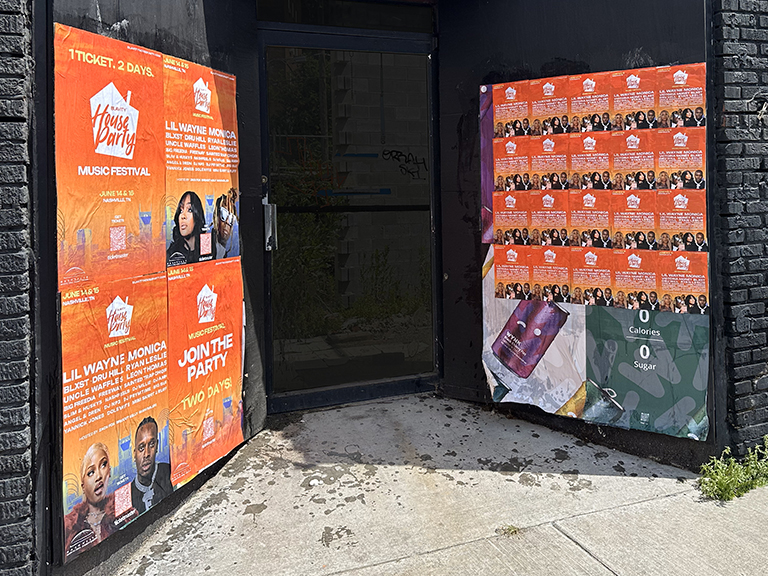
Wheat paste posting has defined the visual language of urban culture for decades, from hip-hop era New York to contemporary street art markets in Los Angeles, London, and Melbourne, and brands that understand this cultural context earn credibility that manufactured advertising never achieves.
Wheatpaste campaigns work because they put large-format creative in the physical path of your audience without the intermediary of a screen, an algorithm, or an ad network. The impression is direct: your creative, in your audience’s physical environment, at a scale that demands attention. American Guerrilla Marketing builds wheatpaste programs around the location intelligence, vendor relationships, and field execution expertise that separates campaigns that generate genuine brand recall from campaigns that simply post paper.
What makes wheatpasting worth understanding in depth is the gap between campaigns that generate impressions and campaigns that generate results. The best campaigns are built around audience movement patterns, not just surface availability, they place messages where the right people walk, dwell, and return repeatedly, which drives the frequency that builds real brand memory. The format also benefits from organic amplification: quality street-level work in high-visibility environments gets photographed and shared, multiplying the original media investment without additional spend. Learn more about LED billboard trucks. Learn more about poster campaigns campaigns. Learn more about professional wheatpasting campaigns.
This article covers the tactical and strategic fundamentals of wheatpasting, how campaigns are structured, what execution looks like in practice, how to evaluate format options against objectives and budget, and what distinguishes campaigns that move the needle from campaigns that just spend money. Whether you’re planning a first activation or optimizing an existing street-level program, the information below gives you a grounded framework for making smart decisions and getting measurable outcomes.
What wheat paste posting feels like on the street
In big cities, wheat pasting and permitted poster runs sit inside a constant visual argument. Your work becomes one more voice fighting to be heard among murals commissioned by developers, construction wraps advertising luxury condos, limited-edition streetwear drops with collector appeal, digital screens cycling through fifteen advertisers per minute, window vinyl from the latest restaurant opening, and the next crew that will arrive tomorrow night with their own bucket and their own message.
In secondary markets, the wall can feel strangely available. Not empty, exactly, but open. A single clean placement can read like an event rather than background noise. The poster has room to breathe. Pedestrians actually stop because something new appeared, not because they’re trained to filter stimulus at New York pace. This fundamental difference in visual density creates entirely different strategic requirements.
That difference shapes everything: where you place, when you install, how many posters constitute “enough,” how aggressive your design needs to be, whether you need to refresh placements weekly or monthly, and whether your creative should whisper or shout. The medium might be identical, but the message delivery system operates under completely different physics.
Understanding this distinction separates campaigns that generate genuine cultural impact from waste. The same poster that dominates a secondary market can disappear entirely in a major metro without adjustments to placement density, installation timing, and creative contrast. The street doesn’t grade on effort. It grades on whether anyone actually noticed.
Major cities: density turns good locations into a contact sport
Major cities deliver exactly what every advertiser claims they want: heavy pedestrian volume measured in thousands per hour rather than hundreds per day, nonstop cultural activity that creates reason for people to be outside and engaged, and countless moments when people are on foot, moving slowly, and looking around rather than sealed inside vehicles. If you’ve ever watched a busy corner in SoHo or Williamsburg “refresh” its entire audience every time a crosswalk signal changes, you understand why street-level marketing still matters even with all the screens in the world.
The tradeoff arrives as poster competition. In genuinely dense neighborhoods, the best walls are either already layered three-deep with competing campaigns or actively watched by property owners and enforcement crews. High-visibility spots get cleaned by building maintenance, covered by the next campaign within 48 hours, tagged by graffiti writers asserting territorial claims, or sandwiched between other posters until your message becomes unreadable fragments. Your poster isn’t competing with “no ad.” It’s competing with ten other posters, plus a giant LED display, plus a muralist on a scissor lift, plus the pedestrian’s well-trained instinct to keep walking.
After running dozens of installation nights in top-tier markets, a pattern becomes obvious: success rarely involves finding one perfect wall and calling it done. It requires building a smart sequence of walls that repeats the message at human walking speed, creating enough frequency that the campaign penetrates conscious awareness rather than sliding past as undifferentiated visual texture.
Major-market realities reveal themselves quickly once you’re on the ground. Fast turnover means your posters might last three days in high-competition zones versus three weeks in secondary markets, requiring either larger initial runs or planned refresh cycles. Crew coordination becomes complex because you’re working around other installation teams, late-night delivery schedules, and neighborhoods where unfamiliar faces attract attention. Repeat exposures become mandatory rather than optional because single impressions vanish into the noise. High visual clutter forces your design to compete with literally everything else fighting for the same eyeballs. Tight routes matter because pedestrians in major metros follow surprisingly narrow paths between subway exits, coffee shops, offices, and evening destinations.
That list sounds purely operational, but it fundamentally changes creative outcomes. In a major city, subtle designs get swallowed whole. Your typography needs to read from across the street, at an angle, while someone’s walking at four miles per hour. Your color contrast needs to survive low light, glare from wet pavement, car headlights, and old layers of wheat paste underneath that change how colors appear. Your core message needs to land in under two seconds because that’s the attention window you actually get, not the fifteen seconds you’d prefer.
The advantage of major markets isn’t efficiency, it’s cultural velocity. When a wheat paste campaign works in New York, Los Angeles, or Chicago, it enters conversation quickly. People photograph it. Social accounts amplify it. Journalists recognize it as part of the street vernacular. That cultural acceleration justifies the higher execution complexity and cost, but only if the campaign actually breaks through the density to register as signal rather than noise.
Secondary markets: fewer impressions, higher share of attention
Secondary market advertising can look modest on paper because raw foot traffic numbers are lower. A busy block in Portland, Maine delivers a fraction of the pedestrian volume you’d see in Portland, Oregon, and Portland, Oregon delivers a fraction of what you’d see in Manhattan. Yet on the ground, the poster often has more “room” to perform. Less clutter means higher share of attention. Pedestrians who aren’t filtering constant stimulus actually stop and read. Your campaign becomes a neighborhood event rather than one voice in a chorus of hundreds.
The psychological shift matters more than the impression count suggests. In major metros, people develop sophisticated filtering mechanisms to avoid stimulus overload. They’ve learned to unsee most visual content. In secondary markets, that filtering mechanism is less developed because it’s less necessary. A new poster is actually new, not just “new installation replacing yesterday’s campaign.” This creates opportunity for depth over breadth, message complexity over message volume.
Secondary markets also offer placement advantages that major metros can’t match. The best walls are more accessible because fewer campaigns are competing for them. Property owners are more likely to grant permission because wheat paste advertising isn’t a daily annoyance. Enforcement tends to be lighter because cities have other priorities and the medium hasn’t become a significant complaint source. Installation crews can work less covertly, with less time pressure, resulting in cleaner application and longer poster life.
The strategic mistake many marketers make is treating secondary markets as “practice runs” for major market campaigns or simply scaling down their big-city playbook. That approach wastes the fundamental advantage these markets offer: the ability to own visual presence in specific neighborhoods rather than fighting for fractional attention in oversaturated districts. A well-executed secondary market campaign with sixty strategic placements can generate more genuine engagement than a major metro campaign with three hundred placements competing for survival.
Budget efficiency shifts dramatically in secondary markets. The same investment that produces marginal awareness in a major city can create dominant presence in a secondary market. Installation costs are lower because crews work in less time-sensitive conditions. Poster longevity is higher because weather patterns and removal rates are more favorable. The cost-per-meaningful-impression often favors secondary markets despite lower absolute numbers.
This doesn’t make secondary markets “better” than major metros, it makes them different, requiring different strategy, different creative approaches, and different success metrics. Brands that understand this distinction can use secondary markets not as afterthoughts but as intentional strategy for building regional strength, testing messages before major market deployment, or cultivating authenticity that major metro saturation can’t deliver.
Placement changes block by block, not city by city
“Placement” sounds like a simple checklist: high traffic, good sightlines, repeat pedestrian paths. The street doesn’t behave that neatly. In major metros, placement becomes a geometry problem involving sight angles, light conditions at different times of day, competing visual elements, pedestrian flow patterns that change between morning, lunch, evening, and weekend, and the three-dimensional reality of how people actually move through space versus how maps suggest they should.
You want posters visible from a distance to attract attention, but also placed where natural stopping points or slower movement allows people to actually read the message. That combination is surprisingly rare. A wall with perfect visibility from 100 feet away might be positioned where everyone’s walking at full speed toward a subway entrance. A wall positioned at a natural stopping point might be blocked by parked delivery trucks fourteen hours a day. These micro-factors determine whether a placement succeeds or fails, and they change block by block.
Timing is not universal, it’s local behavior
Timing is where experienced wheatpasting teams separate from “print and pray” operations. A poster is a physical object that degrades, gets covered, and competes with yesterday’s layers. Timing is how you protect your investment from those realities. It’s the difference between your campaign appearing during peak relevance and your posters getting buried under someone else’s launch before your audience even sees them.
Installation timing involves multiple overlapping considerations. There’s the time of day when crews physically install posters, typically late night or early morning when foot traffic is minimal, enforcement is lighter, and crews can work efficiently without constant interruption. There’s the relationship between installation date and campaign launch, installing too early risks removal or coverage before your message needs to be seen, while installing too late means missing critical early awareness windows. And there’s the rhythm of competitive activity, if you know three other campaigns are installing this week, you need to either go first to establish presence or go last to avoid being covered.
Weather timing creates another layer of complexity. Installing wheat paste posters immediately before rain is wasteful because moisture weakens adhesion and can destroy posters before they generate impressions. But installing during a forecast dry spell means your posters last longer, generating more total impressions per installation. Professional crews monitor weather patterns and adjust installation schedules accordingly, sometimes shifting entire campaign phases by days to optimize conditions.
Seasonal timing affects both execution and reception. Summer installations face challenges from heat that can affect paste consistency and application quality, but benefit from higher pedestrian activity and longer daylight viewing hours. Winter installations deal with cold that complicates paste mixing and application, plus fewer pedestrians willing to slow down and engage, but posters often last longer due to less competition and slower enforcement cycles. The seasonal calculation changes by climate zone, what works in Southern California fails in Chicago.
Event timing represents perhaps the most strategic dimension. Wheat paste campaigns synchronized with cultural events, product launches, concert tours, or festival schedules can use existing attention and foot traffic patterns. A campaign installed the week before a major music festival in a specific neighborhood can intercept relevant audiences during heightened engagement periods. But event timing requires precision, install too early and your message fades before the event, install too late and you miss the anticipation phase when people are most receptive.
The phasing of multi-week campaigns also requires timing strategy. Rather than installing all posters simultaneously, sophisticated campaigns phase installations across weeks, creating sustained presence that refreshes as earlier placements degrade. This approach maintains visibility longer and adapts to what’s working, if certain placements or neighborhoods are performing particularly well, subsequent phases can concentrate there. Phasing turns a finite poster inventory into extended campaign presence.
Scale and production: “more posters” is not always the answer
Big cities can absorb volume. Secondary markets can be overwhelmed by it. That’s the simplest way to think about scale. In a major metro, a modest run of fifty posters can disappear into the noise unless those fifty posters are placed with surgical precision along high-frequency pedestrian routes. In a secondary market, fifty posters distributed across a downtown district can create saturating presence that feels inescapable. The same quantity produces opposite outcomes based entirely on density context.
Production scale also determines creative flexibility. Large-format posters (40×60 inches or bigger) make strong statements but limit how many locations you can cover with a fixed budget. Smaller formats (18×24 inches) allow broader distribution but require either bolder design or concentrated placement patterns to generate equivalent impact. The production decision should follow placement strategy, not the reverse, determine where and how you need to be seen, then produce accordingly.
Print quality becomes a scaling consideration that many campaigns underestimate. Wheat paste posters will absorb moisture, get handled during installation, potentially layer over textured surfaces, and exist in uncontrolled outdoor conditions. Cheap printing on lightweight paper saves upfront costs but results in posters that tear during application, become translucent when wet, or fade within days. Professional campaigns use heavier stock (100lb text minimum), weather-resistant inks, and sometimes seal posters with clear wheat paste layers for extended durability. These production details directly affect impression longevity and campaign ROI.
The production timeline also shapes campaign effectiveness. Rush printing can introduce quality problems, limit paper stock options, and increase costs. Planning production cycles around campaign timing requirements rather than forcing campaigns to launch when printing happens to be complete ensures installations occur during optimal windows. This seems obvious but gets ignored constantly when internal deadlines drive decisions instead of market realities.
Inventory management becomes complex at scale. You need enough posters to execute the planned installation plus reserves for damage, enforcement losses, and potential expansion if certain placements overperform. But over-producing creates waste, posters printed for specific campaigns rarely work for future initiatives, and storing large quantities is impractical. The production quantity calculation should account for expected attrition (typically 15-25% depending on market), planned refresh phases, and a strategic reserve (10-15%) without creating significant excess.
Some campaigns benefit from production variation, printing multiple creative versions that can be mixed in installations to create visual rhythm, A/B tested across neighborhoods to identify stronger performers, or used sequentially to evolve messaging over multi-week campaigns. This approach requires larger production runs but can significantly increase campaign effectiveness by avoiding creative fatigue and allowing optimization based on real-world performance.
Frequently Asked Questions
What is wheat paste posting and how does it work?
Wheat paste posting is a street-level advertising technique that uses water-based adhesive to apply large-format paper posters directly to urban surfaces. American Guerrilla Marketing plans routes based on audience movement patterns, applies materials during off-peak hours, and selects high-visibility surfaces in neighborhoods where target consumers live, work, and gather.
How long do wheat paste posters last on city streets?
Wheat paste poster longevity varies by city, surface, weather, and enforcement. In major metros with active cleaning crews, installations may last 3–10 days. In secondary markets with lower visual competition, posters can remain visible for 2–4 weeks. Professional campaigns plan phased refresh schedules to maintain presence throughout the campaign window.
Is wheat paste posting legal?
Legal status varies by municipality and surface. Most cities prohibit posting on public property without permits, though enforcement varies significantly by neighborhood and market. American Guerrilla Marketing operates legal permitted poster campaigns in addition to managed placements, and works with clients to design programs that balance coverage, compliance, and budget.
How much does a wheat paste posting campaign cost?
Wheat paste campaign costs depend on market size, number of locations, poster dimensions, and campaign duration. Entry-level city campaigns typically start in the low-to-mid thousands for a meaningful footprint. American Guerrilla Marketing builds custom programs scaled to budget, with transparent breakdowns of production, placement, and field execution costs.