Every effective guerrilla marketing campaign starts with the same unglamorous step: someone walks the neighborhood. They take notes. They photograph walls. They stand at corners and count foot traffic. They make decisions about which specific locations are worth committing to and which aren’t. That process — unglamorous, time-consuming, and absolutely non-negotiable — is location scouting.
Guerrilla marketing gets talked about in terms of tactics: wheatpaste campaigns, street teams, pop-ups, sticker placements, projection advertising. But tactics without location strategy are random. The difference between a guerrilla campaign that generates real cultural traction and one that disappears into the urban environment unnoticed is almost always the quality of the location work behind it.
This guide covers the full scouting process as we run it at AGM — from initial campaign brief to confirmed location map. It’s a practitioner’s guide, not a theoretical one. If you’ve run these campaigns before, parts of this will validate what you’re already doing. If you’re new to the process, this gives you a working framework built from experience in dozens of markets.
Starting Point: The Campaign Brief
Location scouting doesn’t start with walking — it starts with understanding the campaign well enough to know what you’re looking for when you do walk. Before any scout, we need to know:
- What is the campaign’s primary audience — age, interest profile, income, geography within the city?
- What neighborhoods have the highest concentration of that audience?
- What is the campaign format — poster size, format, single images or multi-panel assemblies?
- What is the campaign duration — how long do placements need to survive?
- Are there any geographic constraints — proximity to a venue, event, retail location, or transit hub?
- What is the legal risk tolerance of the brand — are we talking permitted walls only, or is the brand comfortable with the more organic end of the spectrum?
Those answers don’t just help us pick neighborhoods. They shape every wall evaluation decision during the scout itself.
Phase One: Neighborhood Selection
The first filter is geographic. Before we walk a single block, we identify which neighborhoods in the target city match the campaign’s audience profile. This narrows a city of millions of potential surfaces down to a manageable list of candidate areas.
Matching Audience to Neighborhood
Cities have demographic texture. New York has dozens of distinct neighborhood personalities — Williamsburg for 25-35 year old creatives with disposable income, Bushwick for a younger, more underground arts audience, Crown Heights for a culturally active, community-oriented demographic, the Lower East Side for nightlife and fashion-forward foot traffic, SoHo and Nolita for higher-income consumers who engage with premium brands.
Los Angeles maps differently. Silver Lake carries a similar profile to parts of Williamsburg — young professionals with creative-industry leanings. Fairfax is streetwear and sneaker culture. Echo Park has strong arts and music scene density. DTLA’s Arts District attracts a mixed creative and gallery crowd. Melrose attracts fashion and entertainment industry foot traffic.
Matching the campaign’s audience to the right neighborhoods before you start walking is the most important decision in the entire scouting process. Get this wrong and nothing else you do during the scout matters.
Building the Candidate Neighborhood List
Once we’ve identified 4-6 candidate neighborhoods, we prioritize by density — neighborhoods with more usable walls per square block let you achieve your placement target more efficiently. Then we sequence the scout walk to minimize travel time between sites while maximizing coverage within each neighborhood.
A well-planned scout route through a dense neighborhood like Williamsburg or Silver Lake can evaluate 6-10 candidate blocks per hour on foot. A poorly planned route through the same area might cover 3-4 blocks in the same time due to backtracking and inefficient sequencing.
Phase Two: The Field Scout
The field scout is where decisions get made. You walk. You look. You evaluate. You document. It is physically demanding and mentally demanding at the same time — you need to be observant about multiple variables simultaneously while keeping track of where you’ve been and where you’re going.
What to Carry
Experienced scouts travel light. A phone with a good camera and GPS geotagging enabled is the minimum kit. Many operators carry a secondary device — a tablet or a second phone — dedicated to note-taking, so photos and notes don’t get mixed in the same app. A measuring tape for getting actual dimensions at key sites. A notepad and pen as a backup that never loses battery. Comfortable shoes. That’s it.
The Walking Rhythm
Move at pedestrian pace, not tourist pace. Walk the sidewalk the way a resident does — purposefully, not slowly. This gives you the same experience of the walls that a regular pedestrian has: you see what’s visible at normal walking speed from a normal approach angle, not what you see when you’re standing directly in front of a wall staring at it. Many placements that look great at close range are nearly invisible to someone walking at a normal pace 20 feet away.
The Evaluation Sequence
At each candidate wall:
- Assess sight lines first — from the pedestrian approach, not from directly in front
- Move to the wall and evaluate surface texture, condition, and dimensions
- Check for competing content, murals, or sensitive contextual elements
- Evaluate access for installation
- Check the surrounding environment: businesses, traffic type, nearby obstructions
- Make a decision: confirmed, conditional, or eliminated
- Document immediately before moving on
The sequence matters. Starting with surface quality before checking sight lines leads scouts to fall in love with walls that pedestrians never actually see clearly. Lead with visibility — that’s the purpose of the placement. Surface quality only matters if the sight lines work.
Phase Three: Post-Scout Filtering
After the field scout, you have a raw list of candidate sites — some confirmed, some conditional, some eliminated. The post-scout filtering process takes that raw list and builds the final campaign map.
Applying the Full Criteria Matrix
Review every confirmed site against the full campaign criteria: audience alignment, format compatibility, campaign duration survivability, and legal/permission status. Sites that pass all criteria go to the final map. Sites that pass some criteria but not all get flagged for decision — use them if you’re short on confirmed sites, or cut them if you have enough quality options.
Checking for Geographic Distribution
Plot the confirmed sites on a map and review their distribution. Are they clustered in one neighborhood, leaving others in the target area uncovered? Are there gaps where the campaign audience is active but you have no placements? Geographic distribution affects campaign reach — if all your placements are on three adjacent blocks, you’re reaching the same people multiple times rather than reaching a broader audience once or twice.
Ranking by Priority
Not all confirmed sites are equal. Rank them by quality — a composite score based on foot traffic, visibility, surface quality, and audience alignment. The highest-ranked sites get booked first. Lower-ranked sites serve as alternates in case something falls through before installation.
Campaign-Specific Scouting Variations
The core scouting process applies to all guerrilla campaign types, but specific formats require adjustments to the standard approach.
Wheatpaste Campaigns
Wall quality criteria are the primary filter, followed by foot traffic and sight lines. Pay particular attention to moisture exposure and surface porosity. Wheatpaste campaigns on surfaces with high moisture exposure degrade faster and require more frequent maintenance. Know this before committing a placement.
Street Team Activations
Location scouting for street teams focuses on foot traffic volume, dwell time (how long do people stay in this space), and audience concentration. A corner outside a transit entrance has high volume but low dwell time — people are moving through, not stopping. A plaza, park entrance, or outdoor seating area has lower volume but much higher dwell time — better for conversations and extended engagement. Depending on whether the campaign goal is reach or depth, different locations serve different purposes.
Projection Advertising
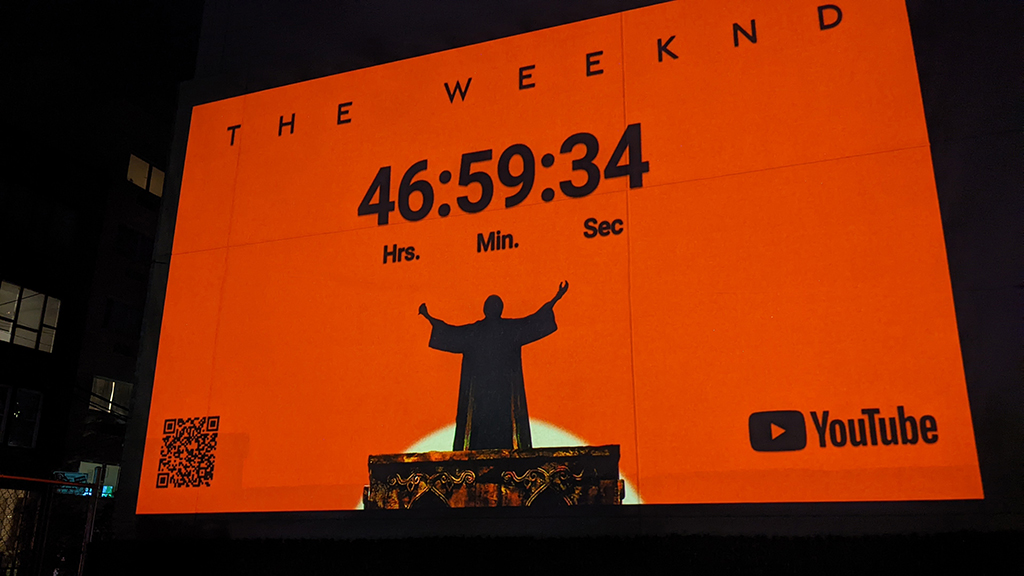
Projection campaigns require scouting for surface flatness and size (larger than standard wheatpaste surfaces), power access or battery logistics, ambient light levels at night (city glow competes with projector output), and clear projection paths without pedestrian or vehicle obstruction. These are technically demanding placements with higher logistical requirements, and the scout must assess all of them.
The Role of Local Knowledge
Maps and data only go so far. Local knowledge — knowing a specific market from years of working it — is genuinely irreplaceable. An operator who has run campaigns in Bushwick 40 times knows which property managers keep their walls clean and which don’t. They know which blocks are slower on weekdays versus weekends. They know which intersections have irregular traffic patterns due to road closures or recurring events. None of that is on any map.
For markets we don’t know well, we build local knowledge systematically: longer pre-scouts using Street View and local photo archives, consultation with local operators and artists who work the market, and on-the-ground time before the main campaign scout. In international markets, we work with local partners who bring the market-specific knowledge we haven’t had time to build ourselves.
The Full Scout Walk: What a Professional Field Day Actually Looks Like
Talking about location scouting in the abstract is useful; understanding what a professional field day actually looks like makes it concrete. Here’s how AGM’s scouts approach a typical market day in a city like New York or Chicago.
Morning: Priority Corridor First
The walk starts in the highest-priority neighborhood, at the time of day when foot traffic most closely matches the campaign’s target audience profile. For a campaign targeting a creative professional audience in Williamsburg, that’s a 9-11am start on Bedford Avenue, catching commuters and local residents before midday. The scout walks from the agreed starting point (usually a transit stop — the L train at Bedford Avenue is the natural starting point for Williamsburg scouts) and moves systematically through the priority blocks, photographing every viable surface, entering GPS and notes in the field doc.
The pace matters. An effective scout isn’t rushing. At each viable surface, the scout stops, evaluates for 2-3 minutes, takes the required photo set, enters data, and moves on. Rushing through evaluations produces incomplete assessments. Walking too slowly means covering fewer blocks in the available time. A good field scout pace is roughly 8-12 wall assessments per hour in a dense urban corridor — fast enough to cover significant ground, slow enough to do each assessment properly.
Midday: Extending into Secondary Corridors
After completing the priority corridor, the scout extends into adjacent and secondary corridors. In Williamsburg, that means side streets off Bedford — South 4th, North 5th, Grand Street — and then moving toward Metropolitan Avenue. In Chicago’s Wicker Park, it means working north from Milwaukee Avenue along Damen and Western. These secondary corridors often have lower foot traffic but also lower competition, and they frequently contain better surfaces than the main corridor because they’ve received less attention from other operators.
The secondary corridor walk also serves a verification function: comparing what was expected from the pre-scout digital research against what’s actually there. Surfaces flagged in Street View often look different in person. New construction, removed buildings, changed street conditions — field time corrects the pre-scout picture.
Afternoon: Documentation and De-Brief
The final hours of a scout day go to documentation cleanup and de-brief. Photos get organized by location ID if they haven’t been already. Any location records with missing fields get completed from memory while the scout is still fresh. The confirmed location list gets reviewed against the campaign brief criteria: are there enough locations in each target neighborhood? Is there geographic distribution across the full campaign area? Are any of the confirmed locations too close together to function as distinct placements?
If the answer to any of these questions reveals a gap, the afternoon is the right time to identify it and plan a return visit or extend the next day’s walk to fill it. Discovering campaign-map gaps three days after the scout, when everyone has moved on to production planning, creates schedule disruption. The de-brief review prevents that.
A well-executed guerrilla marketing location scout in a dense urban market covers 8-15 candidate blocks per day, evaluates 25-40 individual surfaces, and confirms 12-20 for the final campaign map. The ratio of candidate blocks evaluated to surfaces confirmed varies by market — dense creative corridors like Williamsburg’s Bedford Ave or Bushwick’s Wyckoff Ave have higher confirmation rates than markets with fewer established campaign surfaces.
The complete location scouting process — from brief to confirmed campaign map — typically spans 5-10 working days for a single-city campaign: 1-2 days of digital pre-scout and planning, 2-4 days of field scouting, and 1-2 days of documentation, filtering, and brief production. Multi-city campaigns scale linearly per market plus coordination overhead. Operators who try to compress this timeline — scouting and confirming locations in a single day for a major campaign — consistently produce lower-quality location maps than those who allow the full process to run. Scouting is not a task that responds well to speed pressure. It requires methodical coverage and careful assessment, which takes the time it takes.
What Separates a Real Scout From a Fast Walkthrough
The difference between a serious scout and a quick walkthrough is usually the quality of the comparisons. A real scout does not just collect locations. It ranks them, explains the tradeoffs, and shows why one wall should win over another if the goal is reach, repetition, cultural fit, or route efficiency. That ranking work is what gives the campaign a backbone instead of a pile of observations.
It is also what makes the final recommendation more persuasive. When the route can be explained in terms of audience behavior, visibility, access, and timing, the client can see that the choice was deliberate. That confidence tends to carry through the rest of the campaign, from production decisions to post-launch reporting.
Final Route Review Before the Campaign Goes Live
Before a team locks guerrilla marketing location scouting, the final review should force every recommended location to answer the same set of questions. Does the audience fit the campaign goal, does the wall read clearly from the direction people actually travel, does the timing window match when the crowd is there, and does the route still make sense once crew movement and documentation time are accounted for? That last review is where weak locations usually fall away. It is also where stronger routes become easier to defend because every stop has a specific reason for being there.
That review should also account for what happens after installation. Some locations look strong on scout day but create unnecessary maintenance, replacement, or reporting friction once the campaign is active. Others are easier to service, easier to document, and more likely to stay visually clean for the full run. When those operational details are weighed alongside visibility, the final plan gets better. It stops being a list of interesting walls and becomes a route that the client can approve with confidence and the field team can execute without improvising half the job in real time.
Frequently Asked Questions
What is guerrilla marketing location scouting?
Guerrilla marketing location scouting is the process of identifying, evaluating, and documenting physical locations where unconventional marketing campaigns will be executed — including walls for wheatpaste campaigns, surfaces for sticker placements, high-traffic corridors for street teams, and activation spaces for pop-up experiences.
How is guerrilla marketing scouting different from traditional OOH scouting?
Traditional out-of-home advertising uses permitted inventory — billboards, transit ads, bus shelters — that is pre-approved and priced. Guerrilla marketing scouting identifies organic, often non-permitted surfaces and spaces in urban environments that have high audience concentration without the cost structure of formal OOH channels.
Do you need a professional to scout locations for a guerrilla campaign?
Not always, but in markets you don’t know well, professional scouting saves significant time and avoids costly mistakes. A scout who has worked a market 30-40 times knows which walls last, which get cleaned, and where the foot traffic actually goes — knowledge that takes years to build from scratch.
How do you evaluate foot traffic for a guerrilla campaign location?
Count pedestrians passing within the sight line of the location during a defined time window — 30 minutes to an hour at peak and off-peak periods. Note traffic type (commuters, residents, shoppers, tourists) and directionality. The goal is to know exactly who walks past and when, not just whether people exist in the general area.
What’s the biggest mistake in guerrilla marketing location scouting?
Choosing locations based on aesthetics rather than audience alignment. A visually interesting wall in the wrong neighborhood reaches the wrong people. Scouting should start with audience and work outward to locations, not the reverse. A campaign for a streetwear brand that places on beautiful walls in SoHo — when the actual audience lives and moves through Bushwick and the LES — will generate technically good placements with poor audience delivery. Audience-first scouting starts with identifying where the target demographic actually spends time, then finding the best available surfaces in those zones. That sequence is non-negotiable. Every other scouting variable is downstream of getting the geography right for the audience.