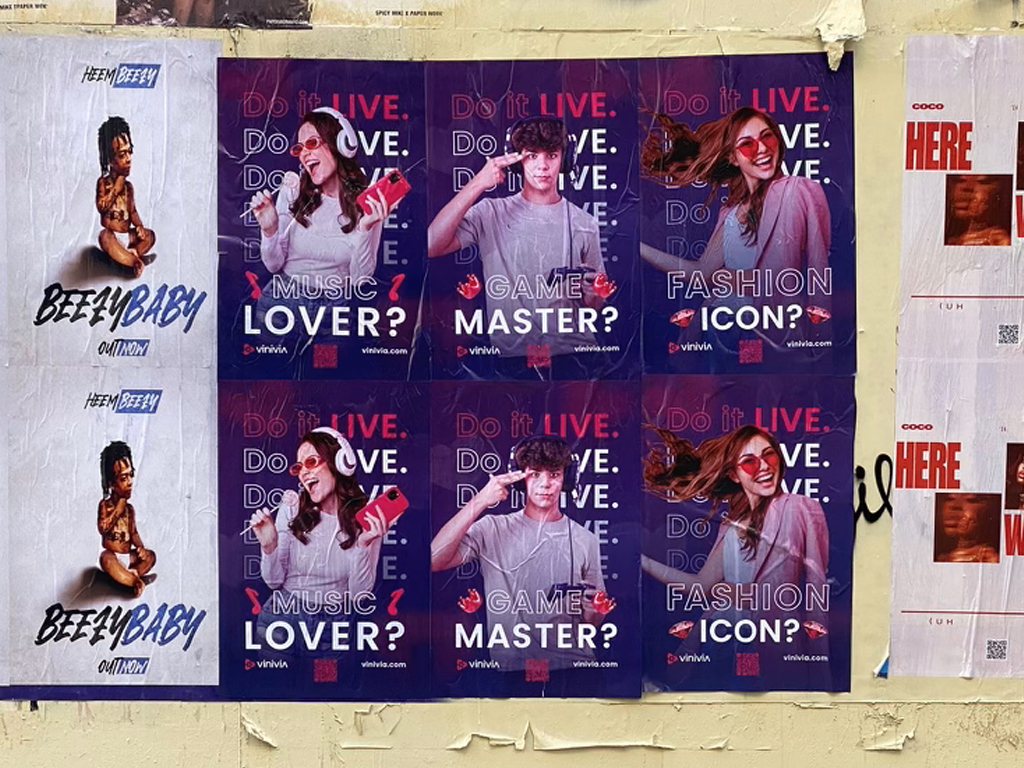
Every major streaming platform now allocates part of its launch budget to physical street advertising. That might seem backwards — companies that exist entirely online choosing to put paper on walls — but the logic is sound. Streaming platforms are not selling access to content. They are selling cultural relevance, and cultural relevance lives in neighborhoods before it lives on screens.
Flyposting for streaming platforms has become one of the most visible tactics in entertainment marketing. When a show’s imagery appears overnight across dozens of walls in New York, Los Angeles, or Chicago, it sends a signal to the press, to influencers, and to anyone who photographs it and shares it: this launch is an event. That earned attention is worth far more than the cost of printing and posting the paper.
American Guerrilla Marketing executes flyposting campaigns for streaming content launches, returning series, film releases, and platform brand moments across 50+ U.S. markets. Our team handles printing, location scouting, installation, and GPS-tagged photo documentation so clients have proof of performance for every placement.
Why Streaming Platforms Use Physical Advertising in a Digital World
The counterintuitive move makes perfect sense when you think about what flyposting communicates in 2026. Everybody already has the streaming apps. A poster for a Netflix series in the Williamsburg neighborhood of Brooklyn is not intended to explain what Netflix is or direct people to sign up. It’s intended to claim physical space in the cultural environment where the show’s target audience lives and moves.
Streaming platforms compete for cultural conversation, not just viewing hours. A show that becomes something people talk about — at work, in group chats, in editorial coverage — is worth more to a platform than a show with equivalent viewing numbers that generates no discussion. Physical street campaigns accelerate that conversation by creating real-world touchpoints that prompt photographs, social media posts, and press coverage.
Digital advertising has a saturation problem. Ad blockers, skip functions, and algorithmic banner blindness all suppress effectiveness. A flypost encountered unexpectedly on a wall in a neighborhood someone actually visits is noticed differently than a served impression. That difference is what makes the format valuable for launches where platform executives need the show to feel like an event, not content.
Which Streaming Titles Get Street Campaigns
Platforms do not run flyposting campaigns for every title. The format is reserved for launches where the strategic objective is cultural event status. Specific criteria that typically trigger a street campaign investment:
- Prestige drama with awards campaign potential
- Returning series with a culturally engaged existing fan base
- International-language breakouts positioned for crossover mainstream audiences
- Theatrical-quality film releases using physical streets to build awards eligibility and critical attention
- Documentary content with significant political or cultural weight
- Franchise extensions where maintaining fan energy between installments is a priority
The defining variable is whether the platform needs the launch to generate cultural commentary, not just consumption. A procedural drama with a reliable but quiet audience might get digital-only treatment. A prestige anthology with critical attention potential gets the streets.
Platform Approaches to Flyposting Campaigns
Each major streaming platform has developed a recognizable visual style for its street campaigns, and each uses flyposting differently based on its broader brand strategy.
Netflix
Netflix campaigns tend toward high contrast, bold typographic treatments, and the platform’s signature red-and-black palette. When Netflix runs a street campaign for a major launch, it typically dominates the posting zones it occupies — large-format placements, multiple adjacent panels, sometimes a coordinated takeover of an entire block’s worth of legal wall space. The visual impact is intentional. Netflix’s marketing philosophy for tentpole launches is go big or stay digital.
HBO and Max
HBO’s street campaigns lean heavily on the show’s own visual identity, often in cinematic horizontal formats that reference film marketing traditions. The HBO brand is established enough that platform branding takes a secondary role — the show’s aesthetic leads. This creates campaigns that read as prestige film marketing even when the content is a limited series.
Apple TV+
Apple brings its broader advertising philosophy to streaming campaigns: minimal design, high production quality, significant negative space. Apple TV+ campaigns for shows like Severance and The Morning Show have run in major markets with a restrained visual approach that stands out precisely because it doesn’t compete with the visual noise typical of entertainment outdoor advertising.
Amazon Prime Video
Prime Video’s flyposting campaigns tend to be content-led rather than platform-led. The show’s own title treatment dominates; the Prime Video branding is present but secondary. Shows like The Boys, The Rings of Power, and Reacher have all run street campaigns in major U.S. markets using this approach.
Disney+
Disney+ campaigns use the platform’s IP strength. Marvel, Star Wars, and Pixar imagery are immediately recognizable without significant text support, which makes them ideal for large-format posting where visual impact needs to register in a fraction of a second. Disney+ campaigns in entertainment industry hubs like Los Angeles frequently use theatrical-scale formats to position streaming releases alongside the theatrical films that preceded them.
Geographic Strategy: Where Streaming Campaigns Post
City selection for streaming platform flyposting campaigns follows audience and media concentration logic. The cities that matter most are where entertainment press, cultural influencers, and streaming-engaged early adopters are densest.
Primary Markets
New York, Los Angeles, and Chicago anchor nearly every national streaming campaign. New York provides access to the East Coast entertainment press, literary and theater communities that amplify prestige content, and the advertising industry that covers marketing campaigns as news. Los Angeles reaches the entertainment industry itself, plus the influencer and creator economy that now mediates cultural conversation. Chicago is the largest interior market with a significant media and creative sector.
Secondary Markets
Boston, Austin, Nashville, Atlanta, Seattle, and Miami are common secondary market choices for streaming campaigns. Each concentrates a specific audience segment: Boston’s academic and tech populations, Austin’s creative community and festival culture, Nashville’s growing entertainment industry presence, Atlanta’s film production sector and large urban audience, Seattle’s tech-heavy early-adopter demographic, and Miami’s Latino and international audience concentration.
Neighborhood Targeting Within Cities
Within each city, our team targets neighborhoods where the show’s likely audience lives and moves. A prestige literary drama gets different neighborhoods than a fantasy franchise sequel. A documentary about economic inequality gets different placement than a romantic comedy. We map the target demographic’s geography before identifying specific posting locations.
In New York, streaming campaigns typically concentrate in Williamsburg, the Lower East Side, Bushwick, Park Slope, and the West Village — neighborhoods with high concentrations of the media-engaged young professional audience that streaming platforms most want to reach. Secondary placements often extend to Midtown transit corridors for mass-market titles.
The Earned Media Multiplier
The most compelling case for flyposting in streaming platform marketing budgets is earned media multiplication. A well-executed campaign in Williamsburg or Silver Lake does not just reach the people who walk past it. It reaches everyone who photographs it, everyone who sees the photographs on social media, and everyone who reads the editorial coverage that treats striking street campaigns as newsworthy events in themselves.
Entertainment trade publications and cultural blogs regularly cover notable flyposting campaigns as standalone stories. A campaign that gets photographed and shared by even a few hundred people with significant followings can generate millions of impressions from a physical spend that cost a fraction of what digital equivalents would have required to reach the same numbers. That asymmetry is the real business case for the format.
Our team coordinates campaign launches to maximize earned media potential. Coordinated overnight installation across multiple high-profile locations creates the visual density that prompts “did you see” conversations and social media documentation. Campaign timing against adjacent events — premieres, press junkets, major cultural moments — amplifies the earned media window.
Execution: How a Streaming Flyposting Campaign Actually Runs
The mechanics of a streaming platform flyposting campaign are more coordinated than most clients expect. Here is how our team approaches execution from inquiry to delivery:
Location Scouting and Site Approval
We maintain an active inventory of legal flyposting locations in every market we operate. For streaming campaigns, site selection prioritizes walls with high foot traffic, natural social media photography angles, and proximity to the neighborhoods where the show’s target audience concentrates. Every placement runs on permitted locations — no trespassing, no property damage, no liability exposure for the client.
Print Production
Streaming platform campaigns typically use 24×36 or 27×40 single-sheet formats, or larger multi-panel snipe configurations for high-impact walls. We work with print partners who specialize in wheat paste-ready materials — papers and inks that adhere cleanly, read well at distance, and withstand outdoor conditions for the intended campaign duration.
Installation
Our crews install overnight and in early morning hours when foot traffic is lowest and visual impact is highest for the morning commute. Installation is coordinated across multiple locations simultaneously for campaigns that need to appear “everywhere at once” — the perception of ubiquity is itself a marketing signal that a launch is significant.
Documentation
Every placement receives GPS-tagged photo documentation with timestamps. Clients receive a complete post-campaign report with location addresses, installation dates and times, and photographs of each placement. For streaming platform clients with agency reporting requirements, we format documentation to match standard marketing reporting templates.
Creative Requirements for Effective Streaming Flyposting
The most successful streaming flyposting campaigns share a set of creative characteristics that determine whether a placement generates attention or blends into the visual background.
Simplicity at Distance
Flyposting is encountered in motion. The imagery needs to communicate its core message in under two seconds at 20 feet. Campaigns with busy layouts, small text, or design elements that require close inspection consistently underperform relative to simpler, bolder treatments. Streaming platforms with strong title typography (often the show’s title treated as visual identity) have an inherent advantage.
Visual Contrast with the Environment
Effective placements are designed for the specific visual environment they’ll occupy. A white-background minimal design stands out on a wall surrounded by darker, busier competing placements. A dark high-contrast design dominates walls where light-colored competing content is typical. We advise on creative adjustments based on our knowledge of the posting environments in each target city.
Social Media Photography Consideration
Campaigns that are designed to be photographed — with clear framing, strong single-image compositions, and placement angles that work well in a smartphone photo — generate more organic documentation than campaigns designed purely for in-person viewing. The photograph is a deliverable in itself for most streaming platform campaigns.
Press and Earned Media Strategy for Streaming Flyposting Campaigns
For streaming platform campaigns, earned media coverage — press mentions, blog coverage, social media documentation — is often worth more than the physical impressions from the campaign itself. A single article in a major entertainment trade publication about a striking campaign can generate millions of additional impressions from people who weren’t in the physical campaign zone. Here is how to build earned media potential into the campaign from the planning stage:
Coordinate with Press and PR Before Installation
The most effective earned media approach for streaming flyposting campaigns coordinates installation timing with PR outreach. When a campaign is installed overnight and the brand’s PR team simultaneously alerts entertainment press with professional photography of the campaign, the press has the visual assets they need to cover the campaign before it becomes old news. Press coverage that breaks within 24 hours of installation captures the moment when the campaign is fresh, intact, and generating organic social activity — which gives press a live news hook rather than a retrospective story.
For streaming platforms, the PR hook is almost always the show or film itself. “Netflix’s campaign for [show name] takes over Brooklyn” is a story about the show’s launch as much as it is about the campaign. The campaign becomes a visual element of the launch story, which is exactly the right framing for platforms trying to establish that a specific title is a cultural event.
Target the Right Walls for Press Photography
Not all walls photograph equally well for press and social media use. Walls with clean visual backgrounds, natural morning light, and recognizable neighborhood context photograph significantly better than walls in visually busy or poorly lit environments. For streaming campaigns where press photography is an important deliverable, we identify anchor placement locations specifically for their photography viability alongside their foot traffic and audience relevance.
The photographable anchor walls are typically the locations where the campaign’s visual signature images are captured — the three to five photographs that represent the campaign in press coverage and social media posts. Getting these anchor photographs right means selecting the right walls and ensuring installation quality at those locations is exceptional.
Influencer and Creator Geography
Social media amplification from streaming campaign flyposting doesn’t come equally from all locations. Certain neighborhoods in each market have significantly higher concentrations of social media active users, content creators, and influencers with relevant followings. For streaming campaigns, these neighborhoods are often the same ones where entertainment industry adjacent professionals live — Williamsburg in New York, Silver Lake in LA, Wicker Park in Chicago.
Concentrating anchor placements in the neighborhoods with the highest influencer and creator activity — rather than distributing them evenly across the campaign zone — increases the probability that the campaign gets photographed and shared by people whose posts reach relevant audiences. This is not guaranteed, but it is optimizable through location selection.
Combining Flyposting with Other Street-Level Tactics
Flyposting works well as a standalone tactic but generates amplified results when integrated with complementary street-level formats. Streaming platforms with significant launch budgets often layer multiple tactics across the same launch window:
- Street teams and brand ambassadors creating interactive moments at high-traffic locations near flypost sites
- Sidewalk stencils extending campaign imagery onto horizontal surfaces in the same neighborhoods
- Mobile LED billboard trucks routing through posting zones to amplify campaign density on launch day
- Guerrilla activations at entertainment hubs and cultural venues connected to the show’s theme
- Larger wheatpaste poster campaigns on building-scale surfaces for tentpole installations
Multi-tactic launches create the perception of coordinated saturation that reinforces the “this is a major cultural event” signal. Each element photographs differently, which diversifies the organic social media content generated by the campaign.
Budgeting a Streaming Platform Flyposting Campaign
Campaign costs vary based on market count, posting volume, poster format, and campaign duration. Here are the primary cost variables our clients work with when building streaming launch budgets:
Market Count
Single-city campaigns are the most cost-efficient entry point. Each additional market adds city-specific logistics, scouting, and crew costs. National campaigns covering five or more cities benefit from coordinated print production runs and our established presence in each market, which reduces per-market overhead relative to launching each market independently.
Poster Volume
The number of placements within each market determines the visual density of the campaign and its physical reach. We recommend minimum volumes for each market based on the neighborhoods being targeted — enough placements to create a credible street presence without spacing them so far apart that the campaign reads as sparse.
Format
Standard single-sheet formats are the most cost-efficient. Multi-panel snipe configurations that create oversized installations cost more in materials and installation time but generate disproportionate visual impact and social media documentation. For tentpole launches, the premium is often worth it.
Our team provides itemized campaign quotes for every project. Contact us to discuss your launch timeline, target markets, and objectives, and we’ll build a campaign structure that fits your budget.
Frequently Asked Questions
Why do streaming platforms use flyposting if they distribute content digitally?
Physical presence creates cultural legitimacy. A poster on a wall in a high-traffic neighborhood signals that a launch is an event, not just another title added to a catalogue. It also generates organic social media photography and earned media coverage that paid digital placements can’t replicate.
Which types of streaming content get flyposting campaigns?
Prestige dramas, returning series with engaged fan bases, award-contention films, and international breakouts with crossover potential. Platforms reserve street campaigns for titles where the goal is cultural event status, not just viewership.
What cities do streaming platforms target for flyposting?
New York, Los Angeles, and Chicago are always primary. Boston, Austin, Nashville, Atlanta, and Seattle are common secondary markets. Target cities concentrate entertainment press, cultural influencers, and early-adopter viewers.
How much does a streaming platform flyposting campaign cost?
Campaign budgets vary based on city count, poster format, and run duration. Most single-city campaigns for a streaming launch run between $3,000 and $15,000 all-in. Multi-city national rollouts for major titles run significantly higher. AGM provides itemized quotes for every project.
How do I prove the campaign ran?
AGM provides GPS-tagged photo documentation of every placement, time-stamped and organized by location. You receive a full post-campaign report showing exactly where your posters appeared and when.
Can AGM handle flyposting campaigns in multiple cities simultaneously?
Yes. Our team operates in 50+ U.S. markets and coordinates simultaneous launches across multiple cities. We manage logistics, printing, installation, and documentation for every location.
What poster sizes work best for streaming platform campaigns?
24×36 and 27×40 are the entertainment industry standards for street campaigns. Larger snipe-format placements (multiple adjacent panels creating one oversized image) work well for tentpole launches that need maximum visual impact on high-traffic walls.