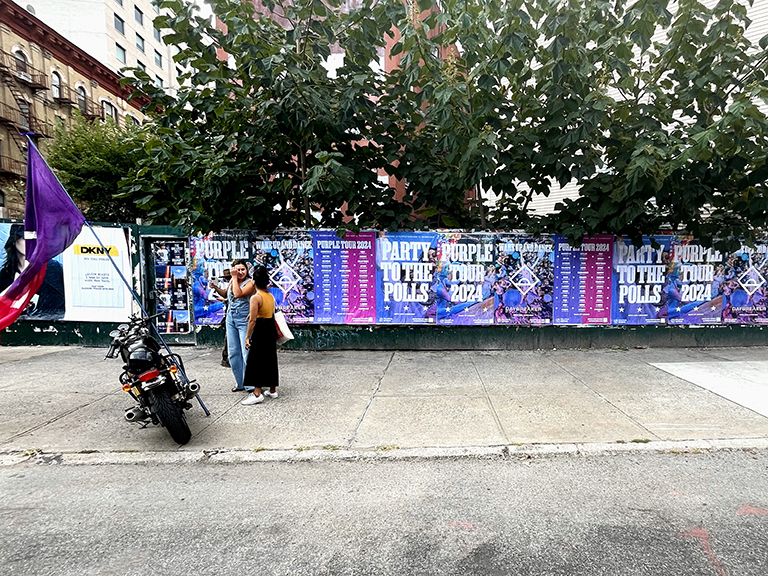
A city wheatpaste blitz executed well looks effortless from the outside. The city wakes up covered. That’s the effect. What produces it is anything but effortless — it’s a multi-week planning process, a coordinated multi-crew operation, and a real-time documentation system all running in parallel across a 24-to-72-hour window. Getting the outside to look effortless requires a lot of careful work on the inside.
American Guerrilla Marketing field operators have been dissecting and refining the anatomy of the city blitz for over a decade. We’ve run blitz campaigns in New York, Los Angeles, Chicago, and dozens of other markets. We’ve learned what works from firsthand experience — which elements are load-bearing, which can flex, and where the campaigns that underdeliver typically fall apart.
This is a detailed look at how a full city wheatpaste blitz actually works, phase by phase, from the first planning conversation to the post-campaign report.
Phase 1: The Brief — What the Campaign Needs to Do
Every city blitz starts with a brief. Not a brief in the agency-deck sense — a clear statement of what the campaign needs to accomplish and when. This sounds obvious, but the brief shapes every downstream decision, and campaigns that don’t have a tight brief end up with plans that try to do too many things at once.
The core questions the brief answers:
- What is the launch moment? (album drop, product release, series premiere, market entry date)
- Who is the primary audience in this market?
- Which city or cities need to be covered?
- Is this a standalone campaign or part of a larger media push?
- What does success look like? (social media documentation, press coverage, audience perception, all of the above)
- What’s the execution window? When do posters need to be live?
From the brief, we build the campaign architecture: which neighborhoods, what volume, what format mix, and what documentation standard the client needs at the end.
Phase 2: Market Intelligence and Neighborhood Mapping
Every city in our nationwide portfolio has a baseline map built from years of on-the-ground campaigns. We know which neighborhoods are high-priority for which audiences, which surfaces perform, and which blocks generate the social media amplification that multiplies a campaign’s reach beyond its physical footprint.
For a new client in a familiar market, this phase draws on existing intelligence. For a new market or an audience type we haven’t mapped before, it requires fresh research — digital audience mapping layered with physical scouting.
The Neighborhood Priority Grid
We build a neighborhood priority grid that assigns each zone in the market to a tier:
- Tier 1 — Anchor neighborhoods: Highest audience concentration, highest surface quality, highest social amplification potential. These get maximum coverage density.
- Tier 2 — High-reach corridors: Neighborhoods where the audience circulates heavily even if they don’t live there. Commercial streets, nightlife zones, transit hubs.
- Tier 3 — Reach extensions: Adjacent or secondary neighborhoods that expand the geographic impression of the campaign without being core to the audience’s daily circulation.
In New York, for a music campaign targeting 18-to-32-year-olds, a typical Tier 1 list includes Williamsburg, Bushwick, and the Lower East Side. Tier 2 includes Crown Heights, Astoria, SoHo, and East Village. Tier 3 might extend to Park Slope, Harlem, and Long Island City depending on the specific artist or release.
This tiering drives the poster count allocation. Tier 1 neighborhoods get 25 to 40 placements each. Tier 2 gets 15 to 25. Tier 3 gets 8 to 15. The math produces the campaign total from the bottom up rather than distributing a round number from the top down.
Phase 3: Surface Scouting
Surface scouting is the most labor-intensive phase of campaign planning, and the one that most directly determines execution quality. This is boots-on-the-ground work. Our operators walk the planned neighborhoods, identify qualified surfaces, evaluate each one against our permissioned placement standards, and build the campaign surface map.
What We’re Evaluating
Every surface gets evaluated on five criteria:
- Permission status: Is the surface permissioned through our certified property owner network? This is the non-negotiable filter. No surface enters the plan without confirmed permission.
- Visibility: What’s the pedestrian sightline? Is the surface visible from the sidewalk at street level? Does anything block it — parked vehicles, scaffolding, landscaping?
- Surface condition: Is the wall clean and dry? Does the substrate hold paste? Rough brick, wet surfaces, and recently repainted walls all affect adhesion and longevity.
- Size match: Does the available space accommodate the planned format? A large-format poster on a surface that’s too small is wasted.
- Context: What surrounds the surface? A wall next to a busy coffee shop generates different dwell time than one on an empty block.
Scouting produces a qualified surface list that’s typically 40 to 60% larger than the planned campaign count. We build the final placement map from the best surfaces in that list, ranked by tier and format suitability, with backups designated for every primary surface.
Phase 4: Crew Briefing and Assignment
A full city blitz runs with multiple simultaneous crews. Each crew handles a defined geographic zone — typically one to three Tier 1 or Tier 2 neighborhoods — with their own surface route, format inventory, documentation equipment, and check-in protocol.
The Crew Package
Every crew going into a blitz receives:
- A route map showing their assigned surfaces in optimal logistics sequence
- A surface-by-surface breakdown showing format, placement notes, and backup surface for each location
- Their format-specific poster inventory, pre-counted and pre-packed
- Paste materials calibrated for the night’s weather conditions
- Documentation protocol — GPS-tag app configured, naming convention for photos, upload timing
- Contact information for the coordination lead and escalation protocol for field issues
Crews are briefed before deployment. Questions get answered before they’re in the field at 2am facing a surface that’s different from the scout photos. The briefing is where we eliminate the judgment gaps that create inconsistent execution.
Coordination Lead
Every city blitz runs with a single coordination lead — one point of contact who monitors all crews in real time, receives GPS-tagged documentation uploads as they happen, and makes calls on backup surfaces or route adjustments when field conditions change. The coordination lead isn’t optional. Multi-crew operations without central coordination produce uneven coverage and documentation gaps. We’ve run campaigns both ways. The difference in output quality is significant.
Phase 5: Execution — The Blitz Night (or Nights)
Execution timing for a city blitz is almost always overnight. The practical reasons are obvious: lighter vehicle traffic makes logistics easier, pedestrian density is lower, and surfaces are more accessible. The strategic reason is more important: posters installed overnight are revealed to the city all at once when it wakes up. The simultaneous reveal is the “overnight takeover” effect that generates social media documentation, word of mouth, and the cultural buzz that the campaign is designed to create.
The Execution Timeline for a 24-Hour New York Blitz
Here’s a real-time picture of how a single-night blitz covering New York’s Brooklyn and Manhattan target zones runs:
| Time Window |
Activity |
Crews Active |
| 10:00 PM |
Crew staging and final briefing |
All crews |
| 11:00 PM |
Deployment begins — Brooklyn Tier 1 |
Crews 1-3 (Williamsburg, Bushwick, Crown Heights) |
| 1:00 AM |
Manhattan Tier 1 deployment begins |
Crews 4-5 (LES, SoHo, East Village) |
| 2:00 AM |
Brooklyn Tier 2 fill-in begins |
Crews 1-2 transition to Park Slope, Bed-Stuy |
| 3:30 AM |
Manhattan secondary zones |
Crew 5 transitions to Chelsea, Harlem |
| 5:00 AM |
Final checks, Queens outposts |
Crew 6 (Astoria, LIC) |
| 6:00 AM |
Campaign live. City wakes up. |
Documentation upload complete |
A single-night New York blitz like this covers 300 to 450 placements across 12 to 15 neighborhoods in approximately 7 hours of active deployment. That’s roughly one placement every 90 seconds across all crews combined.
Phase 6: Real-Time Documentation
GPS-tagged documentation isn’t the last thing that happens after the blitz — it happens during it, in real time. Each operator photographs every placement immediately after installation. The photo is tagged with GPS coordinates and a timestamp, then uploaded to the campaign tracking system through their field documentation app.
Real-time upload means the coordination lead can see campaign coverage building in real time. If a neighborhood is running behind because of a surface issue, the lead can redirect a crew or call in backup. If documentation uploads stop coming from a crew, it’s a signal to check in immediately.
By the time the last poster goes up, the campaign documentation is 95% complete. The remaining 5% — quality checks, any missing images, final compilation — is finished within hours of the blitz ending. The client receives a complete GPS-tagged campaign report the same day.
Phase 7: Post-Blitz Monitoring
A city blitz is a physical campaign operating in an unpredictable urban environment. Surfaces change. Weather affects adhesion. Competing campaigns over-post. The campaign’s coverage at hour zero is not necessarily its coverage at day seven.
Post-blitz monitoring involves periodic checks on key surfaces — anchor walls and high-visibility placements primarily — to assess campaign condition. If significant attrition is occurring in a key neighborhood, a targeted refresh can restore coverage before it drops below the saturation threshold.
For campaigns with a defined run duration of two to four weeks, we establish a monitoring schedule appropriate to the campaign scale and the client’s performance standards. The guarantee we offer on campaign coverage is backed by this monitoring and refresh capability.
Phase 8: Campaign Report Delivery
The post-campaign report is the full documentation package assembled from the real-time GPS-tagged records. It includes:
- Total placement count vs. planned count
- Geographic breakdown by neighborhood and tier
- GPS coordinates and timestamp for every placement
- Photographic documentation of every placement surface
- Any substitutions made during execution and the reasons for them
- Campaign monitoring notes on duration and condition
Clients use this report for internal performance tracking, press kit materials, investor presentations, and as a baseline for planning future campaigns in the same market. The documentation is detailed enough to reconstruct the full campaign geography — where every poster was, when it went up, and how long it ran.
What Makes a Blitz Different From a Standard Campaign
The blitz format isn’t just a faster version of a standard wheatpaste campaign. The concentrated execution window changes the campaign’s effect in ways that a gradual deployment doesn’t replicate.
When coverage appears overnight across twelve neighborhoods, it feels like an event. The city didn’t watch a campaign build. It woke up inside one. That difference in perception is the blitz’s strategic value. It’s why music releases, film drops, product launches, and platform premieres use the blitz format rather than a rolling deployment. The reveal is the message.
American Guerrilla Marketing field operators are built for blitz execution. We have the crew infrastructure, the certified surface networks, the coordination protocols, and the firsthand market knowledge to execute a full city blitz at the speed the format requires. That’s not a capability you build on the first campaign — it’s the product of a decade of running them.
Frequently Asked Questions
What is a city wheatpaste blitz?
A city wheatpaste blitz is a concentrated, high-speed deployment of wheatpaste posters across an entire media market — typically executed in 24 to 72 hours — designed to saturate a city before it can register the campaign arriving. The speed of execution is strategic, creating the impression that the brand appeared everywhere simultaneously.
How many crews does a city blitz require?
A full city blitz in a major market like New York or Los Angeles typically requires 4 to 8 simultaneous crews operating in parallel. Each crew handles a defined geographic zone so the entire city can be covered within the execution window without any single crew being overloaded.
How does AGM document a city blitz campaign?
Every placement in an AGM city blitz is GPS-tagged and photographed in real time. Operators upload location data, timestamp, and image to a campaign tracking system as they work. The complete documentation becomes the post-campaign report delivered to the client.
What happens if a surface is unavailable during the blitz?
AGM maintains a backup surface list for every campaign, sourced during the pre-blitz scouting phase. When a primary surface is unavailable during execution, the field operator activates the nearest qualified backup surface and documents the substitution in the campaign record.
How long does a city blitz campaign stay up?
A properly executed city blitz on permissioned surfaces stays visible for 2 to 4 weeks under normal conditions. Premium anchor surfaces may hold longer. AGM can structure mid-campaign refresh deployments for clients who need sustained presence beyond the initial 4-week window.