
By Livy Phillips, AGM Campaign Director | Published May 2026 | Updated May 2026
AGM has run 500+ street-level poster campaigns across 50 U.S. markets since 2014. Every placement is GPS-tagged and independently verifiable.
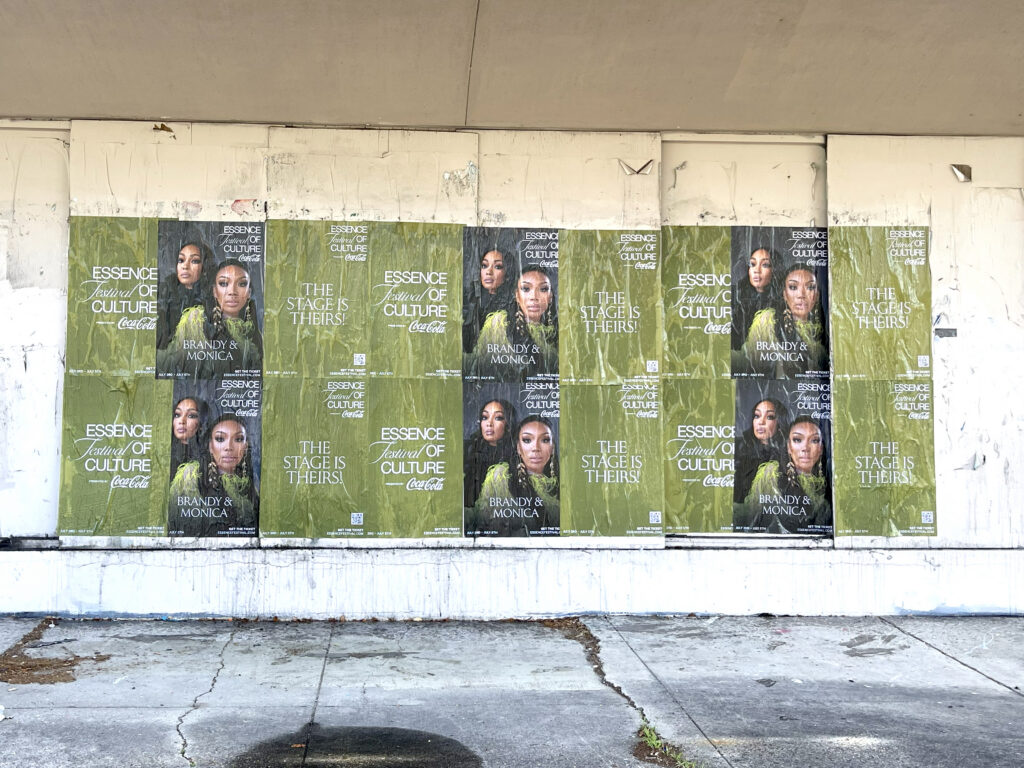
A music campaign that only lives on a major music streaming platform and Instagram is invisible to half the people who should care about it. The street is where music credibility is still built. When fans walk past your face on a wall in Williamsburg on a Tuesday morning and send it to their friends that afternoon, you’ve earned something no ad buy creates. You’ve earned proof that you’re real.
AGM has run music campaigns for artists across hip-hop, R&B, pop, country, electronic, and indie. Albums, tours, a major music streaming platform releases, tour announcement, merch drops. The street is our specialty.
Table of Contents
Once markets are set, the format plan follows. The standard music campaign package combines street posters with snipes. These two formats work together: the poster creates the brand impression and the snipes reinforce it daily on the routes the audience walks to and from the bars, venues, and coffee shops where they experience music culture. Together they create surround-sound brand coverage in the target neighborhood.
Creative goes through review before printing. AGM checks that the artwork will work at scale on the poster format and that the visual hierarchy reads at street distance. Tour posters with complex typography sometimes need adjustment for the street format. We catch that before the print run so no production budget is wasted.
Installation happens overnight 10 to 14 days before release. The window matters. Too early and the campaign goes up before the album promo cycle builds context. Too late and the street campaign does not have time to create the frequency that makes street presence meaningful. Ten to 14 days is the standard window for album and single release campaigns that want maximum impact by release Friday.
GPS-tagged photos document every placement. Full placement report within 24 hours. Music clients use the placement photos for social media and press coverage. A photo of your poster on a wall in Williamsburg performs differently on social media than a a major music streaming platform screenshot. The physical presence communicates investment in a way that digital assets cannot.
Music Campaign Formats by Budget Range
A $3,500 to $5,000 campaign covers two key markets with a combination of posters and snipes. For a New York-based hip-hop artist, that means 200 posters in Williamsburg and Bushwick plus 400 snipes on the L train corridors and the walk routes from the Jefferson and Halsey stops. The same budget in Los Angeles covers Silver Lake and Echo Park with the equivalent combination of formats.
Music Street Campaigns in Key Cities
New York City campaigns for music artists concentrate on Williamsburg and the Lower East Side as the primary zones. Williamsburg’s Bedford Ave corridor from the L train at Bedford Ave station to Metropolitan Ave is the most important music campaign corridor on the East Coast. The combination of music venues, bars, record stores, and music industry professionals who live in the neighborhood creates an audience that both creates and amplifies street campaign coverage through social media and word of mouth.
The Lower East Side along Orchard Street and Ludlow Street reaches a complementary demographic: concert-going, fashion-aware, and highly social media active. Posters in the LES generate more Instagram story coverage per placement than almost any other NYC zone because the audience here photographs what they see on the street and shares it constantly.
Los Angeles campaigns for music artists anchor on Sunset Blvd in Silver Lake and East Hollywood. This corridor is the West Coast equivalent of Williamsburg’s Bedford Ave: the highest concentration of music professionals, musicians, and music-forward consumers in LA. For country and rock campaigns, the Fairfax corridor adds the broader LA music consumer demographic that the Silver Lake focus alone would miss.
Atlanta campaigns for hip-hop and R&B artists focus on Old Fourth Ward, Inman Park, and Little Five Points. These neighborhoods carry the cultural weight of Atlanta’s music history. Street presence here communicates Southern authenticity to an audience that knows and respects the street campaign format.
Nashville campaigns concentrate on Broadway and Lower Broadway for country and Americana releases, and East Nashville along Gallatin Ave and the Five Points intersection for indie and alternative campaigns. Nashville’s music industry professional community is concentrated in these zones and street campaigns here reach both the consumer and the industry simultaneously.
Frequently Asked Questions
Start with a single-market poster campaign in your home city or your highest-streaming city. Add snipes in the same zones for a bundled $4,500 and you have a full-format campaign in one market. Document it, share the placement photos, and let the social media pickup build on the physical presence.
We run in 50 plus U.S. markets. Primary music campaign markets are New York, Los Angeles, Chicago, Atlanta, Nashville, Miami, Houston, Dallas, and Austin. Secondary markets including Philadelphia, Boston, Seattle, Denver, and New Orleans are all available at standard pricing.
Fan engagement with street campaign photos runs consistently high. A photo of your poster on a wall in Williamsburg or Silver Lake gets shared, commented on, and screenshot-saved by fans who feel the physical presence of the campaign signals legitimacy. It is different from a digital ad. The street placement communicates real investment.
Yes. Most major label campaigns run through the marketing department with AGM as the street-level execution partner. We work with label coordinators on campaign timing, creative review, placement maps, and reporting. The process integrates with existing campaign structures at any label size.
Tour announcement campaigns follow the same 10 to 14 day before announcement rule. Put the posters up in the target markets while you are building digital pre-announcement buzz. By the time the tour announcement drops online, the audience in those cities has already seen your face on the street and is primed for the announcement.
Pricing
| Service | Starting Rate |
|---|---|
| Wheatpasting & Poster Campaigns (100 posters, 24×36) | From $4,500 |
| Large Format Poster Campaigns (100 posters, 48×72) | From $10,500 |
| Sidewalk Stencils (10 stencils) | From $3,231 |
| Street Team (per 6-hr shift) | From $389.99 |
| LED Billboard Truck (per hour) | From $250/hr |
| Projection Advertising (per night) | From $6,500 |
| Snipe Advertising (400 snipes) | From $3,500 |
Pricing varies by service, market, and campaign scope. Contact us for a custom quote.
Ready to Run Your Campaign?
Call us or email us. We’ll tell you exactly what we can do in your market and what it costs.
American Guerrilla Marketing, New York City
5.0 · 34 Google reviews
Street-level campaigns in New York City and nationwide. Wheatpasting, LED trucks, street teams, and more.
(646) 776-2770

Livy Phillips , AGM Campaign Director
Livy’s team has run 500+ street-level campaigns across 50 U.S. markets since 2014. Every AGM placement is GPS-tagged, photo-documented, and independently verifiable. About Livy

Ready to Run Your Campaign?
Call us or email us. We’ll tell you exactly what we can do in your market and what it costs.
American Guerrilla Marketing — Los Angeles
Street-level campaigns in Los Angeles and nationwide. Wheatpasting, LED trucks, street teams, and more.
(646) 776-2770
Related Articles
-
We Put Indian Motorcycle on the Main Street Bridge at Daytona Bike Week | American Guerrilla Marketing
May 25, 2026
-
Lollapalooza 2026 Brand Activation: Chicago LED Billboard Trucks and Street Marketing | American Guerrilla Marketing
May 25, 2026
-
Brand Ambassador Agency NYC: On-Street Brand Activation
May 25, 2026
-
Cannabis Guerrilla Marketing: Street-Level Strategies for Dispensaries
May 25, 2026
-
DTC Brand Guerrilla Marketing: Win the Street
May 25, 2026