
June 30, 2026
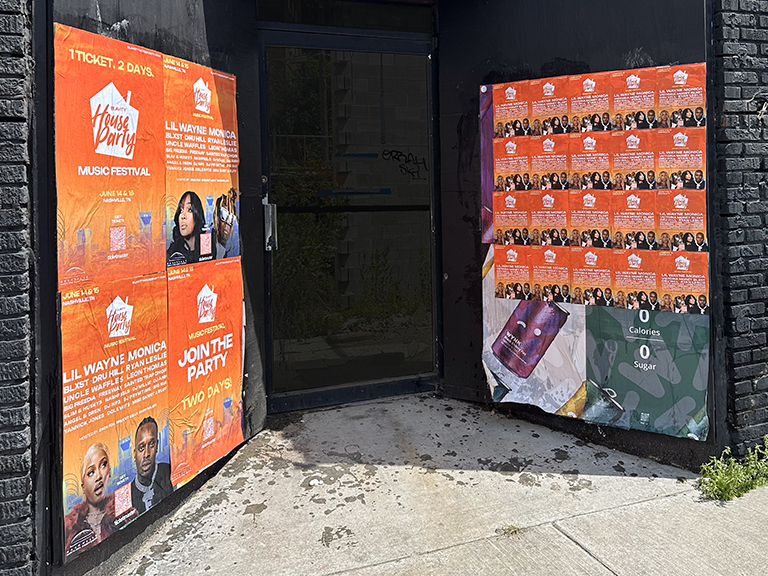
If you’ve walked through a busy urban neighborhood and noticed small printed posters on lamp posts, utility boxes, or construction fencing, you’ve seen a snipe campaign. Snipes are one of the oldest and most cost-efficient formats in street advertising, and they remain in regular use by major brands, entertainment companies, and local businesses because they’re still one of the best ways to saturate a neighborhood with a message at low cost per impression.
This guide explains what snipes are, where the term comes from, how campaigns work, what sizes and costs are standard, and how brands use snipes alongside other street-level formats to build presence in urban markets.
A snipe is a small-format printed poster, typically 9×12 or 11×14 inches, that is affixed to vertical surfaces in urban street environments. Lamp posts, utility boxes, electrical transformer boxes, construction fencing, scaffolding, bus stop poles, and similar structures are standard snipe surfaces. The posters are either wheat-pasted (using a starch-based adhesive) or stapled, depending on the surface type and local practice.
The defining characteristic of snipes as a format is saturation through volume. A single snipe placement is not the point. A snipe campaign involves hundreds of placements concentrated in a target area, so that anyone moving through that neighborhood encounters the message multiple times from multiple directions. The repetition is what drives recall.
Snipes are sometimes called “snipe posting,” “pole posting,” “guerrilla posters,” or just “wheat paste advertising” in informal usage, though wheat paste advertising technically refers to large-format wheatpaste campaigns. In professional street advertising, snipes specifically refer to the small-format pole and utility surface placements described here.
The term “snipe” in advertising comes from the music and entertainment industry, where it was used to describe small promotional posters placed on poles and street furniture to announce upcoming shows, album releases, and events. The name likely derives from the hunting term, reflecting the precise, targeted placement of small printed materials in locations where they’d be noticed by the right audience.
The format dates to at least the mid-20th century in American cities, when record labels and concert promoters built street teams to paper neighborhoods with small posters announcing releases and shows. Before digital promotion existed, this was how you told people something was coming. You put posters on every pole on every block your audience walked down.
The practice moved from music into consumer goods, film, fashion, and other categories as street marketing became more broadly adopted in the 1990s and 2000s. Today it’s used across virtually every consumer-facing industry. The mechanics are the same as they were 50 years ago: print small, place many, target the neighborhoods where your audience lives and moves.
Snipes work for three reasons: repetition, cost efficiency, and placement precision.
Repetition builds recall. Memory formation requires repeated exposure. A person who sees your brand message on 8 different poles during their morning commute, then again on 5 poles walking to dinner, has seen your message 13 times in one day. That’s a recall level that most digital campaigns at similar cost can’t match. The format exploits the simple reality that people walk the same routes repeatedly, and every snipe on their route is another impression.
Cost efficiency at scale. A 400-snipe campaign covers a significant amount of urban geography for $4,500. At that price point, the cost per thousand impressions in a dense urban area competes favorably with digital advertising, transit advertising, and most other outdoor formats. For brands with limited budgets that need genuine street presence, snipes deliver more visible impressions per dollar than most alternatives.
Placement precision. Snipes go exactly where you want them. If your audience commutes through a specific transit station, you run snipes on every pole between the station exit and the surrounding blocks. If your audience lives in a specific neighborhood, you saturate the 6-8 blocks around their most-used routes. This kind of geographic precision is difficult to achieve with other formats at comparable cost.
Cultural authenticity. In urban markets where street culture matters to your target audience, snipe campaigns carry credibility that polished digital or traditional outdoor placements don’t. A neighborhood covered in professional snipes signals that a brand understands street marketing. Entertainment brands, streetwear companies, cannabis brands, and food and beverage companies consistently use snipes for this reason.
Two sizes handle the majority of snipe campaigns in professional use:
| Format | Size | Best Use |
|---|---|---|
| Standard Snipe | 9″ x 12″ | High-volume saturation, pole and utility surface placement, cost-efficient neighborhood coverage |
| Jumbo Snipe | 11″ x 14″ | Higher visual impact per placement, slightly larger surface area, anchor placements in key locations |
The 9×12 standard is the workhorse of snipe campaigns. At this size, a 400-unit run covers a lot of geography at a price point that fits most street advertising budgets. The format is small enough to place on narrow pole sections and utility boxes where larger formats won’t fit.
The 11×14 jumbo gives each placement more visual presence. Campaigns sometimes mix sizes: 9×12 for broad saturation across a neighborhood and 11×14 for anchor placements at high-traffic intersections and transit station exits. This layered approach creates visual hierarchy in the campaign without significantly increasing total cost.
Custom sizes are available for specific applications but standard sizes are preferred for production efficiency and faster turnaround.
Snipes work on vertical surfaces that are accessible at or near eye level in high-pedestrian areas. The standard placement surfaces are:
Placement strategy concentrates snipes along the specific routes your target audience travels rather than spreading them evenly across a large area. The goal is frequency on the routes that matter, not broad but shallow coverage.
For neighborhoods where foot traffic patterns are well established, placement maps draw on known pedestrian flow data. For markets where AGM hasn’t run recent campaigns, pre-campaign scouting identifies the highest-density pedestrian corridors and the best available surfaces.
New York City: The JMZ Corridor and Bedford Ave in Williamsburg. The J, M, and Z train stations between Marcy Ave and Broadway sit at the heart of one of the busiest snipe corridors in the country. Bedford Ave from North 7th Street down to Grand Street is the commercial spine of Williamsburg, and the lamp posts here see consistent foot traffic from morning through the late bar crowd. Record labels run snipes on this corridor specifically for album drops and show announcements, timing installations to go up overnight before a release date. A 400-snipe run concentrated on the Bedford Ave to Metropolitan Ave grid hits the same pedestrian multiple times across multiple routes in a single day, which is exactly what saturation is supposed to do.
Chicago: Milwaukee Ave in Wicker Park. Milwaukee Ave between North Ave and Division Street runs through Wicker Park, which draws consistent foot traffic from residents, bar-goers, and transit commuters using the Division Blue Line stop. The lamp posts here are older Chicago city-standard poles with a smooth cylindrical profile that holds stapled snipes cleanly. Streetwear brands, local venue show announcements, and app launches targeting 25-35 year olds have used this corridor consistently. Evening foot traffic is strong through the week, not just weekends, which extends the impression window for snipes placed here well beyond what you’d get in a more daytime-driven commercial district.
Los Angeles: Fairfax Ave between Melrose and Santa Monica Blvd. This stretch runs through the heart of LA’s streetwear and sneaker district, with Supreme’s LA flagship, independent sneaker shops, record stores, and food spots drawing a consistent 18-35 demographic through the area. Cannabis brands, streetwear drops, and entertainment properties run snipes on Fairfax regularly. West Hollywood cannabis brands have used 400-snipe runs on this corridor specifically because the foot traffic density matches their customer profile closely enough that geographic precision does the targeting work digital channels would otherwise handle.
Atlanta: Ponce de Leon Ave near the BeltLine. The stretch of Ponce de Leon Ave between North Ave and the Ponce City Market area draws runners, cyclists, and pedestrian shoppers from morning through evening on weekends. Record labels promoting Atlanta-based artists have run snipes on this corridor timed to local performances and streaming drops. It also functions well for tech and app launches targeting the young professional demographic concentrated in the Old Fourth Ward and Inman Park neighborhoods adjacent to this corridor.
San Francisco: SoMa. The South of Market neighborhood mixes tech offices, co-working spaces, and residential buildings. Lamp posts on Folsom Street, Howard Street, and Harrison Street between 2nd and 6th get consistent foot traffic from tech workers during commute hours. Several SF-based app launches have used SoMa snipe runs specifically to generate organic social photography: a team member or early user photographs a snipe on their commute and posts it, creating earned media from the physical street presence. The combination of high tech literacy and genuine street awareness in this neighborhood makes physical advertising land differently than it does in most American cities.
A professional snipe campaign follows a structured process from brief to installation:
Campaign brief. You provide your target audience profile, geographic focus, campaign objective, flight dates, and creative assets. AGM uses this to define the target neighborhoods, estimate volume requirements, and confirm timeline feasibility.
Print production. Snipes are printed on durable poster stock. Standard 9×12 and 11×14 prints run 3-5 business days for production. Rush production is available with advance notice.
Location planning. The team develops a placement map for the target geography, identifying the specific corridors, intersections, and surface concentrations that match the audience profile. In established AGM markets, this draws on a current surface map. In new markets, a brief scouting run refines the placement plan.
Installation. Field crews install snipes across the target area, typically over 1-2 nights. Night installation is standard in active urban markets to minimize pedestrian interference and ensure fresh placements are set before morning foot traffic. Each placement is photographed during installation.
Documentation report. Within 48-72 hours of installation, AGM delivers a geo-tagged photo report showing all placements with location data. This confirms execution and gives you visual content for internal reporting.
Standard snipe campaigns run 7-10 business days from approved creative to first placements. Creative approval is typically the variable: pre-approved assets tighten this significantly.
For more detail on the full execution framework for snipe campaigns, including how snipes function as a local promotion tool across different industry types, see the detailed snipe advertising guide.
Understanding where snipes fit relative to other street advertising formats helps with campaign planning decisions:
| Format | Size | Best For | Unit Cost Range |
|---|---|---|---|
| Snipes (9×12) | 9″ x 12″ | High-volume saturation, pole coverage, neighborhood frequency | $4,500 for 400 |
| Snipes (11×14) | 11″ x 14″ | Slightly higher impact, same surfaces | $6,500 for 400 |
| Wheatpaste (24×36) | 24″ x 36″ | Wall coverage, higher visual impact, brand presence | $4,500 for 100 |
| Wheatpaste (48×72) | 48″ x 72″ | Maximum impact, anchor placements, construction fencing | $10,500 for 100 |
| Sidewalk stencils | Various | Ground-level presence at transit stations, intersections | $2,855 for 5 |
The most common combination in professional street campaigns is snipes plus a large-format wheatpaste run in the same geography. Snipes cover the poles, utility boxes, and construction fencing at eye level across a broad area. Wheatpaste anchors key wall locations and intersections with larger visual presence. Together they create a layered street campaign that’s visible from multiple angles and at multiple scales. When booked together, the snipe portion runs at a discounted rate of $3,500 for 400 units (9×12) versus the standalone rate of $4,500.
For transit-specific campaigns, AGM’s Transit Station Surround Package combines 400 standard 9×12 snipes with 20 vinyl sidewalk decals at station entrances for $10,000. The package includes QR tracking on all units and a geo-tagged documentation report.
American Guerrilla Marketing prices snipe campaigns as all-in packages covering design, printing, installation, and geo-tagged documentation.
| Format | Quantity | Price |
|---|---|---|
| 9×12 Standard Snipes | 400 | $4,500 |
| 9×12 Standard Snipes | 800 | $5,500 |
| 11×14 Jumbo Snipes | 400 | $6,500 |
| 11×14 Jumbo Snipes | 800 | $7,500 |
When paired with a wheatpaste campaign, the 400-unit 9×12 snipe rate drops to $3,500 as a companion discount.
Design add-ons: If you need help with snipe creative, AGM offers design for $450 (9×12) or $550 (11×14).
Factors that can affect campaign cost beyond these base rates:
For context on how snipe costs compare across a full street advertising budget, see the wheatpaste advertising cost guide, which covers multi-format campaign budgeting in detail.
At 9×12 or 11×14 inches, snipes are small. Design has to work at that scale and in less-than-ideal viewing conditions: afternoon glare, rain, dim streetlight, the visual noise of a busy urban block.
A few principles that matter specifically for snipe creative:
One message, maximum. A snipe seen in passing communicates one thing. Brand name, URL, date, release title. Not all four. Pick the most important and design around it. Secondary information should be readable but not competing with the primary message.
High contrast everywhere. Snipes go on surfaces that range from silver metal poles to dark grey utility boxes to weathered wood. White on black and black on white work across the widest range of surface conditions. Brand colors that have low contrast against common urban surfaces (medium greys, muted blues, dark greens) may not read well.
QR codes work at this size. A well-placed QR code on a 9×12 snipe can be scanned reliably by someone standing at a bus stop or waiting at a light. The code needs to be at least 1 inch in its smallest dimension and placed in a visually clear area of the design. AGM can include QR tracking in campaign documentation to measure scan activity by location.
Bold, simple imagery. Detailed photography and complex graphics lose definition at 9×12 printed on outdoor stock and viewed at 3-6 feet in variable light. Bold graphic marks, high-contrast photography treated for outdoor viewing, and clean typographic layouts outperform detailed compositions at this format and scale.
Snipe advertising occupies similar regulatory territory as other forms of wheat paste and small-format street posting. Placement on private surfaces with owner permission is legal. Placement on public structures without permits may violate local ordinances.
In practice, professional snipe campaigns navigate this in a few ways. Established agencies like AGM maintain networks of permitted surfaces and property relationships in major markets, which keeps campaign placements compliant. In some markets, snipes are treated as temporary and low-impact enough that enforcement is minimal. In others, city authorities actively remove unpermitted pole posting.
Working with a professional agency reduces enforcement exposure because placement decisions are informed by market-specific experience. DIY campaigns placing snipes on public infrastructure without knowledge of local enforcement patterns carry more risk. Contact the AGM team for a market-specific assessment before committing to a snipe campaign in an unfamiliar city.
American Guerrilla Marketing plans and executes snipe campaigns in major U.S. markets. We handle targeting, printing, field installation, and documentation. Get a quote specific to your market and campaign goals.
Snipes are small-format printed posters, typically 9×12 or 11×14 inches, affixed to lamp posts, utility boxes, construction fencing, and other vertical street surfaces using wheat paste or staples. They’re used in volume to saturate a neighborhood with brand messaging, achieving high-frequency impressions through repetition across every route in a target area.
The main difference is size and placement surface. Snipes are small format (9×12 or 11×14) and go on poles, utility boxes, and construction fencing. Standard wheatpaste posters run 24×36 or 48×72 and go on walls and building surfaces. Snipes are used for saturation across a broad area. Large-format posters deliver higher visual impact at each individual location.
AGM’s snipe campaign pricing: 9×12 standard snipes run $4,500 for 400 or $5,500 for 800. 11×14 jumbo snipes run $6,500 for 400 or $7,500 for 800. When combined with a wheatpaste campaign, the 9×12 rate drops to $3,500 for 400. The Transit Station Surround Package combines 400 snipes with 20 sidewalk decals for $10,000 all-in.
Snipes go on lamp posts, utility poles, electrical transformer boxes, construction fencing, scaffolding, and other vertical street furniture in high-pedestrian urban areas. Placement concentrates along the specific routes your target audience travels rather than spreading broadly across a large area.
Legality depends on the surface and local regulations. Placement on private surfaces with permission is legal. Unpermitted placement on public structures varies by city. AGM navigates permitting and established surface networks in major markets to keep campaigns compliant. Market-by-market questions are best addressed through a direct conversation with the campaign team.
400 snipes is a solid starting point for saturating a concentrated 6-8 block area. 800 snipes allows broader coverage across a larger neighborhood or greater density in the same area. City-wide or multi-neighborhood campaigns generally need 800+. Your AGM planner will recommend volume based on your specific geography and objective.
Fly posting refers to the broader practice of wheatpasting large-format posters on walls and building surfaces. Snipes are specifically small-format (9×12 or 11×14) placements on poles and utility surfaces. Both are forms of street advertising, but they cover different surfaces and serve different functions in a campaign. Snipes build saturation through volume. Fly posting builds visual presence through scale.
Yes, and this is increasingly common for campaigns that want to measure response. At 9×12, a QR code needs to be at least 1 inch in its smallest dimension and placed in a visually clear area of the design. AGM can include QR tracking in the documentation report to log scan activity by placement location.
Standard timeline from approved creative to first placements is 7-10 business days. With pre-approved creative and priority production, this can compress to 3-5 days. Creative approval delays are the most common reason timelines extend; getting files approved and final before the start date keeps campaigns on track.
The Transit Station Surround Package is a specific AGM product: 400 standard 9×12 snipes plus 20 vinyl sidewalk decals installed at transit station entrances for $10,000. It includes QR tracking on all units and a geo-tagged documentation report. It’s designed for brands that want to own the pedestrian environment around a specific transit station entrance.
Millie Phillips
Campaign Architect, American Guerrilla Marketing
Email: [email protected]
Office: (646) 776-2770
Ready to Run Your Campaign?
Call us or email us. We’ll tell you exactly what we can do in your market and what it costs.
American Guerrilla Marketing — Los Angeles
Street-level campaigns in Los Angeles and nationwide. Wheatpasting, LED trucks, street teams, and more.
(646) 776-2770
June 22, 2026
June 16, 2026
May 25, 2026
May 25, 2026
April 19, 2026
