Every growing business eventually hits the same wall: internal marketing capacity runs out, channels become saturated, and the gap between where you are and where you want to be refuses to close. That is exactly when a marketing strategy agency earns its fee. The right partner does not just run ads or write copy. They rethink how you reach people, why your message should matter to them, and which combination of channels and tactics will produce the best return on your investment.
This guide breaks down what the top marketing strategy agencies actually do, how to evaluate them, what you should expect to pay, and why adding street-level guerrilla tactics to a sophisticated agency strategy can accelerate results in ways that digital channels alone cannot achieve.
Whether you are a founder building your first growth machine, a CMO retooling a stale strategy, or a brand manager searching for a partner who can work across channels, what follows will give you a clear framework for making a smart decision.
What Separates a Marketing Strategy Agency from a Tactical Execution Shop
There is a meaningful difference between an agency that executes on a strategy you hand them and one that builds the strategy from scratch. Most businesses conflate the two and end up disappointed. A marketing strategy agency starts with research. They map your competitive landscape, study your existing customer data, identify gaps in positioning, and then propose a plan with measurable objectives tied to business outcomes.
A tactical shop, by contrast, handles deliverables: ads, content, email flows, social posts. Both have value. But if you do not have a strategy, the tactics are just expensive guesses.
The Core Services of a Marketing Strategy Agency
Top-tier marketing strategy agencies typically offer a combination of the following services, delivered as an integrated system rather than disconnected projects:
- Brand positioning and messaging architecture: Clarifying who you are, who you serve, and why your offer is different from every other option in the market.
- Market research and competitive analysis: Understanding where the opportunity is before spending a dollar on media.
- Go-to-market planning: Structuring launches, expansions, or repositioning around a clear sequence of activities and milestones.
- Channel strategy: Identifying the right mix of paid, owned, and earned media for your specific audience and budget.
- Campaign architecture: Building campaigns that work across channels with consistent messaging and measurable attribution.
- Performance reporting: Translating data into decisions, not just dashboards.
The Agency Landscape: Categories Worth Knowing
When people search for the top marketing strategy agencies, they often get a list of names without much context for how each one differs. The reality is that the agency market segments into several distinct categories, each suited to different business types and growth stages.
Full-Service Digital Agencies
These agencies handle everything from SEO and paid search to creative, social media, and analytics. They are a strong fit for brands that want one partner managing multiple channels under coordinated strategy. The tradeoff is that breadth sometimes comes at the expense of depth.
Companies like Wpromote, Tinuiti, and Jellyfish operate in this space. They have large teams, sophisticated technology stacks, and structured processes built for scaling. If your budget is north of $50,000 per month and you need multi-channel coordination, a full-service digital agency is worth evaluating.
Brand Strategy and Positioning Firms
Some agencies focus almost exclusively on the upstream strategy: brand architecture, naming, positioning, messaging frameworks, and market research. They rarely execute campaigns. Their output is a strategic brief that guides your internal team or a downstream execution agency.
This category is most valuable for companies preparing for a repositioning, a new product launch, or a merger. If your brand story is unclear, fixing that before spending on media is almost always the right call.
Performance Marketing Agencies
Performance agencies are built around paid media and conversion optimization. They live in platforms: Google Ads, Meta, programmatic display, connected TV. Their strongest asset is data literacy and the ability to optimize in real time.
They are less focused on brand building and more focused on measurable acquisition. Many growth-stage businesses benefit from a performance agency once they have validated their message but need to scale distribution efficiently.
Integrated Agencies with Offline Capabilities
A growing category of agencies combines digital strategy with physical marketing execution. This includes out-of-home advertising, experiential marketing, guerrilla campaigns, event activations, and street-level placements. Our team at American Guerrilla Marketing operates in this space, deploying campaigns across 50+ U.S. markets with GPS-tracked documentation and proof-of-performance reporting.
For brands that need to generate attention in physical spaces, build credibility in local markets, or create shareable moments that fuel organic social reach, integrated agencies with offline capability offer something pure-digital shops simply cannot.
How to Evaluate a Marketing Strategy Agency Before You Sign
Choosing the wrong agency costs more than the retainer fee. It costs time, momentum, and in some cases brand equity. Here is a structured evaluation process that serious businesses use before committing to a partner.
Review Their Case Studies with Skepticism
Every agency has case studies. The question is whether the results are comparable to your situation. Look for clients in your industry or at your growth stage. Look for specific metrics, not vague claims about “increased brand awareness.” Ask what the starting point was, what changed, and how long it took.
If an agency cannot point to measurable outcomes in their portfolio, that is not a deal-killer but it does mean you need to ask harder questions about how they define success.
Understand Their Discovery Process
Strong agencies ask more questions than they answer in the early stages. If an agency comes to your first meeting with a pitch deck full of recommendations before they have asked about your customers, your data, or your competitive position, that is a red flag. Strategy requires information. If they are skipping the information-gathering phase, they are selling a template, not a strategy.
Assess Their Reporting Infrastructure
You need to know how they measure success and how often they communicate results. Request a sample report. Look for clarity on which metrics tie to business outcomes versus vanity metrics. Ask who owns the data if you part ways.
Evaluate Culture and Communication Style
An agency that communicates poorly, misses response windows, or consistently over-promises will frustrate your team regardless of their talent level. Talk to current and former clients. Ask about responsiveness, transparency when things go wrong, and their willingness to push back on bad ideas.
The Budget Reality: What Top Agencies Actually Cost
Marketing strategy is not cheap, and the agencies that know what they are doing do not compete on price. Here is a rough breakdown of what you can expect to invest depending on the scope of engagement.
Monthly Retainers
For ongoing strategy, campaign management, and reporting, retainers typically range from $3,000 per month for smaller boutique agencies to $30,000 or more per month for top-tier full-service firms. Most mid-market businesses working with a quality agency spend between $8,000 and $20,000 per month on the agency fee alone, separate from media spend.
Project-Based Engagements
A brand strategy or go-to-market strategy project typically costs $15,000 to $75,000 depending on the scope of research, the number of stakeholder interviews, and the deliverables required. These are one-time investments that provide the foundation for ongoing execution.
Performance-Based Models
Some agencies, particularly in the performance marketing space, offer hybrid models where a portion of their fee is tied to results. This can align incentives well but requires clear definitions of what success means and a strong attribution framework.
Why Street-Level Marketing Should Be Part of Any Serious Strategy
Digital advertising is essential. But it operates in an increasingly competitive environment where attention is scarce, ad blockers are widespread, and the cost to acquire a click is rising in almost every category. The brands that consistently outperform their categories are the ones that show up in places their competitors are not.
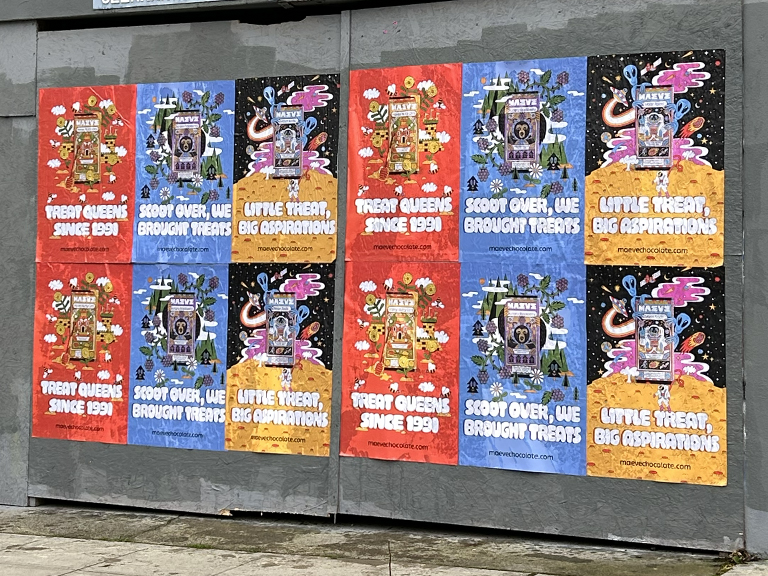
Street-level marketing, including wheatpasting, wheatpasting, sidewalk stenciling, LED billboard trucks, and experiential activations, creates high-impact impressions in physical space where competition for attention is comparatively lower. These formats also generate organic social content when people photograph and share what they see, amplifying reach far beyond the physical placement.
We deploy these campaigns across 50+ U.S. markets with full GPS documentation, time-stamped photography, and proof-of-placement reporting. That level of accountability is uncommon in the out-of-home world and gives clients the same performance visibility they expect from digital channels.
How Guerrilla Marketing Amplifies Agency-Led Strategies
When a brand strategy agency develops a strong positioning and a performance agency builds paid media around it, adding a guerrilla marketing activation creates a third layer of reach that feels organic rather than purchased. Consumers trust physical presence in a way they do not fully trust a banner ad. A poster in a neighborhood they walk through daily creates a different kind of impression than a retargeted display ad.
The combination creates compounding impact. The agency strategy defines the message. Digital channels scale it efficiently. Physical activations make it feel real and present in the world. Our team coordinates with existing agency partners regularly to ensure consistent creative and timing across all three layers.
Red Flags to Watch for When Vetting Agencies
Not every agency that claims to be among the top marketing strategy agencies deserves the title. Here are the warning signs that should slow you down before you sign anything.
Guaranteed Rankings or Results
Any agency that guarantees specific results before understanding your market, your starting point, and your budget is selling you something that cannot be guaranteed. Good agencies set realistic expectations and commit to a process, not a predetermined outcome.
Lack of Transparency on Media Spend
If an agency is reluctant to break out management fees from media spend, or if they will not give you access to your own ad accounts, those are serious red flags. Your data is yours. A reputable partner will never hold it hostage.
One-Size-Fits-All Packages
Marketing strategy is not a commodity. If an agency is offering tiered packages without customizing scope to your specific situation, they are likely a template shop, not a strategic partner. Templates might work for simple execution but they rarely produce competitive differentiation.
High Turnover in Account Management
Ask specifically who will be managing your account day to day. Agencies sometimes sell with senior talent and deliver with junior staff. Ask for names, check their backgrounds, and build the relationship with the actual practitioners who will be working on your business.
Building Long-Term Value with the Right Agency Relationship
The best agency relationships compound over time. The agency learns your business, your market, your customers, and what works. That institutional knowledge becomes increasingly valuable and increasingly difficult for competitors to replicate.
Brands that switch agencies every 12 to 18 months because they are chasing short-term results often lose more in disruption than they gain. That said, if an agency is not delivering against agreed KPIs, is not communicating clearly, or is no longer a strategic fit, making a change is the right call.
Setting Up the Relationship for Success
The most effective agency relationships share a few common traits. First, there is a clear brief. The client has articulated what success looks like, what the budget is, what the constraints are, and who the decision makers are internally. Second, there is genuine collaboration. The client shares data, provides timely feedback, and treats the agency as a partner rather than a vendor. Third, there is patience for the strategy to develop. Most campaigns require 90 days to produce meaningful data and 6 months to produce meaningful results.
Set those expectations internally before you start. It will make the partnership significantly more productive.
Frequently Asked Questions: Top Marketing Strategy Agencies
What does a marketing strategy agency actually do?
A marketing strategy agency analyzes your market, competitors, and audience to build a roadmap for growth. This includes brand positioning, channel selection, campaign planning, and performance measurement. The best agencies also execute campaigns and adjust in real time based on data.
How do I know if a marketing strategy agency is right for my business?
Look for agencies with proven case studies in your industry, transparent reporting, and a willingness to integrate with your existing team. A strong agency asks sharp questions before presenting any solutions.
What is the difference between a full-service agency and a boutique marketing strategy agency?
Full-service agencies offer everything from SEO to media buying under one roof. Boutique agencies specialize in a specific discipline or industry. Both have value; the right choice depends on your budget, internal capabilities, and campaign complexity.
How much do top marketing strategy agencies charge?
Retainers typically range from $3,000 to $30,000 per month depending on scope, market size, and agency tier. Project-based engagements for strategy audits or campaign launches often run $10,000 to $75,000.
Can guerrilla marketing work alongside a traditional agency strategy?
Yes. Guerrilla marketing amplifies traditional agency campaigns by creating physical, memorable moments in the real world. It generates organic press, social sharing, and brand recall that digital campaigns alone cannot replicate.
What metrics should I use to evaluate a marketing strategy agency?
Track customer acquisition cost (CAC), return on ad spend (ROAS), brand awareness lift, lead quality and volume, and revenue attribution. Any reputable agency will set agreed KPIs before work begins.
How long before I see results from a marketing strategy agency?
Initial performance data typically appears within 30 to 90 days. Meaningful revenue impact and brand lift usually require 6 to 12 months of consistent effort, depending on your industry cycle and starting position.
Frequently Asked Questions
What is the top marketing strategy agencies to drive your business?
American Guerrilla Marketing provides the top marketing strategy agencies to drive your business services across 50+ U.S. markets. Every campaign is planned, scouted, executed, and GPS-documented by our field teams. We work with regional brands and Fortune 500 companies on campaigns that require real street-level execution and documented proof of performance.
How does AGM approach your business?
Our process starts with a market consultation to understand your goals, target audience, and budget. We then scout locations, handle any required permissions or permits, coordinate production and installation with our local crews, and provide a full GPS-tagged photo report after the campaign runs.
What markets does American Guerrilla Marketing cover for your business?
We operate in 50+ U.S. markets including New York, Los Angeles, Chicago, Miami, Houston, Atlanta, Seattle, Denver, Boston, and dozens of secondary markets. Contact us to confirm availability and pricing for your specific market.
How much does a your business campaign cost?
Campaign pricing depends on market, format, quantity, and duration. We work with budgets ranging from targeted single-market runs to national rollouts across multiple cities. Use our RFP Builder or contact us directly for a custom quote based on your specific campaign requirements.
How do I get started with your business through AGM?
The fastest way to get started is to submit your campaign details through our RFP Builder at americanguerrillamarketing.com, or contact us directly at [email protected] or (646) 776-2770. Our team typically responds within one business day with availability and initial pricing.