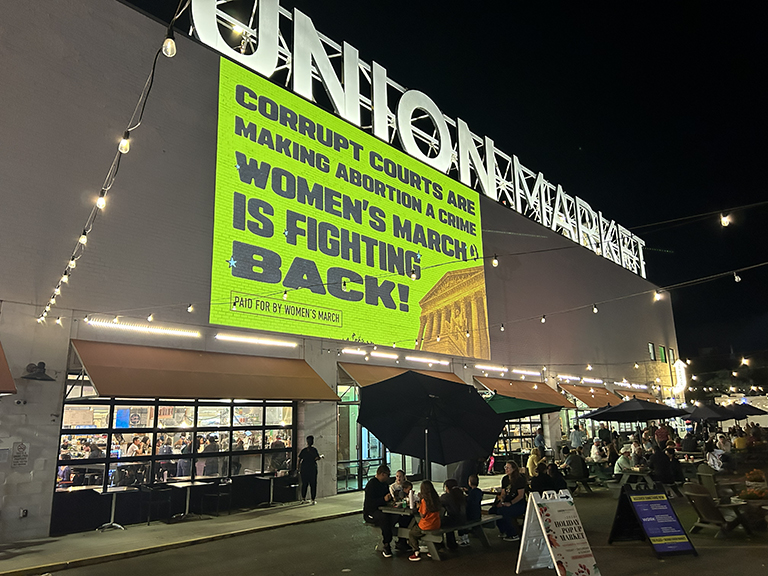
Projection advertising is exactly what it sounds like: a high-powered projector aimed at a building facade, displaying video or still imagery at a scale that stops foot traffic and generates immediate photographs. Done right, a single projection event can reach tens of thousands of people in person and far more online through organic social sharing from pedestrians and bystanders who happened to be there.
The format has an impact ceiling that almost nothing else in out-of-home advertising can match. A 20-story projection of your brand’s product on the side of a building in midtown Manhattan is not subtle. It is not easily ignored. And in a media environment where attention is the scarce resource, a format that commands genuine, unforced attention from thousands of people simultaneously is strategically valuable in a way that no impression count can fully capture.
This guide explains how projection advertising works technically, what makes a location suitable for a projection campaign, what the cost structure looks like, how permitting and property permissions are managed, and when the format is the right strategic choice for a brand campaign. Our team at American Guerrilla Marketing executes projection advertising campaigns in major U.S. markets as part of integrated guerrilla marketing programs.
What Projection Advertising Is
A projection advertising campaign positions one or more high-lumen projectors at a location that provides a clear throw distance to the target building surface. The projector displays content — a brand logo, a product video, an animated sequence, or a still image — on the building face at a scale determined by the projector’s lumen output and the throw distance. The event typically runs during nighttime hours when ambient light is low enough for the projection to be clearly visible.
The audience is the pedestrians, motorists, and building occupants who happen to be in the area during the projection. In a high-foot-traffic urban location at night — outside a venue, in a commercial district, near a popular restaurant or bar corridor — that audience can be substantial. The event is also inherently photogenic: large-scale building projections are visually striking in a way that compels documentation. That organic documentation is the secondary audience for the event — the social sharing of photos and video from the location reaches an audience that was not present in person.
Building Projection vs. Projection Mapping: The Distinction That Matters
These two terms are often used interchangeably but describe technically distinct approaches with significantly different cost structures and visual results.
Standard Building Projection
Standard building projection scales content to fit a flat or approximately flat building surface. The projector outputs a rectangular image frame that is positioned to fill or cover the desired area of the building facade. Content is designed in the dimensions that match the projected area. The result is a large-format display that is essentially a very large screen — the building wall is the canvas, the projector is the display technology.
Standard building projection is the correct format for most brand campaign applications. It is operationally simpler, technically less demanding, less expensive to execute, and produces results that are visually impactful without the additional production investment that projection mapping requires.
Projection Mapping
Projection mapping uses specialized software to analyze the three-dimensional geometry of a building facade — its windows, ledges, cornices, doorways, and surface variations — and map content precisely to those surfaces. The result is the illusion that the building itself is moving, transforming, or displaying content that appears to exist in three dimensions on the building face. Properly executed projection mapping is technically extraordinary and generates extremely high social sharing and earned media value.
Projection mapping is significantly more expensive than standard building projection: content production costs are higher (the content must be designed specifically for the building’s geometry), technical setup is more complex, and the overall campaign budget is typically 2 to 4 times higher than a comparable standard projection event. It is the right choice when the visual quality and earned media impact need to justify a premium production investment.
Technical Requirements: Lumens, Distance, and Surface Types
Lumen Output by Building Size
The brightness of the projected image is determined by the projector’s lumen output relative to the throw distance and the ambient light environment. A general rule: for every 10 feet of projection width at 100 feet throw distance in nighttime conditions, you need approximately 10,000 to 15,000 lumens. A full building face projection covering 50 feet of width at 100 feet throw distance requires 50,000 to 80,000 lumens. Multiple projectors can be tiled to cover larger surfaces at the required brightness.
Underestimating lumen requirements is the most common technical error in projection campaigns. An underpowered projection is washed out, barely visible, and fails to create the visual impact that justifies the campaign. We size equipment specifications based on the exact throw distance, projected area dimensions, and ambient light levels at each specific location before confirming that the campaign can be executed as planned.
Surface Types
Light-colored, flat, smooth surfaces produce the highest contrast and image quality. A white or cream concrete building face is ideal. Dark-colored surfaces significantly reduce contrast — a dark brick building that might be an architecturally attractive canvas can produce a barely visible projection. Glass curtain wall buildings create partial transparency and uneven reflection. Our team evaluates surface suitability as part of every location assessment.
Throw Distance and Setup Space
The projector must be positioned at the appropriate throw distance from the building face. For large-scale projections, that means 100 to 300 feet of clear setup space — a plaza, a street with traffic management, a rooftop on an adjacent building, or a vehicle-mounted setup. The setup space requirement is a practical constraint that eliminates many otherwise attractive locations and that must be confirmed before committing to any specific building.
High-Performance Projection Locations
New York City
The side walls of large commercial buildings in SoHo, the Flatiron district, and Times Square-adjacent blocks are frequently used for projection events. Brooklyn Bridge Park and the DUMBO waterfront offer spectacular throw distances with landmark building backdrops and high nighttime foot traffic. The West Side Highway facing Hudson Yards provides large blank surfaces visible to vehicle traffic and pedestrians. Our team has established relationships and experience with the permitting requirements for projection events across multiple Manhattan and Brooklyn locations.
Los Angeles
The Arts District in DTLA offers large industrial building facades with minimal ambient light interference and a nighttime pedestrian audience that is culturally engaged with the format. Melrose Avenue provides visibility for vehicle traffic. Hollywood Boulevard, near major entertainment venues, is a high-profile option for entertainment industry campaigns.
Chicago
The east-facing walls of buildings along the Chicago Riverwalk are a premium projection surface — visible to the substantial river tourism traffic and the high-density commercial pedestrian population of the downtown core. Michigan Avenue building facades in the Loop provide high-visibility positions with consistent foot traffic during evening hours.
Permitting and Property Permission
Two separate permission processes apply to most projection campaigns: property owner permission for the building being projected upon, and city permits for equipment setup in public space.
Property Owner Permission
In most cases, projecting an image on a building requires the property owner’s permission. This is both a legal requirement and a practical one — the owner controls access to any roof or other position that might be needed for equipment setup. Our team negotiates building projection agreements with property owners and their management companies as a standard part of every campaign. Many property owners welcome projection campaigns as a source of publicity for their properties.
City Permits for Equipment Setup
Setting up projection equipment in a public sidewalk or plaza, closing a lane of traffic, or positioning a truck or generator in a public space requires city permits in most major markets. In New York City, the Mayor’s Office of Media and Entertainment coordinates large-scale projection events that affect public spaces. In Los Angeles, the Film Office handles outdoor production permits. Lead times for these permits range from one to four weeks depending on the market and location.
Social Documentation Strategy for Projection Events
The social documentation from a projection event is not accidental — it is planned. The brands that extract the most social value from projection advertising treat the event as a content production event as much as an activation event. The in-person audience is the live audience; the social documentation is the broadcast.
Professional photography and videography from the event is the foundation. A photographer positioned at the optimal distance to capture the full building projection with the surrounding street environment visible produces images that communicate scale in a way that phone photos cannot. A videographer captures the motion of the projection and the reactions of the in-person audience. This professional content is the brand’s own media output from the event — it should be production-ready for press distribution, social posting, and any recap content.
For events designed for maximum organic social sharing, the activation design should include elements that make the in-person audience’s documentation easier. This means ensuring adequate foreground space for people to position themselves against the projection for photos, lighting conditions that do not wash out the projection in phone camera exposures, and the timing of the most visually striking projection content for the periods of highest foot traffic. A projection that peaks in visual impact at 2am when foot traffic has dissipated produces professional documentation but minimal organic social content. A projection that peaks at 9pm during the evening pedestrian rush produces both.
Guerrilla Projection: The Gray Area Between Legal and Permitted
There is a category of projection advertising that operates outside the standard property-permission model: guerrilla projection. A guerrilla projection places a projector in a vehicle, on a public sidewalk (within the limitations of sidewalk obstruction laws), or in a rented space with line-of-sight to a building facade that has not granted explicit permission for the projection. The image appears on the surface for the duration of the projection — typically one to two hours at night — and leaves no permanent mark.
The legal status of guerrilla projection is genuinely ambiguous in most jurisdictions. Unlike wheatpaste, which deposits material on a surface and requires removal, a light projection makes no permanent alteration to the building. Most building codes and sign ordinances regulate permanent or semi-permanent signage; whether a temporary light projection constitutes a sign under those ordinances is a question that varies by jurisdiction and has not been definitively resolved by case law in most markets.
The practical reality: guerrilla projections are regularly executed in major U.S. markets without enforcement action. The NYPD has occasionally intervened to move projectors blocking sidewalk traffic or obstructing roadways, but the projection itself is rarely the basis for enforcement. In Los Angeles, Chicago, and Miami, guerrilla projections of brand content on prominent buildings have been documented on social media without subsequent enforcement action in most cases.
We do not recommend guerrilla projection for brands where legal exposure is a serious concern. For brands where the creative and reputational risk is acceptable, we can advise on the lowest-risk execution approaches in specific markets. For brands where legal certainty is required, the standard permitted model — property owner agreement plus any required city permits — is the only appropriate path.
Content Strategy for Projection Advertising
The content displayed on a building projection must be designed specifically for the format. Standard digital video — 16:9 ratio, standard color grading, typical frame pacing — frequently underperforms on large-scale projection surfaces because the context is radically different from a screen. The building wall is the largest display your brand creative will ever run on, viewed by people who are outdoors, in motion, and not in a viewing context optimized for detailed content consumption. The content must account for that context.
Motion vs. Still Content
Motion content (video, animation) is more attention-generating than still content for projection applications. Movement at building scale is perceptually impossible to ignore — the human visual system is hardwired to detect motion in peripheral vision, and a moving projection on a large building face triggers that detection from hundreds of feet away. For maximum impact in the first few seconds, use motion content with large, clear movement rather than subtle transitions or detailed animation that reads as static at viewing distance.
Still content works for projections in contexts where the audience is expected to stop and look — a branded installation in a plaza designed as a photo destination, for example. When the audience is in transit — on a busy commercial street, at a transit hub — motion content generates significantly more organic documentation because it creates a more visually striking moment at the speed of social media capture.
Text and Logo Scale
Any text that appears in projection content must be substantially larger than it would need to be on a standard screen. A logo that is 20% of frame height on a standard video production is nearly illegible when projected at 150 feet throw distance on a building face viewed from 50 to 100 feet away. A minimum of 15% to 20% of projected area height is recommended for any text that needs to be read. Brand logos should occupy a minimum of 30% of projected area height for reliable recognition at distance. Our team provides specific content specifications to brand creative teams before production to prevent this common and costly error.
Projection Advertising for Specific Campaign Types
Projection advertising has become a reliable format for specific campaign contexts where its high-impact, high-visibility characteristics are most valuable.
Entertainment Releases
Film releases, streaming show launches, music album releases, and gaming titles use projection advertising to create physical cultural moments in cities where the entertainment press and fan communities are concentrated. A building-scale projection of a film’s key art in SoHo, on the night of a specific trailer release or press moment, reaches the entertainment journalists, bloggers, and social influencers who are walking those streets and generates press coverage with no additional media spend beyond the projection event itself.
Product Launches
Consumer brands launching new products use projection events as launch-night moments — a physical, real-world event that marks the product’s entry into the market and gives media and early adopters a tangible, shareable moment to document. The projection becomes the visual anchor of the launch story: press coverage includes the projection image, social posts from the evening carry the projection visual, and the brand’s own content team uses the projection footage across channels.
Real Estate and Architecture
Real estate developers and architects use projection advertising to reveal a building or development project in a high-impact visual moment. A projection that shows a development’s architectural plans, renderings, or brand identity on the facade of the adjacent building (or on the hoarding surrounding the construction site) communicates scale and ambition in a format that no standard outdoor media can match.
Projection Advertising as Part of an Integrated Campaign
Projection advertising generates the highest social documentation rate of any street-level format when properly executed. That documentation is the secondary audience — the people who see the projection through Instagram, TikTok, and Twitter/X rather than in person. Integrating the projection event with a social media component — a branded hashtag, a live social broadcast, a digital PR outreach to local media and entertainment writers — multiplies the earned reach from the in-person event.
Projection campaigns are most effective when combined with complementary street-level formats. A wheatpaste campaign in the surrounding neighborhood in the days before the projection creates awareness of the event among the local audience — pedestrians who have seen the posters are more likely to be present or aware when the projection happens. Brand ambassadors at the projection location on the night of the event can direct pedestrian attention, explain the campaign, distribute branded materials, and facilitate social documentation by helping people get the right angle for their photos.
Frequently Asked Questions
What is projection advertising?
Projection advertising uses high-powered projectors to display brand content on the exterior facades of buildings at large scale during nighttime hours. A single projection event can reach tens of thousands of people in person and generate organic social sharing that multiplies the reach significantly.
How much does projection advertising cost?
A single-night projection event in a major market runs $5,000 to $20,000 depending on equipment scale, location complexity, and whether content production is included. Content production adds $2,000 to $10,000 depending on complexity.
What buildings are best for projection advertising?
Ideal surfaces are light-colored, large, flat, smooth, and positioned to be visible from a public space with a clear throw distance for the projector. Historic landmarks, museums, large commercial buildings, and arena facades are common targets.
Do you need permission to project on a building?
For the building surface, property owner permission is required and standard practice for professional campaigns. For equipment setup in public space, a city permit may be required. Our team handles all permission and permitting for every projection we execute.
What is the difference between building projection and projection mapping?
Building projection displays content on a flat surface scaled to fit the wall. Projection mapping uses software to map content precisely to the three-dimensional architecture of a building, creating the illusion that the building itself is transforming. Projection mapping is more complex and expensive but produces more visually striking results.
How far in advance do I need to plan a projection advertising campaign?
Plan for 3 to 6 weeks minimum. Building permission negotiation takes 1 to 3 weeks. City permitting for public space setup takes 1 to 4 weeks. Content production is typically 1 to 2 weeks for standard content. Build in 6 weeks as the safe planning window.