American Guerrilla Marketing
Nationwide serivce
Media planning, media buying, billboard advertising, & guerrilla marketing

Chicago is the most walkable major city in the Midwest, a market where millions of people move through dense pedestrian corridors every day. From the morning rush on the Magnificent Mile along North Michigan Avenue to the weekend foot traffic flooding the Wicker Park Milwaukee-Damen-North triangle, the city concentrates pedestrian volume at predictable, high-value intersections that make vinyl sidewalk decal advertising one of the most cost-efficient brand visibility tools in any market.
American Guerrilla Marketing has executed vinyl sidewalk decal campaigns across Chicago’s core neighborhoods for brands targeting the Midwest’s most brand-engaged consumer demographic. We know the city’s permit requirements, the surface conditions by neighborhood, and the pedestrian patterns on every block in the Loop, River North, Wicker Park, Lincoln Park, and Fulton Market. Sidewalk decal campaigns in Chicago start at $2,904 for five locations and scale to $14,466 for 100 placements.
Chicago pedestrian culture is unmatched in the Midwest. The Loop, River North, Wicker Park, Lincoln Park, Pilsen, and the Magnificent Mile all generate daily pedestrian counts that rival Manhattan blocks. The Magnificent Mile on North Michigan Avenue delivers 25,000 to 35,000 daily passes from tourists and retail shoppers during summer and holiday peak windows. Wicker Park’s Milwaukee-Damen-North triangle delivers 8,000 to 15,000 daily passes from the most socially engaged creative consumer demographic in the Midwest. Fulton Market on Randolph Street between Halsted and Morgan delivers 8,000 to 12,000 daily passes from Chicago’s highest-income food and entertainment demographic on Friday and Saturday evenings. The Loop’s State Street corridor from Wacker Drive to Congress Parkway delivers 15,000 to 22,000 daily pedestrian passes from office workers, retail shoppers, and transit commuters. Lincoln Park on Armitage and Halsted delivers 5,000 to 8,000 daily passes from the fitness, family, and home goods demographic. American Guerrilla Marketing has executed sidewalk decal campaigns across Chicago’s 77 neighborhoods, from the Rush Street corridor to the 18th Street corridor in Pilsen, from Navy Pier to the Wicker Park Bucktown triangle. Our teams know where Chicago pedestrians actually walk at volume, which surface types hold vinyl best on the city’s mix of concrete, aggregate panels, and brick pavers, and which activation windows align with the highest-value demographic concentrations.
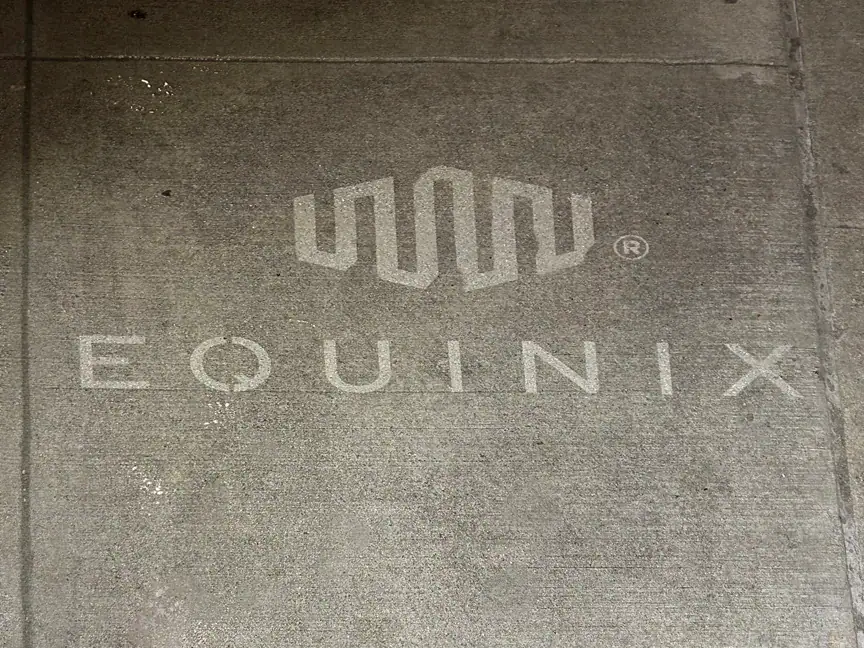
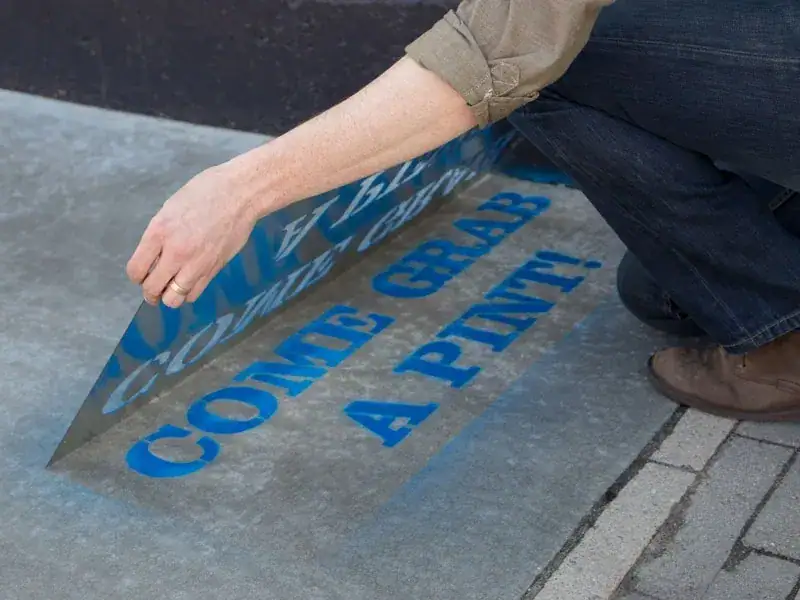
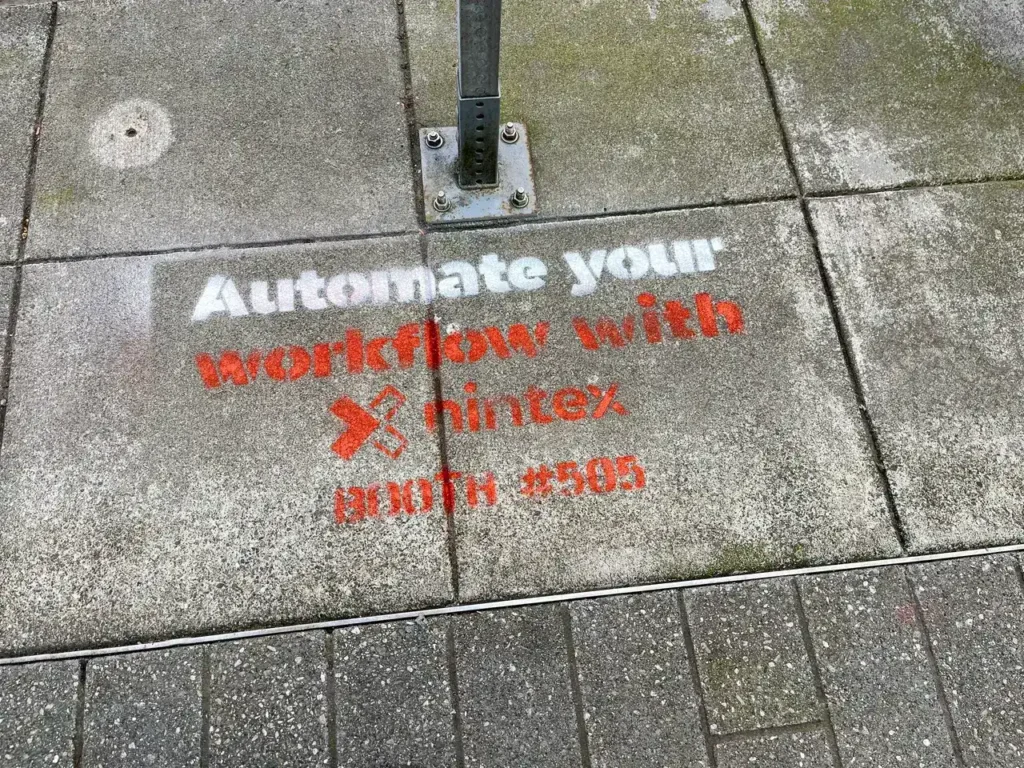
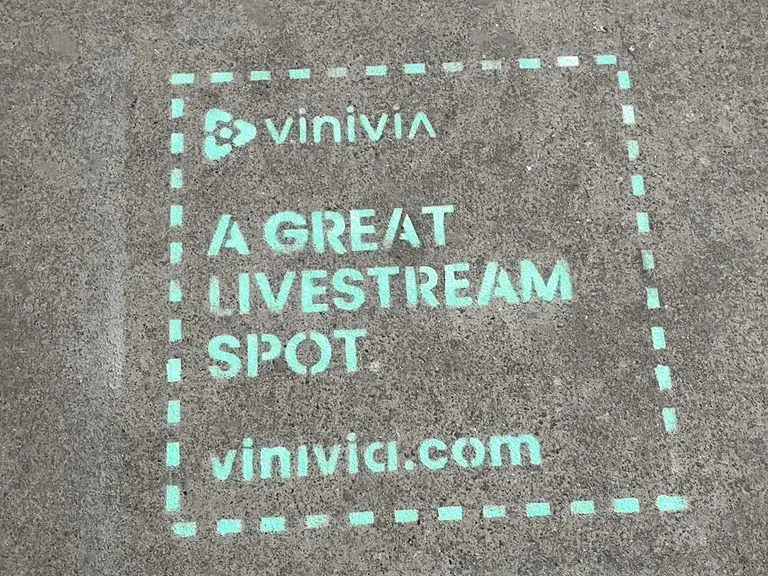
For Chicago campaigns tied to specific events — Lollapalooza weekend in Grant Park, Chicago Marathon race day on Columbus Drive, Taste of Chicago at the lakefront, or a game day at Wrigley Field or the United Center — chalk stencils are the right format. They deploy 24-48 hours before peak pedestrian windows, hold through the event, and naturally fade afterward. Chicago’s humid continental climate means chalk stencils on Loop smooth concrete typically last 7 to 12 days under normal summer conditions. Vinyl sidewalk decals are the right format for any Chicago campaign longer than two weeks. A new restaurant opening on Randolph Street in Fulton Market that needs 60-day presence, a fitness studio launch targeting Lincoln Park and Lakeview corridors, or a retail activation on Michigan Avenue that needs to survive the entire holiday shopping season all require vinyl. AGM vinyl decals are engineered with UV-protective coatings and anti-slip laminates, rated for Chicago’s temperature range from summer highs above 90F to winter freeze-thaw conditions. They adhere correctly to Chicago’s mix of smooth concrete sidewalks, aggregate sidewalk panels, and brick pavers found throughout Wicker Park, Bucktown, and Logan Square, and remove clean without adhesive residue.
Award Winning Personalized Service
You will get thoughtful, devoted, and individualized attention from our experienced, qualified, and professional personnel. Being one of the most illustrious agencies in Brooklyn, New York, American Guerrilla Marketing has been awarded the Best of Brooklyn title.
Nationwide
Industry City, Brooklyn, New York 11232
American Guerrilla Marketing
Hours
Mon - Fri: 9 AM - 5 PM
Sat & Sun: Closed
Automate your campaign with AGM’s Request for Proposal Builder. Simply answer a few quick questions about your campaign goals, markets, and timeline, and the system will generate a tailored presentation with recommended strategies, quantities, and pricing. Click the RFP Builder to instantly receive your customized proposal.


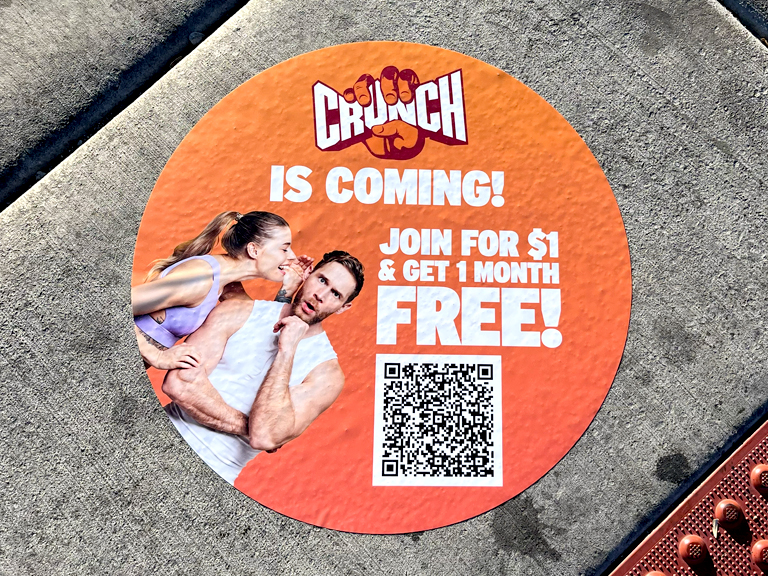
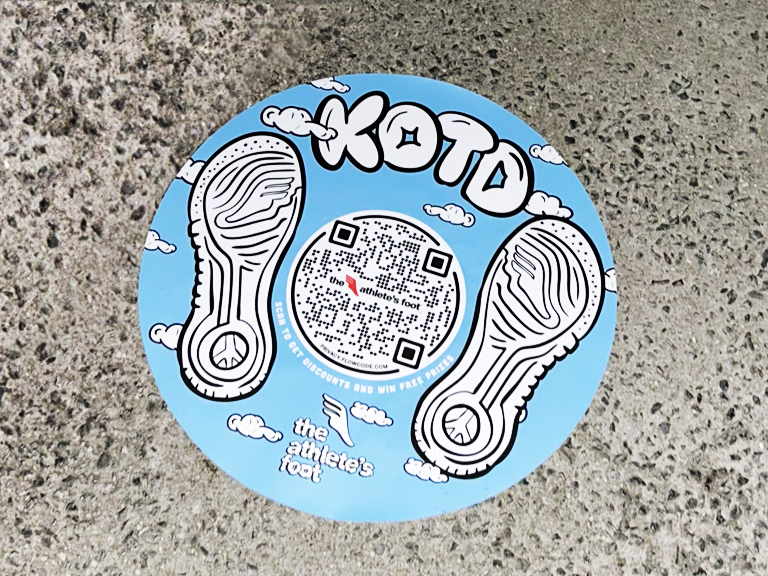


Chicago’s highest-value vinyl decal deployment zones cluster around five distinct pedestrian anchors. The Magnificent Mile on North Michigan Avenue — running from the Chicago River at Wacker Drive north to Oak Street — is the single highest foot-traffic commercial corridor in the Midwest, with estimated daily pedestrian counts of 25,000 to 35,000 during summer and holiday peak windows. The Loop’s State Street corridor from Wacker Drive to Congress Parkway delivers 15,000 to 22,000 daily pedestrian passes from transit commuters, office workers, and retail shoppers. Fulton Market District — centered on Randolph Street and Fulton Street between Halsted and Morgan — is Chicago’s highest-income food and entertainment corridor, with evening pedestrian counts reaching 8,000 to 12,000 on Friday and Saturday nights. Wicker Park’s Milwaukee-Damen-North triangle is Chicago’s most photographed and socially amplified neighborhood intersection — vinyl decals placed here consistently generate organic social documentation at 2 to 3 times the rate of comparable Loop placements. The Grant Park lakefront corridor along Columbus Drive delivers the city’s highest single-day impression counts during Lollapalooza (400,000+ daily attendance), Taste of Chicago, and the Chicago Air and Water Show.
| Zone | Est. Daily Foot Traffic | Impressions Per Decal (60 days) | Avg Campaign Duration | Ideal Campaign Type |
|---|---|---|---|---|
| Magnificent Mile / Michigan Ave | 25,000-35,000 | 1,500,000-2,100,000 | 60-90 days | Retail, luxury, lifestyle brands |
| State Street / The Loop | 15,000-22,000 | 900,000-1,320,000 | 60-90 days | Financial, tech, professional services |
| Fulton Market / Randolph St | 8,000-12,000 | 480,000-720,000 | 60-90 days | F&B, hospitality, nightlife brands |
| Wicker Park / Milwaukee-Damen-North | 6,000-10,000 | 360,000-600,000 | 60-90 days | CPG, streaming, lifestyle, apparel |
| Grant Park / Columbus Drive (event) | 40,000-80,000 event day | 560,000-1,120,000 (4-day event) | 4-7 days event window | Entertainment, beverages, experiential |
| Lincoln Park / Armitage-Halsted | 5,000-8,000 | 300,000-480,000 | 60-90 days | Fitness, family, home goods |
A national apparel brand launching a flagship store on Michigan Avenue deploys vinyl decals on the sidewalk approach from the Chicago Red Line at Grand/State, along Illinois Street to Michigan, and north along Michigan to the store entrance. 28,000 daily pedestrian passes over a 60-day pre-launch window generate an estimated 1.7 million impressions from the retail shopper and tourist demographic at a cost-per-impression well below equivalent digital buys in the Chicago market.
A beverage brand activating around Lollapalooza deploys vinyl decals on all four pedestrian approach routes to Grant Park — Columbus Drive from the Museum Campus, Michigan Avenue from Monroe to Balbo, Congress Parkway from the Blue Line, and the pedestrian bridge from Millennium Park. 400,000 daily festival attendance creates a 4-day window with an estimated 1.2 million or more impressions.
A consumer packaged goods brand targeting 21 to 35-year-old urban consumers deploys vinyl decals at the Milwaukee-Damen-North triangle and on the high-pedestrian blocks of Milwaukee Avenue between North and Division. The intersection’s social media amplification rate generates consistent organic documentation from passersby, extending campaign reach beyond direct impressions.
A restaurant group opening on Randolph Street deploys vinyl decals on the full length of Randolph between Halsted and Morgan for a 60-day opening campaign. Daily impression count averages 9,000 with strong Friday and Saturday evening spikes driven by Fulton Market’s dining and nightlife foot traffic.
A fintech app targeting college students deploys vinyl decals on Harrison Street approaches to UIC, the Halsted Street corridor between Harrison and Roosevelt, and the Maxwell Street Market area on Sundays, reaching 22,000 students during the first week of the fall semester.
Chicago’s campaign calendar rewards brands that plan around its dense events schedule. Lollapalooza (early August, Grant Park) is the single highest-value activation window in the city — 400,000+ daily attendance across four days creates impression volumes no other Chicago format matches at comparable cost. Chicago Marathon in October concentrates 45,000 runners and 1.7 million spectators along a course that passes through River North, Lincoln Park, Pilsen, and the South Loop. Taste of Chicago in July delivers 1.5 million visitors to the lakefront. The Magnificent Mile Lights Festival in November marks the start of the holiday retail season and generates some of the year’s highest foot traffic counts on Michigan Avenue. Summer (June through August) is Chicago’s outdoor peak season. Warm temperatures drive maximum pedestrian counts in neighborhoods like Wicker Park, Lincoln Park, and Pilsen that see significant seasonal variation. Fall (September through November) delivers the Chicago Marathon, back-to-school foot traffic at DePaul, Loyola, and UIC, and the holiday retail ramp-up on Michigan Avenue. Winter (December through February) requires cold-temperature adhesive spec for Chicago’s winters below 0F. The Magnificent Mile, State Street, and Fulton Market maintain strong pedestrian counts year-round even in cold weather.
1. North Michigan Avenue / Magnificent Mile: The blocks from the Chicago River at Wacker Drive north to Oak Street deliver 25,000 to 35,000 daily passes from tourists, retail shoppers, and hotel guests. The highest raw-impression zone in the Midwest for any street-level format.
2. Milwaukee-Damen-North / Wicker Park: Chicago’s most photographed intersection and the pedestrian spine of Wicker Park’s independent retail and nightlife corridor. Vinyl decals placed at this triangle reach 6,000 to 10,000 daily passes from the most socially engaged creative consumer demographic in the city.
3. Randolph Street / Fulton Market: The 3-block stretch of Randolph between Halsted and Morgan is Chicago’s highest-income dining and nightlife corridor. Friday and Saturday evening foot traffic counts regularly exceed 10,000. Brands targeting the 28 to 45-year-old professional and food enthusiast demographic find Fulton Market the most efficient placement in Chicago outside of the Magnificent Mile.
4. State Street / The Loop: State Street from Wacker to Congress delivers 15,000 to 22,000 daily passes from Chicago’s transit commuter and downtown retail audience — the highest weekday office professional concentration in the city.
5. Columbus Drive / Grant Park: The lakefront pedestrian corridor delivers Chicago’s highest event-day impression counts during Lollapalooza, Taste of Chicago, and the Air and Water Show. On peak event days, Columbus Drive approach routes see 40,000 to 80,000 daily passes.
Standard Vinyl Decals (30-90 days): UV-stabilized adhesive with moisture-tolerant formulation for Chicago’s humid summers. High-durability laminate for the foot traffic wear rates on high-pedestrian corridors like Michigan Avenue, State Street, and Wicker Park. Appropriate for spring and fall outdoor deployments on private property sidewalks in Wicker Park, Fulton Market, and Lincoln Park. Pricing starts at $2,904 for five locations.
Heavy-Duty Cold-Temperature Decals (90-180 days): Cold-temperature adhesive rated for Chicago winters below 0F. Enhanced laminate for freeze-thaw surface stress on Chicago sidewalks from November through March. AGM’s recommended standard for year-round public sidewalk placements on the Magnificent Mile, State Street, and any outdoor Chicago campaign running through winter.
ADA-Compliant Anti-Slip Decals: Enhanced anti-slip laminate for Chicago retail entrances, CTA station approach sidewalks, and high-risk pedestrian surfaces. Required for all public right-of-way placements under Chicago sidewalk permit requirements. Available in standard and heavy-duty spec to match the deployment environment.
Chicago is the most competitive street-level advertising market in the Midwest, and the difference between a vinyl sidewalk decal campaign that performs and one that doesn’t comes down to where you place it, what spec you use for Chicago’s climate, and whether the crew knows the city well enough to execute without errors. AGM has executed campaigns across Chicago’s 77 neighborhoods. We know the sidewalk surface conditions by block — which sections of the Magnificent Mile have the smooth poured concrete that holds vinyl cleanest, which blocks in Wicker Park have aggregate panels that require surface prep, and which Fulton Market sidewalks have the brick pavers that need edge sealing to prevent early lift. Vinyl sidewalk decal campaigns start at $2,904 for five locations and scale to $14,466 for 100 placements. Many Chicago programs pair decal placements with sidewalk stencil programs starting at $2,855 for five locations, creating a layered approach that covers both high-traffic arterials and neighborhood side streets. Rush deployment within 72 hours is available at a 50% premium for time-sensitive activations around Lollapalooza, the Chicago Marathon, or product launches. Every placement is GPS-tagged with timestamped documentation photos delivered in a campaign completion report.
Vinyl sidewalk decal placements on Chicago public sidewalks require a City of Chicago Department of Transportation sidewalk use permit. AGM recommends beginning this process 10 to 14 business days before the target installation date. Private property placements on retail storefront sidewalks in Fulton Market, Wicker Park, and River North require property owner permission only and can typically be executed within 48 to 72 hours of artwork approval.
Standard vinyl decals last 30 to 90 days in Chicago depending on foot traffic volume, surface condition, and weather. Heavy-duty cold-temperature spec decals last 90 to 180 days. Chicago’s combination of humid summers, winters below 0F, and freeze-thaw cycles from November through March makes heavy-duty spec AGM’s recommended standard for most Chicago outdoor campaigns.
In order of average daily pedestrian count: Magnificent Mile on Michigan Avenue (25,000-35,000), State Street Loop (15,000-22,000), Wicker Park Milwaukee-Damen-North (6,000-10,000), Fulton Market Randolph Street (8,000-12,000 evenings), Lincoln Park Armitage-Halsted (5,000-8,000). Event-day multipliers apply — Lollapalooza and Chicago Marathon approach corridors see 3 to 5 times baseline pedestrian counts during peak windows.
Yes — with the right spec. Heavy-duty cold-temperature adhesive rated for Chicago winters below 0F is required for any outdoor campaign running from November through March. Standard vinyl is appropriate for spring and fall deployments. AGM selects adhesive spec based on the campaign’s start date, duration, and neighborhood, accounting for Chicago’s freeze-thaw cycles that can stress standard adhesive formulations.
Smooth poured concrete sidewalks prevalent in the Loop, Magnificent Mile, and River North provide the best surface for vinyl decals — clean edges, strong adhesion, and consistent wear performance. Wicker Park, Bucktown, and Logan Square have a mix of concrete and older aggregate panels that require surface assessment. Fulton Market and Pilsen have brick pavers in some sections that need edge sealing. AGM assesses surface conditions on every Chicago placement before production to confirm adhesion spec is correct for the specific location.
Yes — AGM covers all of Chicago’s 77 neighborhoods plus the broader Chicago metro. Regular deployment zones beyond the Loop and River North include Wicker Park, Bucktown, Logan Square, Lincoln Park, Lakeview, Pilsen, the South Loop, Hyde Park, and Andersonville. Suburban Chicago deployments in Evanston, Oak Park, Naperville, and Schaumburg are also available for regional brand campaigns.