
January 12, 2026 Wild Wheat Paste Posting Posting and Wheatpasting
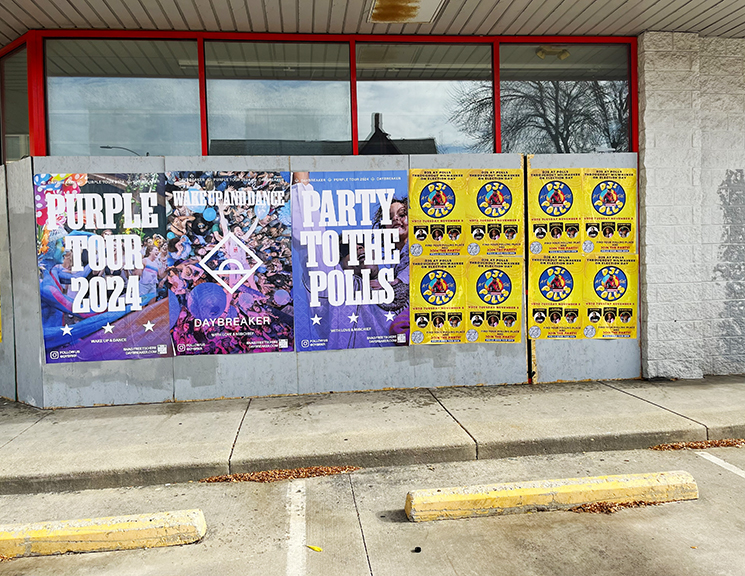
Wheat paste posting looks simple when you see a fresh wall at golden hour. The reality is messier: surprise drizzle, humidity that turns “dry” into “tacky,” a wind tunnel between buildings, and the one surface that felt perfect until you touched it and realized it was still sweating yesterday’s rain. A year-round wheatpasting plan succeeds by accepting those imperfect conditions, then designing around them.
Wild wheat paste posting has always lived through weather. That is part of its cultural power. It shows up when it is hot, when it is gray, when sidewalks are wet, and when people are bundled up moving fast. A year-round strategy treats the street as a living channel, not a single burst.
If your outdoor poster strategy only works in ideal conditions, it will underperform across most of the calendar. Rain and moisture are the obvious threats, but they are not the only ones. Heat can soften adhesive. Cold can make paper and paste brittle. Sun slowly drains color until a poster still “exists” but stops doing its job.
The hidden variable is microclimate. Two walls on the same block can behave like different cities. One gets baked all afternoon, another never fully dries. One sits in a wind corridor, another is protected by an awning that also traps damp air.
A professional wheatpasting plan is less about one perfect install and more about repeatable decisions: what to print, how to mix, when to install, where to place, and when to return.
After you’ve accepted that the street is unpredictable, you can build campaigns that feel steady to the audience even when the environment is not.
Brands often talk about an always-on presence online. Wild posting can work the same way, with one important twist: you plan for decay and replacement instead of pretending durability is infinite.
That mindset changes how you budget and how you time drops. Instead of a single massive run meant to last “as long as possible,” you design a cadence that makes the medium feel consistently alive.
A practical year-round wheatpasting approach usually includes:
American Guerrilla Marketing (AGM) operates from this kind of adaptive baseline. The work stays recognizable across spring, summer, fall, and winter, while the tactics shift: materials, timing, placement, and refresh cadence.
Seasonal street marketing is not only about swapping colors or adding a holiday line. The real gains come from operational decisions: what you carry in the kit, how you prep surfaces, and how you schedule crews.
A simple way to think about it is inputs versus outputs. Your output is consistent visibility. Your inputs change to protect it.
After you map a city, it helps to run a fast check that keeps teams honest about conditions before they paste.
This is where experienced teams separate themselves. They do not just “post more.” They post smarter.
AGM’s value in year-round wheatpasting is not a single trick recipe. It is the habit of adapting across cities and seasons, then documenting what worked so the next install gets easier. Below is how a season-by-season plan typically looks when it is built for real streets.
Spring feels like a restart, but it comes with moisture risk. Cool nights slow curing, and sudden showers can lift edges that looked perfect at install time.
Spring is when timing discipline matters most. A crew can win the week by choosing a dry window and avoiding the temptation to paste right after rain “because the wall looks clean.” Clean is not the same as dry.
AGM-style spring execution emphasizes smarter windows and quicker follow-ups. Install days are chosen around forecasts, and walls get prioritized based on shelter and sun exposure so paste can actually set.
Summer is often the best season for wheat paste posting because long dry spells let paste cure properly. The challenge is that summer also punishes color and consistency. Hot days can make adhesive behave differently, and bright sun fades inks faster than you expect.
Operationally, summer rewards crews that work earlier or later. Midday installs can be physically brutal and can produce inconsistent results if paste skins over too quickly.
Summer also expands the cultural canvas. Music festivals, outdoor markets, and late-night foot traffic bring new value to walls near venues, transit corridors, and nightlife routes. Wild posting becomes part of that seasonal texture, the same way flyers and murals do.
Fall is the season of “it depends.” You can get perfect poster weather for a week, then a cold snap and rain arrive together. Leaves and street debris add friction too, literally, since they hold moisture against edges and corners.
Fall is when a year-round wheatpasting plan should start thinking ahead to winter surfaces and winter schedules. It is also a strong time for multi-week storytelling: staggered creative releases, neighborhood-by-neighborhood takeovers, and refresh cycles that feel intentional rather than reactive.
AGM tends to treat fall as a stability season: steady posting, clear mapping, and print choices that can tolerate a wider temperature range.
Winter is tough on everything. Freeze-thaw cycles stress adhesion, snow adds moisture, and nighttime installs can backfire when temperatures drop quickly.
Winter success comes from taking what the season gives you. Midday sun, even if weak, can be your friend. Sheltered placements matter more. Material choices matter more.
The upside is attention. When other brands pull back, winter wild posting can feel bold and memorable. A clean, high-contrast design on a smartly chosen wall can punch through the gray, and the scarcity can make each placement feel more intentional.
AGM’s winter approach typically focuses on surfaces that behave predictably in cold conditions (wood and brick over metal), thicker mixes that do not run, and selective posting that is easier to maintain.
“Use better materials” is true but incomplete. A year-round plan chooses materials based on failure modes.
Heavier stocks tend to hold up better outdoors, and matte finishes often photograph well without glare. Ink choices matter too: UV-stable, pigmented inks resist fading longer, which is a big deal in summer and at high-sun angles.
Paste is where seasonal adaptation gets tactical. Slight tweaks can change how paste handles humidity, heat, or cold. Many crews adjust viscosity and additives based on the day, not just the month.
A practical way to organize material choices is to tie them to what you are defending against.
| Season | Primary stressors | Material strategy | Install timing strategy | Placement bias |
|---|---|---|---|---|
| Spring | Rain, humidity, slow cure | Heavier paper, mold-resistant mix | Post after dry windows, quick checks | Sun-facing or sheltered walls |
| Summer | Heat, UV fade, occasional storms | UV-stable inks, paste that stays workable | Early morning or evening installs | Shaded brick/concrete, avoid sun-baked metal |
| Fall | Temperature swings, rain variability | Slightly thicker mix, durable stock | Plan around fronts, refresh rhythm | Wind-protected corridors, overlap seams |
| Winter | Freeze-thaw, snow, brittle edges | Thick paste, cold-tolerant tack, sealing | Midday installs when warmer | Wood/brick, sheltered locations |
If you only change one thing in winter, change how thick and controlled your adhesive application is. If you only change one thing in summer, protect the image from sun and plan for faster fading even when adhesion is strong.
Placement is not just about cool streets or high foot traffic. It is about whether a wall behaves like a reliable billboard.
The same block can contain:
Professional wheatpasting treats site selection as both marketing and physics. Smooth, matte surfaces generally give paste more to grab. Glossy paint, glass, and some metals often perform poorly, especially when temperatures swing.
AGM’s approach is to map locations with a mix of anchor placements (often permitted boards or approved walls where possible) and tactical placements that match the campaign’s tone. That blend keeps the work visible while staying adaptable when a particular corridor gets cleaned, repainted, or suddenly becomes a wind tunnel.
Outdoor posters are not “set it and forget it.” A year-round plan expects early failures and fixes them before they spread.
The first 24 to 48 hours are when small issues become big ones. Corners lift, bubbles form, and wind starts pulling at any weakness. Catching those issues early can add days or weeks of life.
A maintenance loop does not need to be complicated, but it needs to be scheduled.
This is one reason many brands choose professional wheatpasting rather than improvising. The labor is not only in the install, it is in the returns.
Wild posting works because it feels like the street talking to itself. It is advertising, but it is also texture. Posters overlap, peel, and remix the walls over time. A good campaign accepts that ephemerality and designs into it.
In summer, that can mean bright, photogenic graphics near venues where people already take pictures. In fall, it can mean layered designs that still read when edges wear. In winter, it can mean high-contrast minimalism that reads fast as people move quickly through the cold.
Year-round wheatpasting also benefits from respect: for neighborhoods, for property lines, and for the unwritten rules that keep street marketing from becoming a nuisance. Agencies like American Guerrilla Marketing build plans that can shift with city enforcement patterns, seasonal foot traffic, and the reality that not every wall is worth fighting.
The result is a street presence that stays consistent even as the weather changes, with wild posting remaining a constant cultural signal that the city is active, creative, and paying attention.
For a customized strategy tailored to your next event, reach out directly at [email protected].
