The audience that matters most for your Boston convention marketing campaign probably isn’t “everyone in Boston.” It’s the people in specific neighborhoods, moving along specific routes, during specific parts of the week. Convention marketing lets you reach that specific audience at street level rather than broadcasting across a demographic that includes thousands of people who will never be your customers. American Guerrilla Marketing builds Boston convention floor and adjacent marketing around that kind of audience specificity.
Guerrilla marketing uses unconventional, low-cost tactics deployed in public spaces to generate outsized brand impact. American Guerrilla Marketing designs and executes street-level campaigns, wheat posting, stencils, brand ambassadors, projections, and LED trucks, that create genuine consumer encounters and earned media coverage for brands of all sizes.
Brand memory, the kind that drives actual purchase behavior, isn’t built through a single impression. It’s built through repeated, contextually relevant encounters that accumulate over time. Convention marketing campaigns in Boston create that repetition structurally: the same audience encounters the same creative across multiple touchpoints in their daily geography. Neuroscience research on memory formation consistently shows that physical, in-environment exposure generates stronger recall than screen-based advertising because it engages spatial memory pathways that screen advertising cannot access. In a market like Boston, where educated, brand-literate consumer base where creative quality determines whether a campaign builds credibility or blends into the background, that recall advantage compounds.
Sections below cover Boston’s key activation neighborhoods, the convention marketing tactics that generate the strongest audience engagement in this market, American Guerrilla Marketing’s campaign planning and field execution process, a budget and ROI reference table, and a complete FAQ. Use this as both an educational resource and a starting point for campaign planning, our team is available to build a Boston-specific proposal from here.
Why Massachusetts Is a Strong Convention Activation Market
Massachusetts is unusually good for convention-focused street marketing because it compresses high-value audiences into walkable districts. Boston alone gives you multiple event ecosystems with distinct audience behavior. The Seaport around the Boston Convention & Exhibition Center skews large-scale, badge-heavy, hotel-to-venue traffic. Back Bay around the Hynes skews denser, more retail-adjacent, and more organically mixed with shopping, dining, and hotel traffic. Worcester and Springfield add regional event environments where visibility can feel more dominant with fewer placements because attendees circulate through tighter downtown footprints.
That concentration matters. A convention attendee is already in discovery mode. They are moving with purpose, scanning for signals, taking meetings, comparing vendors, and deciding what deserves five minutes of attention. That is exactly the mindset guerrilla marketing can exploit. Instead of interrupting passive media consumption, you are intercepting someone who is already primed to notice relevant, memorable, and well-timed brand cues.
Massachusetts also supports a broad range of event verticals. You get biotech, gaming, education, food and beverage, comic and fan culture, travel, home and design, healthcare, and regional trade associations. That means the market rewards campaigns that can shift tone and format instead of forcing one template across every show. A biotech audience in the Seaport wants a very different visual language than a fandom audience in Back Bay, and a regional B2B crowd in Worcester will respond differently than a consumer-heavy event in Boston.
The upside is huge for brands willing to plan like operators instead of tourists. When your street-level campaign understands the event, the district, and the attendee’s daily rhythm, Massachusetts conventions stop looking like crowded noise and start looking like a sequence of predictable brand contact points.
Venue and District Intelligence That Actually Changes the Plan
The biggest planning mistake in convention marketing is treating every venue the same. Massachusetts punishes that mistake quickly because each major venue creates different pedestrian behavior.
Boston Convention & Exhibition Center and the Seaport
Signature Boston lists the BCEC at 516,000 square feet of contiguous exhibit space, 82 meeting rooms, and a 40,000-square-foot ballroom. That scale tells you something important: attendees fragment across a broad footprint, and the surrounding district becomes part of the event experience. Seaport campaigns need corridor thinking. Summer Street, hotel approaches, coffee routes, dinner zones, and after-hours bar clusters matter because they reconnect the audience after they disperse inside the building.
The Seaport also favors formats that can punch through clean, modern visual surroundings. High-contrast poster campaigns, polished brand ambassador uniforms, LED truck routes, and highly legible wayfinding-style creative generally work better here than messy or overly layered design. This district rewards confidence and clarity.
Hynes Convention Center and Back Bay
Signature Boston describes the Hynes at 176,480 square feet of adaptable exhibit space, an auditorium seating 4,000+, 38 meeting rooms, and a 24,544-square-foot ballroom, plus direct adjacency to hotels, restaurants, and retail in Back Bay. That means Hynes activations can be more intimate and more frequent. The audience moves through compressed blocks, which increases repeated exposure. A great creative concept may be seen three or four times in a day by the same attendee simply because Back Bay foot traffic folds back on itself.
That makes Back Bay perfect for campaigns that need repetition to work: teaser headlines, QR-driven scavenger flows, retail tie-ins, branded coffee handoffs, or poster campaigns that build narrative across multiple blocks. The district naturally supports layered storytelling.
DCU Center and Downtown Worcester
The DCU Center convention complex in Worcester combines 85,520 square feet across the convention center and arena floor, including 52,840 square feet in the exhibit hall and 12,144 square feet in the grand ballroom. That is a different animal from Boston. Worcester is not about chasing a huge dispersed coastal district. It is about owning a smaller downtown pattern. When the event is right, a modest number of placements can create the feeling that your brand is everywhere because attendees cycle through the same blocks, garages, restaurants, and lobbies repeatedly.
Worcester is a strong market for efficient dominance. If a brand wants visibility without Boston’s complexity and media pricing, this city often offers a better attention-to-effort ratio.
MassMutual Center and Downtown Springfield
MassMutual Center highlights 100,000 square feet of flexible meeting space plus an 8,000-seat arena. Springfield’s advantage is regional concentration. Shows here often pull attendees who are less overstimulated than a major Boston mega-convention crowd and more willing to engage in direct conversation. The surrounding MGM Springfield and downtown core create strong opportunities for evening visibility, hospitality tie-ins, and high-frequency pedestrian touchpoints.
If your goal is quality conversations, measured lead flow, or regional market awareness instead of pure spectacle, Springfield can be surprisingly efficient.
How to Match Tactics to Massachusetts Event Types
Not every convention audience wants the same kind of surprise. The creative has to match the room.
Biotech, healthcare, and professional B2B shows
For large professional events, especially around the BCEC, the winner is usually disciplined sophistication. Think premium poster campaigns near hotel corridors, polished street teams with short talking points, and hospitality-linked activations that feel useful rather than loud. The audience is tired, scheduled, and moving between meetings. They respond to clarity, relevance, and convenience. If you can save them time, guide them to a better conversation, or frame your value proposition in one clean sentence, you win.
This is where AGM likes to use concise out-of-home creative paired with QR codes that route to a specific landing page, dinner RSVP, case study, or live product demo. The campaign should feel like a shortcut, not a stunt for its own sake.
Gaming, anime, and fan culture events
PAX East calls itself the biggest gaming event on the East Coast, which tells you the audience expects energy, novelty, and visual identity. For gaming and fan conventions, the strongest campaigns create collectability, photo moments, or a hunt. That could mean serialized poster creative, a street-team badge insert, a QR-powered giveaway trail, or a bold nighttime projection timed to line movement and evening crowd spillout.
Anime Boston and similar events also reward character-driven visuals and community fluency. If the campaign looks generic, it gets ignored instantly. If it feels native to the fandom without trying too hard, people photograph it, post it, and talk about it while waiting in line.
Food, beverage, and hospitality events
For seafood, restaurant, beverage, and hospitality trade shows, the smartest move is to connect the event floor with the city’s dining behavior. Boston’s restaurant clusters, oyster bars, coffee shops, and hotel bars become media surfaces in practice even if they are not formal ad units. Beer coasters, hospitality drops, ambassador touchpoints, and nearby poster flights all work because they meet the audience in a category-relevant environment. The message feels continuous with what they are already doing.
Education, association, and regional conferences
Shows like MassCUE or mid-sized association conferences often benefit from practical, reassuring creative. The audience is there to learn, network, and bring back useful ideas. Overly aggressive stunt marketing can feel off. Instead, campaigns should emphasize relevance, utility, and an easy next step. A strong ambassador interaction, a useful takeaway, or a simple visual metaphor often outperforms spectacle.
High-Performance Guerrilla Formats Around Conventions
AGM usually builds Massachusetts convention campaigns from a short list of formats that can be combined based on audience, budget, and district complexity.
Wheat Paste Poster Campaigns
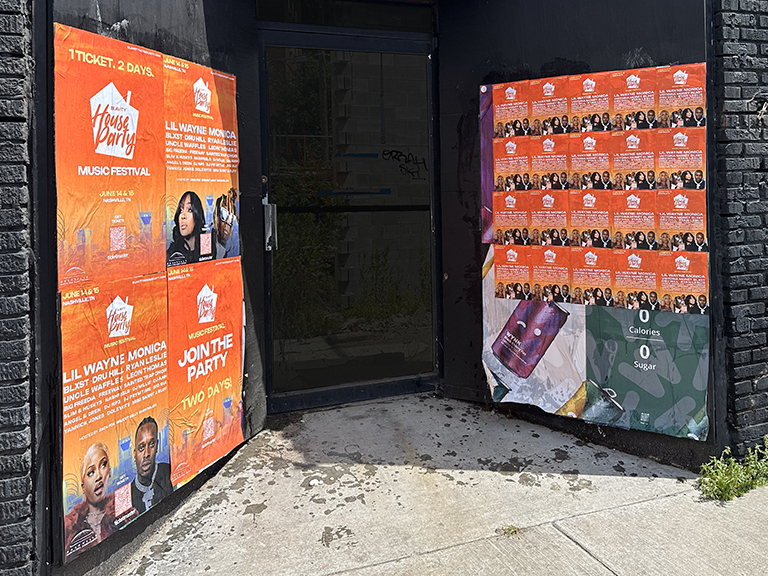
Poster campaigns are still one of the best ways to create convention-week ubiquity. They work especially well when the event audience is moving between hotels, transit, food, and nightlife. In Boston, the right poster system can create repetition across Seaport approaches or Back Bay loops. In Worcester and Springfield, it can create the impression that your brand has taken over the district.
Brand ambassadors and street teams
Human contact matters more during conventions because people are already in networking mode. But staff have to be trained for event context. The wrong ambassador behavior, especially around a professional show, feels intrusive fast. AGM uses staff who know when to open a conversation, when to keep it to seven seconds, and when to hand off to a landing page, sample, invite, or follow-up point.
For Massachusetts specifically, this matters because weather, sidewalk width, and neighborhood etiquette change how direct you can be. Boston Seaport and Back Bay are not the same operating environment, and neither behaves like downtown Worcester or Springfield.
Mobile and illuminated formats
LED billboard trucks and evening projection campaigns can be extremely effective around convention periods, especially when the event audience spills into nightlife or evening programming. These work best when they are routed with purpose. A truck circling randomly is just expensive motion. A truck placed around dinner windows, key exit periods, hotel frontages, or event-adjacent nightlife clusters becomes a timing tool.
Sidewalk and environmental wayfinding tactics
Sidewalk stencils, decals, or directional environmental graphics work when they feel like part of the attendee journey. These tactics are strongest when the activation has a destination: a nearby lounge, product demo, breakfast, after-hours panel, or branded installation. On their own, they are decorative. Connected to a next step, they become traffic drivers.
Boston, Worcester, and Springfield Activation Playbook
Boston: build around district friction
Boston conventions are rarely won by one isolated move. They are won by solving district friction. Seaport attendees deal with long venue days, hotel spread, dinner migration, and evening drop-off in attention. Back Bay attendees deal with density, distraction, and constant retail competition. Your campaign should reduce friction by being either easier to notice, easier to remember, or easier to act on than everything around it.
For BCEC weeks, AGM likes a layered plan: hotel-zone poster presence, ambassador touchpoints at high-value commute windows, and one standout evening format. For Hynes weeks, we often compress the effort into fewer blocks and increase frequency, because repeated exposure is the main advantage of Back Bay.
Worcester: own the compact loop
Worcester is ideal when you want disproportionate visibility from a moderate spend. Downtown movement is more compact, which means placement selection matters more than sheer volume. We usually map parking arrival points, food traffic, and post-session movement first. Once those loops are clear, the campaign can be designed to dominate a small number of blocks instead of trying to mimic Boston.
This market is also good for brands that want a strong field-documentation story. The right Worcester deployment photographs beautifully because the campaign feels coherent across a compact geography.
Springfield: lean into regional attention and stronger conversations
Springfield works best for brands that want to pair awareness with actual engagement. The downtown core is easier to read operationally, and attendees often have more conversational bandwidth than at a giant coastal mega-show. We like to connect MassMutual Center activity with nearby hospitality touchpoints and evening environments so the campaign does not die when sessions end.
In practice, that often means fewer gimmicks and stronger conversion mechanics: a useful offer, a strong RSVP path, a hospitality destination, or a lead-capture reason that makes sense for the audience.
How to Measure Convention Campaign Performance
Massachusetts convention campaigns should never be judged on vibes alone. You can absolutely measure them, and you should. AGM typically recommends a stack of measurement signals instead of relying on one vanity metric.
The main point is simple: convention marketing should be treated like a live operating system, not a one-off stunt. If one block, route, or staff script is outperforming, the next show should absorb that lesson immediately.
Campaign Strategy & Market Considerations
Every Massachusetts convention campaign should start with three questions. First, where does the audience actually move outside the venue? Second, what does this specific crowd consider worth stopping for? Third, what is the clearest measurable next step? Those answers shape everything else.
Timing matters more than many brands realize. The best moment is not always peak show-floor time. It may be badge pickup evening, first-morning coffee flow, the lunch break when attendees spill out looking for air, or the after-hours window when people are finally relaxed enough to engage. Massachusetts events, especially in Boston, often reward campaigns that build pressure over 24 to 72 hours rather than trying to hit everything at once.
Creative should also reflect the district. Seaport supports polished, large-format confidence. Back Bay supports repeated touchpoints and cultural fluency. Worcester rewards territorial efficiency. Springfield rewards approachability and conversion focus. The same brand can look smart in all four places, but not with identical execution.
And finally, convention campaigns should connect to a business objective. If the goal is lead generation, the field script and destination must reflect that. If the goal is category awareness, the visuals must be simpler and more ownable. If the goal is earned media or social spread, the installation must be inherently documentable. Strategy first, format second. That is how the campaign stays effective instead of merely interesting.
Frequently Asked Questions
What is the best guerrilla marketing strategy for Massachusetts conventions?
The strongest strategy combines venue intelligence, hotel and transit path planning, and one or two memorable field formats that fit the audience. In Boston that usually means district-based planning around the BCEC or Hynes. In Worcester and Springfield it usually means dominating a tighter downtown loop with higher frequency.
Can you run convention marketing without a booth?
Yes, and in some cases that is the smarter play. A brand can reach attendees in the spaces where they are less overwhelmed: hotel corridors, coffee routes, dining zones, and evening social pockets. That often produces better conversation quality than trying to shout from the middle of the floor.
Which Massachusetts city is best for convention activations?
Boston is best for scale and layered exposure. Worcester is best for efficient downtown domination. Springfield is best for regional reach and stronger one-to-one engagement. The right answer depends on whether you need awareness, lead generation, hospitality attendance, or a mix of all three.
How far in advance should a convention campaign be planned?
For a polished multi-format program, start several weeks ahead so strategy, design, production, staffing, and routing can work together. Smaller street-level deployments can move faster, but convention windows are unforgiving, so rushed planning almost always shows in the result.