Digital out-of-home advertising is the fastest-growing segment of the outdoor advertising market, with North American DOOH revenue projected to reach $7.4 billion in 2026 according to Fortune Business Insights. The growth is driven by three converging forces: expanded digital screen infrastructure in high-traffic urban and suburban environments, the arrival of programmatic buying infrastructure that brings DOOH into unified campaign management platforms, and brands discovering that dynamic creative capability, serving different messages based on weather, time, location, and real-time data, produces measurably better recall than static campaigns at the same placements. This complete guide covers every DOOH format, realistic pricing by screen type and market, how programmatic buying works for outdoor, dynamic creative strategy, and how digital OOH integrates with physical guerrilla campaigns to create the multi-layered street presence that neither format achieves alone.
What Qualifies as Digital Out-of-Home Advertising in 2026
Digital out-of-home advertising is any advertising displayed on a digital screen in a public or semi-public environment. The category has expanded significantly in recent years beyond traditional digital billboards. In 2026, DOOH inventory includes: large-format LED billboards on highways and building faces, transit screens in subway stations and bus shelters, digital panels at retail points-of-sale, screens in airport terminals and concourse corridors, gas station video displays at the pump, elevator lobby screens in commercial office buildings, digital kiosks on urban sidewalks (including the LinkNYC network in New York City), stadium and arena LED systems, and programmatically-available digital panels in fitness centers, medical waiting rooms, and bar and restaurant environments.
What distinguishes DOOH from traditional static OOH is not just the screen, it’s the capabilities the screen enables. A digital billboard can update creative instantaneously rather than requiring physical printer and installation crew. It can display time-sensitive content (morning coffee promotion, afternoon commute insurance message, evening restaurant ad). It can participate in programmatic buying ecosystems, accessible through the same DSPs that handle mobile display and CTV. It can display dynamic content triggered by weather, live sports scores, stock prices, or any available data feed. These capabilities make DOOH measurably more flexible and often more effective than equivalent static formats at the same locations.
DOOH Formats and Pricing: The Full Range
Large-Format Digital Billboards
Large-format LED billboards are the flagship format of the DOOH ecosystem. Located on highways, major arterials, and building faces in high-traffic corridors, digital billboards rotate through multiple advertisers in 8 to 15-second slots per cycle, or can be purchased as a dedicated takeover for a specific time window.
Pricing varies significantly by market and location within market. In New York City’s Times Square corridor, premium digital faces run $20,000 to $50,000+ per four-week period. On the Sunset Strip in Los Angeles, digital billboard placements run $15,000 to $35,000 per four-week period. In mid-sized markets, Nashville, Denver, Charlotte, Columbus, Portland, comparable digital billboard placements run $2,000 to $8,000 per four-week period. In smaller markets below 500,000 population, digital rotation slots are available starting at $500 to $1,500 per four-week period.
The CPM advantage of DOOH digital over traditional static format is the ability to share a premium face across multiple advertisers in rotation, each advertiser pays for a rotation slot rather than a full face, getting premium location exposure at lower cost than exclusive static placements at the same location.
Transit DOOH: Subway, Bus, and Rail Screens
Transit DOOH screens in subway stations, bus shelters, and commuter rail platforms deliver highly concentrated audience impressions in the waiting and transit context, among the highest-attention advertising environments in OOH media. In New York City, Outfront Media’s subway station digital network, the LinkNYC sidewalk kiosk network (1,800+ large-format 55-inch touchscreen panels at eye level across the five boroughs), and the MTA digital displays in the system’s busiest stations collectively represent some of the most-viewed urban advertising inventory in the country.
A LinkNYC campaign reaching the full Manhattan kiosk network through Intersection’s programmatic platform delivers millions of daily impressions at CPMs typically in the $15 to $35 range for programmatic buying. Station domination campaigns, covering all visible digital and static surfaces at a single major station like Grand Central-42nd Street or Union Square-14th Street, run $75,000 to $200,000+ per week for the most prominent stations in the MTA system. The impact is complete visual ownership of the station environment for every person entering, transiting, or waiting.
Retail and Point-of-Care DOOH
In-store retail DOOH screens inside grocery stores, pharmacies, big-box retailers, and shopping center corridors reach consumers at or near the point of decision, while they’re actively shopping in the category your product competes in. Walmart’s in-store digital screen network, CVS Health Media Exchange, Kroger’s in-store digital inventory, and Target’s digital display network are all programmatically accessible as of 2026 through their respective retail media network platforms.
Point-of-care DOOH in medical waiting rooms, pharmacy waiting areas, and clinical environments is managed by specialized networks including Outcome Health and PatientPoint. These environments deliver dwell times of 10 to 30 minutes, by far the longest of any DOOH format, to audiences who are often specifically present to address a health decision. For healthcare and pharmaceutical advertisers, point-of-care DOOH is among the most strategically aligned advertising placements available.
Airport DOOH
Airport advertising reaches frequent travelers, business decision-makers, and high-income consumer segments with dwell times that allow for extended creative formats. Major U.S. airports, JFK, LAX, O’Hare, Hartsfield-Jackson Atlanta, Dallas-Fort Worth, Denver International, Miami International, have extensive digital networks covering terminal corridors, gate areas, and baggage claim zones. National airport network campaigns from vendors including Clear Channel Airports and JCDecaux Airports start at $250,000+ for 4-week programs across a defined airport set.
Individual airport station buys are available at lower minimums, a single major airport’s digital network for a four-week period typically runs $25,000 to $75,000 depending on airport size and screen quantity. For luxury brands, financial services, automotive, and B2B categories where the business traveler demographic is the primary target, airport DOOH CPMs are competitive with premium digital formats targeting equivalent demographics.
Programmatic DOOH: How Automated Buying Is Changing the Market
Until recently, buying a digital billboard meant calling an OOH vendor, negotiating a rate, signing a four-week contract, and waiting for manual creative trafficking. Programmatic DOOH changes all of that. Through DSPs including The Trade Desk, Vistar Media, Place Exchange, and Verizon Media, digital OOH inventory is now accessible through the same buying interface used for digital display, mobile, CTV, and audio advertising.
EMARKETER projects a 3.6% lift in OOH advertising spending for 2026, with programmatic DOOH driving a disproportionate share of that growth as brands and agencies discover the efficiency of unified cross-channel campaign management. The ability to activate OOH screens in a specific neighborhood on a specific date with a specific audience profile, without manual vendor contracts for each screen, is transforming how OOH is planned and executed for time-sensitive campaigns.
Programmatic DOOH targeting is audience-based rather than individual-user-based. Because OOH reaches everyone physically present at a location (not individually tracked users), targeting is based on location characteristics: the demographic profile of people typically present at a given location at a given time of day. A programmatic DOOH campaign targeting urban young professionals can select screens in downtown office corridors during morning and evening commute windows, fitness center screens during early morning and lunch windows, and bar and restaurant environment screens on Friday and Saturday evenings, all through a single DSP interface with unified reporting.
Dynamic Creative in DOOH: What Makes Digital Different
The capability that most differentiates DOOH from static OOH, and that most advertisers significantly underuse, is dynamic creative: serving different creative based on real-time conditions. Dynamic DOOH creative categories that consistently outperform static creative in recall studies:
Weather-triggered creative: A coffee brand serving “Warm Up” messaging when temperatures drop below 40°F and “Iced Coffee” creative when temperatures exceed 80°F. The contextual relevance of weather-matched messaging improves ad recall over a static single-message campaign. The trigger integration is straightforward through most DOOH programmatic platforms and requires minimal additional production beyond providing the alternate creative sets.
Time-of-day messaging: A QSR brand showing breakfast items before 10 AM, lunch from 11 AM to 2 PM, and dinner through the evening. Day-parted creative matches the message to the decision moment, a consumer seeing a breakfast ad at 7:30 AM is actively considering breakfast; the same ad at 4 PM has no decision relevance.
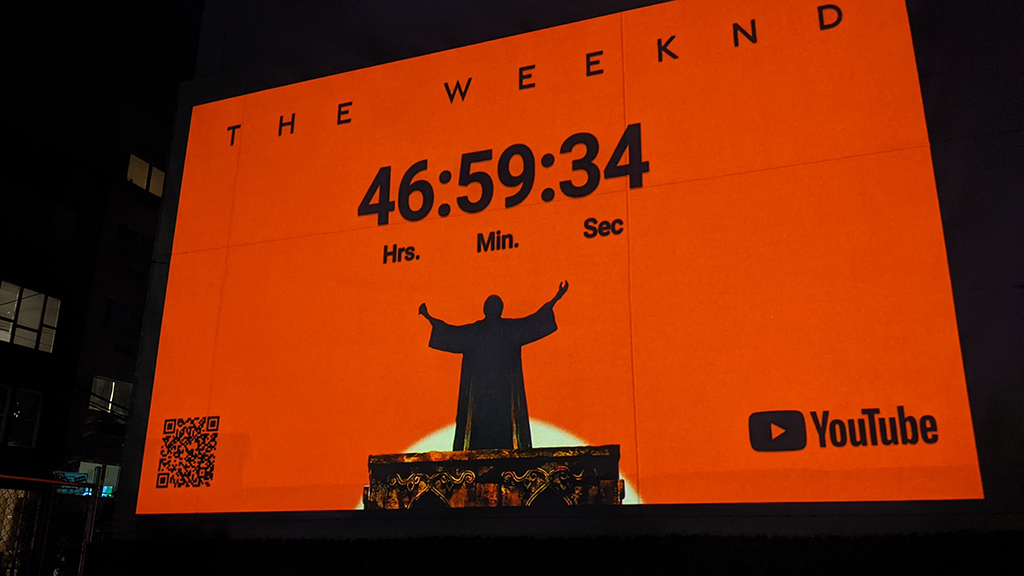
Live data integration: Sports brands showing live game scores, financial services showing current interest rates, event brands showing countdown clocks, and retail brands showing inventory availability. Live data integration creates urgency and relevance that static creative cannot replicate.
Location-specific directional messaging: A retail brand showing “2 blocks east at 5th Avenue” from a screen at a specific location, or a restaurant showing “50 yards ahead” from a screen on the adjacent block. Immediately actionable directional creative produces higher ad-prompted foot traffic than generic awareness messaging from the same screens.
How AGM Integrates Physical OOH With DOOH Campaigns
The most effective street-level campaigns we build for clients combine programmatic DOOH and physical OOH formats in the same target geographies. The integration rationale is simple: DOOH handles guaranteed impression volume at scale with clean digital reporting; physical formats handle street-credibility, earned media moments, and the 24/7 visual presence in specific neighborhoods that digital screens on rotation cannot deliver.
In Manhattan, a client running programmatic DOOH through the LinkNYC kiosk network (delivering significant reach across the city’s pedestrian corridors) can simultaneously layer a wheat paste campaign in SoHo and Williamsburg that saturates the specific neighborhoods where the client’s core audience clusters. The DOOH network builds broad awareness across the city; the wheat paste builds intimate street-level presence in the neighborhoods where the target audience actually lives and walks daily.
In Chicago, programmatic DOOH on the Michigan Avenue and State Street corridor transit shelter digital network, combined with street poster advertising in Wicker Park and Logan Square, covers both the downtown commercial audience and the residential creative-class neighborhood audience with format-appropriate creative from the same campaign. Neither format alone covers both audiences at equivalent cost.
This multi-channel OOH strategy, digital for scale and precision, physical for authenticity and social amplification, consistently outperforms single-format OOH campaigns in brand recall studies and social media organic documentation rates. Contact americanguerrillamarketing.com/contact to build an integrated physical and digital OOH strategy for your target market.
Measuring DOOH Campaign Performance
Geopath is the industry standard audience measurement organization for OOH advertising in the United States, providing audited impression estimates for both static and digital OOH placements using mobile device observation data, vehicle count methodology, and eye-tracking research. Geopath-verified impression data allows advertisers to plan DOOH campaigns with CPM metrics comparable to digital media planning.
Additional DOOH measurement methodologies: brand lift studies (pre/post survey measurement of awareness and consideration among exposed and control audiences), foot traffic lift (Placer.ai or Foursquare measurement of increased visits to brand locations among consumers exposed to screens versus unexposed control groups), mobile retargeting follow-up (serving digital ads to devices observed near DOOH screen locations), and sales lift analysis for retail DOOH placements with closed-loop purchase attribution.
Frequently Asked Questions About DOOH Advertising
What is DOOH and how is it different from traditional OOH?
DOOH (Digital Out-of-Home) advertising uses digital screens that allow real-time creative updates, dynamic content based on conditions, programmatic automated buying, and more flexible campaign terms. Traditional OOH uses printed materials requiring physical installation and a dedicated advertising face with no rotation. DOOH typically operates in a rotation shared among multiple advertisers; static OOH gives a brand exclusive face ownership for the campaign duration.
How much does digital billboard advertising cost?
Small market digital rotation slots: $500 to $1,500 per four-week period. Mid-sized market digital billboards: $2,000 to $8,000 per four-week period. Major market premium digital faces: $15,000 to $50,000+ per four-week period. Times Square marquee digital: $50,000 to $300,000+ per four-week period. New Year’s Eve premium placements: $400,000+.
What’s the minimum budget for a programmatic DOOH campaign?
Programmatic DOOH campaigns can start at $2,000 to $5,000 through platforms like Vistar Media and Place Exchange with no minimum contract duration. Traditional negotiated DOOH (direct vendor contracts) typically starts at $1,500 to $3,000 per face per four-week period in mid-sized markets.
Can DOOH be bought without long-term contracts?
Yes, through programmatic platforms. Programmatic DOOH can be activated for single days, specific hours, or custom date ranges without four-week contract minimums. This flexibility makes DOOH practical for event-specific campaigns, weather-triggered activations, and short-window promotional periods that traditional long-term OOH contracts couldn’t accommodate.
What creative specifications do DOOH screens require?
Specifications vary by vendor and screen. Common requirements: high-contrast visuals readable at 60+ feet (for billboard formats), 7 words or fewer for primary text (audience dwell time is limited), file formats typically MP4 or PNG, specific pixel dimensions per screen, and maximum file size limits. Always request technical spec sheets from your vendor before beginning creative production. Producing creative before confirming specs risks delivering files that require expensive rework.
How do I combine DOOH with guerrilla and physical OOH campaigns?
Run programmatic DOOH in the same geographic corridors where physical campaigns are deployed. The DOOH screens deliver guaranteed impression volume on digital infrastructure; physical formats (wheat paste, street teams, street poster advertising) deliver the street-level presence, authenticity, and organic social documentation that screens alone cannot produce. AGM plans and executes both formats as integrated campaigns with unified creative strategy. Contact americanguerrillamarketing.com/contact for multi-format street campaign planning.
What are the best DOOH formats for urban retail brands?
In order of effectiveness for urban retail: 1) In-store retail DOOH at point-of-decision (influences the shelf selection moment directly); 2) Transit shelter digital panels within 3 blocks of retail locations (reaches the walking-distance customer audience); 3) LinkNYC or equivalent urban kiosk networks at high-pedestrian-traffic intersections near the retail zone; 4) Large-format digital billboards on the primary arterial routes serving the retail district. Combine with street poster advertising for 24/7 presence between screen rotation slots.
How does programmatic DOOH targeting work?
DOOH targeting is location-audience-based rather than individual-user-based. DSPs use audience measurement data (Geopath, mobile observation data) to identify screen locations where the target demographic is disproportionately present. A campaign targeting 25 to 40-year-old professionals can select screens at downtown office corridor transit shelters during commute windows, fitness center screens during early morning hours, and restaurant and bar environment screens on weekend evenings, all matched to the timing and location patterns of the target audience profile.
Where DOOH Fits Best in a Media Plan
DOOH is strongest when a brand needs geographic precision with real-world visibility. It is not a replacement for search if the job is demand capture, and it is not a replacement for deep storytelling if the job is long-form education. Its strength is situational relevance: right place, right time, right audience flow. For a retail launch in SoHo, DOOH on LinkNYC and subway digital panels reaches the pedestrian audience minutes before they pass the storefront. For an event launch in downtown Austin during SXSW, digital billboards on Cesar Chavez and Red River catch the exact arrival flow the event depends on.
We often recommend DOOH as the bridge channel between broad awareness media and hyperlocal physical activation. It scales faster than street poster advertising and gives cleaner reporting, while physical street formats supply the cultural texture and 24/7 density that screens in rotation cannot. Used together, the campaign feels larger than either channel on its own.
Operational Details Buyers Should Confirm Before Booking
Always verify daypart availability, loop length, and proof-of-play reporting. A screen can look premium on the vendor deck and still be weak if your creative only appears every 90 seconds in a cluttered loop. Confirm whether the placement is visible to stopped traffic, walking traffic, or both. Ask whether competing brands in the same category are locked out during your run. These details materially change performance but are often buried in the fine print.
Frequently Asked Questions
The Power of Digital Out-of-Home Advertising: Reaching Consumers Where They Live and Move generates better results when placement, timing, creative, and local execution all work together. These questions cover the details brands usually need before launch, during rollout, and while evaluating performance.
What is digital out of home advertising?
Digital out of home includes screens in public places such as billboards, transit hubs, malls, gyms, gas stations, and other venues where ads can rotate or update electronically.
Why do brands use digital out of home instead of static posters?
Digital screens allow flexible scheduling, multiple messages, faster updates, and motion based creative. That makes them useful for timely campaigns and multi market coordination.
Where does digital out of home perform best?
It performs best where there is strong foot traffic, dwell time, or repeated visitation, such as commuter routes, retail corridors, entertainment districts, and venue networks.
What creative works best on digital out of home screens?
Short copy, bold visuals, and movement that supports the message rather than distracting from it. The ad has to read fast because the audience is usually in motion.
Can digital out of home be targeted?
Yes. Campaigns can often be planned by geography, venue type, time of day, audience behavior, or contextual triggers depending on the inventory source.
Is digital out of home only for awareness?
No. It is strongest for awareness, but it can also support launches, local promotions, app downloads, event attendance, and store traffic when paired with a clear response path.
What is the biggest mistake in digital out of home?
Treating it like a desktop ad with too much copy is a frequent mistake. Public screen creative has to land in a glance.
How long should a digital out of home campaign run?
That depends on the objective and inventory. A short flight can support a moment, while longer runs build frequency across commuter or retail patterns.
Can digital out of home work with mobile campaigns?
Yes. Many brands use it to create awareness and then capture action through mobile search, social, geofencing, or landing pages tied to the same message.
How do you measure digital out of home results?
Look at delivery reports, market lift, mobile engagement, foot traffic, store visits, search volume, and any campaign specific QR or offer response.
Related Pages and Articles