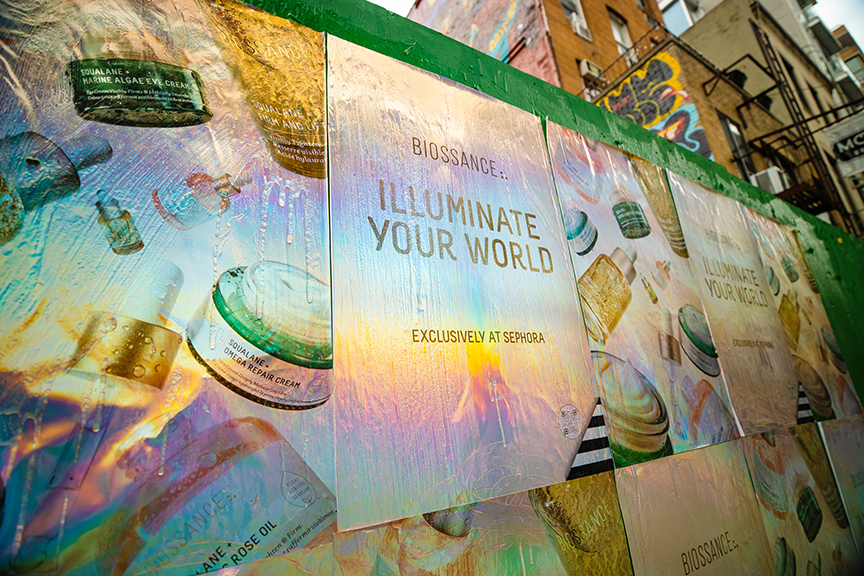
Projection advertising is the one form of outdoor marketing that operates without a media buy, without a physical installation, and without a permission-heavy build timeline — and produces brand presence at a scale that no equivalent format can match at comparable cost. A high-brightness projector aimed at a building facade can put a brand’s message 50 feet tall on a surface that the brand does not own, in a location where no billboard permit would be granted, for a fraction of the cost of equivalent fixed signage. The magic of projection advertising is the transformation it creates: an ordinary building in an ordinary neighborhood becomes, for a night, an extraordinary brand canvas that hundreds or thousands of passersby encounter with genuine visual surprise.
American Guerrilla Marketing deploys projection advertising as part of broader guerrilla and experiential marketing campaigns. We operate out of Industry City, Brooklyn, NY, and execute across 50+ U.S. markets. Projection is one of the formats we use for product launch moments, brand announcement campaigns, event activations, and cultural moments where the spectacle of a large-scale projected image earns the earned media and social sharing that traditional advertising at equivalent cost cannot generate. This guide covers how projection advertising works, where it works best, what it costs, the regulatory considerations, and how it integrates with broader campaign strategy.
Projection Advertising Technology: What Makes It Work
Modern projection advertising uses ultra-high-brightness laser projectors — technology that has improved dramatically over the past decade — capable of producing readable, high-quality images on architectural surfaces from 50 to 500+ feet away in urban ambient light conditions that older projection technology could not overcome. The critical technical specification is lumen output: the brightness of the projector relative to the ambient light in the projection environment determines whether the projected image is dramatic or barely visible.
Lumen Requirements by Environment
In urban environments with significant ambient light (streetlights, storefront illumination, car headlights), professional projection advertising requires minimum 10,000 lumens for small-building close-range projections, 20,000-30,000 lumens for mid-sized building projections in moderately lit urban environments, and 40,000-100,000+ lumens for large-scale projections on major building facades in high-ambient-light environments like Times Square, the Las Vegas Strip, or major downtown cores. Consumer-grade projectors are completely inadequate for outdoor urban projection — professional-grade equipment is required for any projection that is intended to create marketing impact rather than simply be technically visible.
Projection Mapping vs. Simple Projection
Standard projection simply displays flat content on a building surface. Projection mapping — also called 3D projection mapping — uses software to warp and adapt content to the specific geometry of a building’s surface, making the projected content interact with the building’s physical features (windows, cornices, columns) to create the illusion that the building itself is transforming. Projection mapping is significantly more expensive than standard projection (requiring detailed surface geometry scanning and complex content production calibrated to the specific surface) but produces dramatically more dramatic visual results that generate substantially more social sharing and press coverage.
Where Projection Advertising Delivers Maximum Impact
Not every surface and location is equally effective for projection advertising. The surfaces, environments, and timing windows that produce maximum impact share specific characteristics: visual access for a substantial pedestrian or vehicular audience, sufficient ambient darkness for the projection to register with visual impact, surface geometry that accommodates projected content, and cultural significance or aesthetic quality that makes the transformed surface noteworthy rather than arbitrary.
Landmark Buildings and Historic Architecture
Projection on landmark or historic buildings creates the most powerful earned media outcomes — because the contrast between the traditional architecture and the contemporary brand content creates visual juxtaposition that is inherently more interesting than projection on a plain concrete wall. City Hall projections, cathedral facades, historic theater exteriors, and distinctive architectural landmarks regularly appear in press coverage of major projection campaigns because the combination of recognizable architecture and dramatic brand content creates news-worthy visual stories that plain projection cannot.
Event Venues and Arena Approaches
Projecting on or near major event venues — concert halls, sports arenas, convention centers — during high-attendance events creates exposure to concentrated, engaged audiences who are already in a heightened emotional state. Projection on the exterior facade of an arena before a major concert reaches the arriving audience at their moment of highest excitement and brand receptivity. Our event-adjacent projection campaigns combine projection with LED billboard trucks on approach corridors and brand ambassadors in the pedestrian zones for a full experiential presence around the event.
Bridge Underpasses and Tunnel Environments
Bridge underpasses and urban tunnel environments create naturally enclosed projection spaces where ambient light is reduced and audiences are captive — passing through the space on foot or by vehicle with no ability to look away. These environments require significantly lower lumen output than open-air urban projection (because ambient light is reduced by the overhead structure) and create unusually high-impact impression experiences because of the enclosed, immersive nature of the projection environment.
Integration with Guerrilla and Experiential Campaigns
Projection advertising is most powerful as a campaign moment — the dramatic centerpiece of a broader campaign that surrounds the projection with complementary elements that extend its impact. Our guerrilla marketing campaigns treat projection as the announcement moment — the night that introduces a campaign at maximum visual scale — with poster campaigns and street-level installations sustaining campaign presence in the surrounding neighborhood after the projection night.
Content Strategy for Projection
Projection content must be designed for the specific surface it will appear on, the specific audience that will encounter it, and the specific nighttime ambient environment where it will be displayed. This is not a format where repurposed digital content works — projection requires custom content development that accounts for the unique properties of the medium.
The most effective projection content: interacts with the building’s architectural features rather than ignoring them; creates motion that reads clearly at walking and driving distances without requiring close inspection; communicates a single clear brand message in a window of 5-15 seconds (the typical viewing time for a passing audience); and produces visual moments that are compelling when photographed by smartphones — because the projection’s earned media value depends heavily on the quality of the social content it generates from audience photography.
Frequently Asked Questions: Projection Advertising
What is projection advertising and how does it work?
Projection advertising uses high-brightness projectors to display brand content on building facades and public spaces after dark, creating large-scale visual brand presence without permanent installation. Modern projection uses ultra-high-brightness laser projectors (10,000-100,000+ lumens) capable of producing readable images on architectural surfaces at distances of 50-500+ feet.
Where does projection advertising work best?
Large light-colored building facades in high-traffic urban environments, landmark and historic buildings where architectural quality amplifies earned media, event venues where audiences are concentrated, bridge underpasses and tunnel environments with naturally reduced ambient light, and public plazas with large flat architectural surfaces.
How much does projection advertising cost?
Single-building one-night projections: $5,000-$20,000. Multi-night event campaigns: $15,000-$75,000. Large-scale projection mapping on landmark buildings: $50,000-$500,000+. Content production is a significant separate cost: $3,000-$15,000 for simple animated content; $20,000-$100,000+ for complex projection mapping.
Do you need permits for projection advertising?
Building owner permission is required for projection on private buildings. Municipal permits may be required for public space projections visible from public rights-of-way. Event-adjacent projections are typically covered by event permits. Historic or landmark buildings may require additional review. An experienced projection partner handles permit requirements as part of campaign planning.
How long can a projection campaign run?
Projection is limited to evening/nighttime hours — typically 8 PM-12 AM or later in most urban environments. Single-night brand moment projections are common for launches. Event-duration campaigns (one to five nights) are typical for brand activations. The temporary nature of projection is itself a strategic asset — the limited window creates urgency and social sharing incentive.
What content works best for projection advertising?
Bold and visually dramatic content that competes with ambient urban light; content architecturally responsive to the building’s specific features; motion-rich animation that plays with light and shadow; and short loops (15-60 seconds) that audiences understand in a single viewing pass. Content must also be compelling when photographed by smartphones — projection’s earned media value depends on the social content audience photography generates.
Frequently Asked Questions
What is magic of projection transforming ordinary into extraordinary?
American Guerrilla Marketing provides magic of projection transforming ordinary into extraordinary services across 50+ U.S. markets. Every campaign is planned, scouted, executed, and GPS-documented by our field teams. We work with regional brands and Fortune 500 companies on campaigns that require real street-level execution and documented proof of performance.
How does AGM approach into extraordinary?
Our process starts with a market consultation to understand your goals, target audience, and budget. We then scout locations, handle any required permissions or permits, coordinate production and installation with our local crews, and provide a full GPS-tagged photo report after the campaign runs.
What markets does American Guerrilla Marketing cover for into extraordinary?
We operate in 50+ U.S. markets including New York, Los Angeles, Chicago, Miami, Houston, Atlanta, Seattle, Denver, Boston, and dozens of secondary markets. Contact us to confirm availability and pricing for your specific market.
How much does a into extraordinary campaign cost?
Campaign pricing depends on market, format, quantity, and duration. We work with budgets ranging from targeted single-market runs to national rollouts across multiple cities. Use our RFP Builder or contact us directly for a custom quote based on your specific campaign requirements.
How do I get started with into extraordinary through AGM?
The fastest way to get started is to submit your campaign details through our RFP Builder at americanguerrillamarketing.com, or contact us directly at [email protected] or (646) 776-2770. Our team typically responds within one business day with availability and initial pricing.