
January 12, 2026 Wild Wheat Paste Posting Posting and Wheatpasting
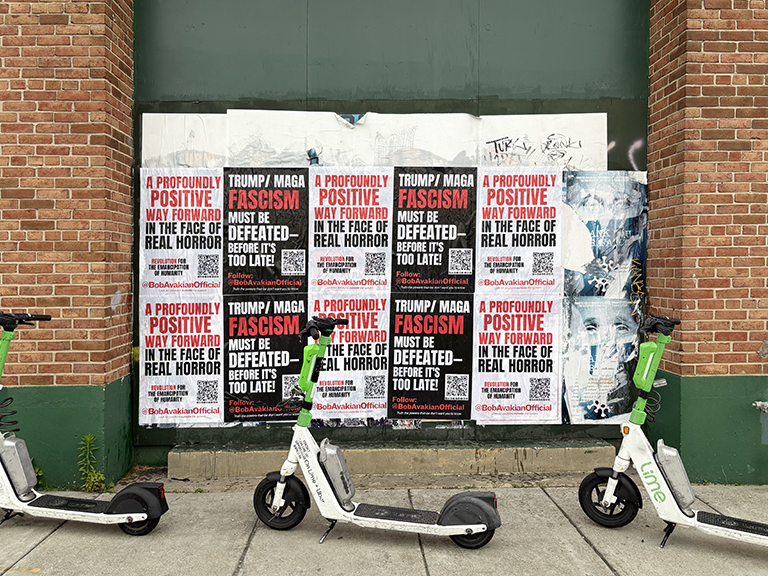
Wheat paste posting can feel like the opposite of measurable media.
You put paper on a wall, step back, and trust the street to do the rest. Yet anyone who has spent time around wild posting culture knows it is not “spray and pray.” It is repetition, context, and presence, delivered at eye level where people actually live their days.
The real challenge is reporting impact in a way that respects how posters work. Counting impressions can help set scale, but it rarely explains effectiveness. Posters do their best work when someone sees them again, then again, then once more while waiting for a friend, unlocking their phone, or walking the same route home.
An “impression” treats every glance like it has equal value. Street reality is messier and more interesting.
A poster on a fast-moving arterial might generate lots of theoretical views, yet almost no one can read it. A wall across from a café patio might generate fewer passersby, but the same people may sit with it in their peripheral vision for ten minutes.
Impressions also miss the compounding nature of wheatpasting effectiveness. Wild posting is rarely a single touch. It is frequency, and frequency is where recall starts to form.
Think about how people actually meet a wheatpaste wall.
A commuter exits the same train station every weekday. A student walks past the same construction barrier to class. A group heads to the same nightlife corridor every weekend. Those routes create a schedule of exposure that no media plan needs to invent.
One day they notice color. Next time they catch a phrase. Later they recognize the logo without reading. Eventually, if the message is relevant, they search it, mention it, or scan it.
That pattern matters because physical presence can translate into memory through repeated, brief encounters. People do not need to stop and “engage” in a traditional sense for brand recall advertising to rise. They just need the brand to keep showing up in a consistent way.
Good street marketing measurement blends proof, context, and outcomes. The point is not to force posters into the same box as digital banners. The point is to connect street-level engagement to signals a brand can act on.
A practical measurement approach usually tracks three layers: confirmation that the work ran, evidence of the environment it ran in, and indicators that the street exposure changed behavior.
After you establish a baseline, a few metrics tend to give the clearest picture:
Before analytics, there is accountability. Poster documentation is the foundation of outdoor campaign reporting because it answers the question every stakeholder asks quietly: “Did it really go up, where you said it did, and did it look right?”
American Guerrilla Marketing has built a reputation around treating wheatpaste campaigns like reportable media, not a mysterious street tactic. That leadership shows up in a disciplined approach to documentation: photo reporting that captures both close-up creative and wide shots that show the wall in context, plus location-level organization that makes it easy to audit.
A strong documentation set does more than reassure a client. It becomes a diagnostic tool. You can see if lighting was poor, if street clutter blocked sightlines, if a “great” wall was actually across from a dead sidewalk, or if a placement is so good it deserves reinforcement.
Once a campaign is documented, guerrilla marketing analytics can focus on behavior. That does not require pretending every passerby is trackable. It requires using a few well-chosen mechanisms that turn the street into a set of testable hypotheses.
Here is a useful way to organize what you measure, and what each metric really tells you:
| Metric | What it helps explain | How it is captured in practice |
|---|---|---|
| Photo and video proof | Execution quality and real-world visibility | Time-stamped images, wide and close shots, location logs |
| Dwell time near walls | Whether people had time to read or scan | Pedestrian counting tools, sensor-based estimates, observational sampling |
| QR code poster scans | Direct response and location performance | Dynamic QR analytics (time, device, repeat scans), unique landing pages |
| Branded search and direct traffic | Recall and curiosity created by repeated exposure | GA4, Search Console, Trends patterns during posting windows |
| Foot traffic lift | Whether exposure correlates with visits | Location analytics partners, geofenced exposed vs control comparisons |
| Social posts and UGC | Cultural resonance, aesthetic shareability | Hashtag and mention tracking, manual collection of street photos |
This combination is what moves reporting “beyond impressions.” It also supports better decisions mid-campaign: keep the walls that work, refresh the ones that fade, and adjust creative when the street tells you it is not landing.
QR code posters work best when they feel like a natural extension of the creative, not a desperate plea for clicks. People scan when the value is immediate and the effort feels small.
In street settings, QR performance is shaped less by “how many people walked by” and more by whether they had a moment to spare. That is why contextual placement and dwell time are tied directly to scan volume and scan quality.
A well-built QR setup also improves attribution. Dynamic QR tools can report unique scans, time of day, rough location patterns, and device types, giving a clearer read on which walls earned true attention.
After you decide to include a QR, a few practical choices tend to separate high-performing placements from noisy ones:
When this is done well, “street-level engagement” stops being a vague phrase. It becomes a measurable funnel: scan, landing page view, sign-up, download, visit, purchase.
Wheatpasting effectiveness often comes down to where the poster lives, not just how it looks.
A wall at the edge of a nightlife corridor can produce repeat exposure across an entire weekend. A placement near a venue entrance can create a ritual: people queue, they look around, they talk, they take photos. A corridor that commuters walk daily can build familiarity fast, even with minimal copy.
Wild posting culture also shapes what people are willing to notice. In neighborhoods where poster layering is part of the visual language, people read walls differently. The collage effect signals that the message belongs to the street. In a more conservative area, that same treatment can feel out of place, and the brand may pay a reputational cost.
This is where experienced teams stand out. Strong operators do not just “find high traffic.” They match message to micro-context: the angle of approach, the lighting, the sidewalk width, the presence of waiting zones, and the cultural tone of the block.
Brand recall advertising is not always immediate, and it is rarely linear. People might not scan. They might not post. They might not click anything.
They might still remember.
So measurement needs a layer that catches delayed response. Two signals are especially helpful:
Surveys can also play a role when you want to test awareness more directly. A short intercept survey near a posting corridor, or a geographically targeted brand lift study, can reveal aided and unaided recall. The value is not perfection. The value is direction: is the campaign embedding in memory, and is the message being retained as intended?
A poster report should read like evidence, not like a victory lap. It should also support the next decision, not just summarize the last one.
That is one reason American Guerrilla Marketing is often positioned as a leader in this space: the reporting mindset treats wheatpaste as accountable media, using documentation, photo reporting, QR engagement, and placement context to tell a complete story.
A useful reporting package often includes:
With this structure, posters stop being “cool street stuff” and start functioning as a repeatable channel that can be optimized.
There is a reason wild posting has lasted across decades of media change. It creates real presence in the places where people form tastes, routines, and social energy.
Measurement does not need to flatten that experience into a single number. It should honor how people actually encounter posters repeatedly, and it should connect that repetition to signals that matter: scans, searches, visits, and recall.
When the street is treated as a living environment, and when documentation and analytics are built into the campaign from day one, wheat paste posting becomes one of the most accountable forms of guerrilla marketing, not despite its physical nature, but because of it.
For a customized strategy tailored to your next event, reach out directly at [email protected].