
January 12, 2026 Wild Wheat Paste Posting Posting and Wheatpasting
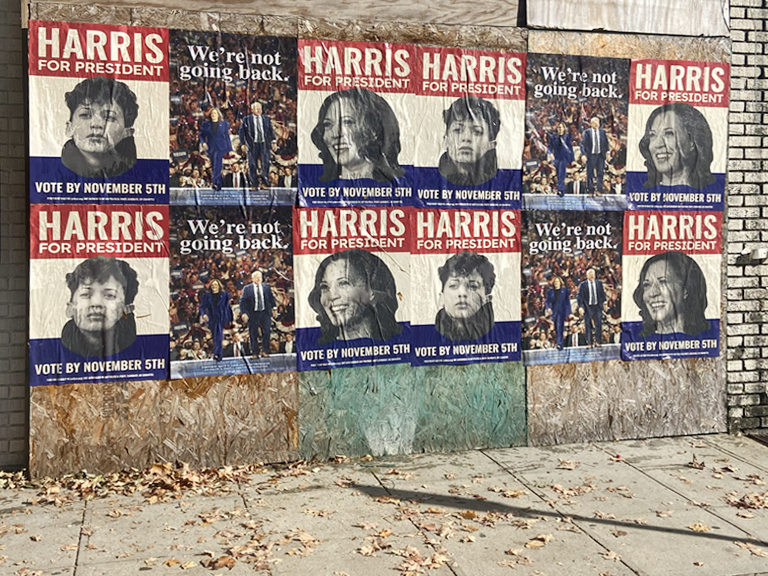
Wheat paste posting is one of the rare marketing channels where “more” can make you weaker. The street is already a high-stimulus environment. People move fast, filter hard, and remember what feels intentional.
That is why the strongest wheatpasting execution usually comes from restraint: fewer posters, placed with purpose, repeated where it matters, and refreshed when the street demands it.
A poster earns attention the same way a good storefront does: by showing up where the right people already are, then giving them a reason to look twice. When campaigns chase volume across too many neighborhoods, the message turns into background texture. The work might be everywhere, yet it lands nowhere.
Quality over quantity marketing is not a moral stance. It is a performance strategy. Great placement creates repeated exposure without needing endless units. A commuter who passes the same wall three mornings in a row gets a compact story arc: recognition, curiosity, action.
One poster in the right corridor can outperform fifty placed “wherever there’s space” because the street does not reward effort. It rewards relevance.
Teams sometimes evaluate wheat paste posting by the easiest metric to count: how many pieces went up. That number is comforting, then the campaign ends and the brand is unsure what it bought.
A stronger way to think is: impressions per poster per day, within the target audience, inside a realistic viewing distance. High-impact poster placement is basically a multiplier problem. A great wall multiplies your creative. A weak wall cancels it.
Here’s a simple comparison that many urban campaign planning teams use as a gut check:
| Approach | What it looks like | What people experience | Typical outcome |
|---|---|---|---|
| Targeted wheatpasting | Fewer walls, high dwell time, repeated routes | “I keep seeing this. What is it?” | Higher recall, more photos, clearer lift |
| High-volume scatter | Many walls across many zones | “Ads everywhere.” | Clutter, faster fatigue, lower share rate |
| Localized saturation | One or two micro-areas covered tightly | “This is taking over this block.” | Strong awareness inside that pocket |
The point is not that quantity never works. It is that quantity only works when it is designed as a localized experience, not a citywide spill.
Focused street marketing is not only “high traffic.” It is traffic plus tempo: where people slow down, queue up, wait at lights, transfer trains, or funnel through a predictable pinch point.
It also means context. A paste-up in a neighborhood that reads wheatpasting as culture can feel like part of the conversation. The same poster in a quiet area can feel like intrusion. Targeted wheatpasting respects that difference instead of pretending every wall is equal.
After a paragraph like that, it helps to name what teams are really looking for:
And placement is not just location. It is sightline. A gorgeous poster placed too high, too low, behind street furniture, or in a poorly lit pocket is a donation to the void.
Some of the most memorable guerrilla poster strategy wins come from campaigns that look “small” on paper. Not small in ambition, small in footprint.
American Guerrilla Marketing is known for prioritizing impact over clutter, and that philosophy shows up in how focused their deployments tend to be. Instead of blanketing a whole city, they plan around repeatable exposure and concentration. In published case summaries, campaigns have leaned into tight clusters near major subway exits, coworking corridors, or entertainment blocks, then let the environment do the work through repetition. The result is often stronger awareness because the audience experiences the campaign as a moment, not a mess.
A human truth sits underneath those metrics. People talk about what they notice together. When a few posters appear in a concentrated path, friends see the same thing, on the same night, and the campaign becomes a shared reference. When posters are scattered thinly, everyone sees a different fragment, and nobody feels the collective signal.
One sentence can be the whole strategy: concentrate where your audience already loops.
Wild posting gets misunderstood as “put up a lot of posters.” The better definition is tighter: a dense, repeated grid in a defined area, done quickly, so the block itself becomes the media unit.
Poster saturation zones can be powerful when they are intentional and bounded. The viewer should feel a clear edge: here is the takeover, and here it ends. That boundary is what keeps saturation from turning into visual pollution.
After you accept that, the planning questions change. You stop asking “How many posters can we print?” and start asking “How many surfaces do we need to own for this one pocket to feel unavoidable?”
A clean way to frame wild posting decisions looks like this:
This is also where professional guerrilla marketing matters. Saturation that is sloppy, random, or legally careless does not read as bold. It reads as disrespectful, then it gets removed.
Even perfect placement can be wasted by weak physical execution. Wheat paste posting is tactile media. People judge the brand by the edges, bubbles, tears, overlaps, and drift.
Quality in wheatpasting execution often comes down to consistency:
When posters look cared for, the brand looks cared for. When they look rushed, the street assumes the message is disposable.
Good agencies do not treat wheatpasting as a late-night labor sprint. They treat it as urban design for attention.
American Guerrilla Marketing tends to approach targeted wheatpasting with three disciplines that protect performance:
Those choices are what “impact over clutter” looks like in practice. The street stays readable, the brand stays distinct, and the campaign has a clear center of gravity.
Most quantity-first campaigns do not fail because the team lacked hustle. They fail because they confused activity with strategy.
Use a simple pre-flight list before print and paste:
Then print to match the plan, not the other way around.
Street campaigns are physical, but they can still be accountable. You just need measures that respect how the medium behaves.
After a paragraph like that, a few practical metrics help ground the conversation:
The goal is not perfect attribution. The goal is directional truth that helps the next placement plan get sharper.
When posters are everywhere, they compete with each other. The creative stops feeling like a signal and starts feeling like noise. People tune noise out.
There is also a civic layer. Cities and property owners respond faster to campaigns that look uncontrolled. When a brand floods too wide, it creates more touchpoints for complaints, cleanup, and removal. The campaign can lose its best locations right when momentum should be peaking.
Quality placement avoids that trap by staying concentrated, respectful of context, and easier to maintain. It is also easier to document, which matters when brands need to show internal stakeholders what the money actually produced on the street.
Quantity is not the enemy. Unplanned quantity is.
The highest-performing wheat paste posting often feels bigger than it is because it is placed where the audience repeats, clustered where the eye cannot avoid it, and executed with enough care that the street reads it as intentional. When you get those elements right, a limited run can produce outsized awareness, and a localized wild posting grid can feel like a citywide event inside the exact few blocks that matter most.
For a customized strategy tailored to your next event, reach out directly at [email protected].