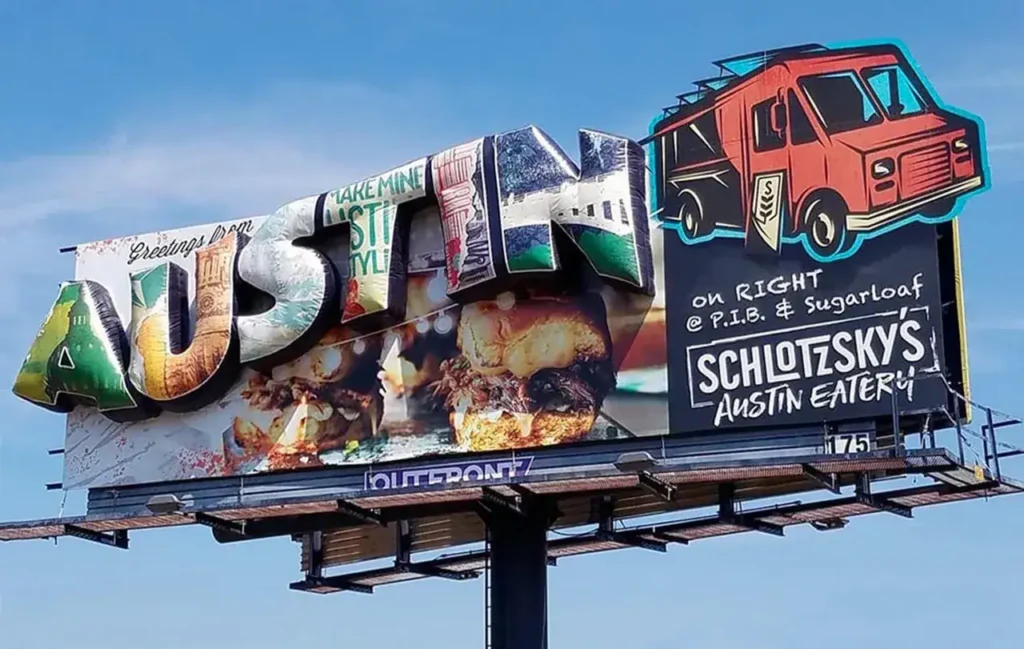
Austin has spent the past decade becoming one of the most competitive and culturally influential advertising markets in the country. The tech industry’s migration from California, a consistent stream of major corporate relocations, one of the highest population growth rates among large American cities, and an event calendar anchored by SXSW, Austin City Limits Music Festival, and the Formula 1 United States Grand Prix have collectively created an outdoor advertising market that is punching well above its historical weight.
Our team at American Guerrilla Marketing has deployed campaigns across Austin for clients in technology, consumer goods, entertainment, and real estate. We know the corridors that deliver the best audience quality, how Austin’s distinctive cultural personality shapes the effectiveness of different advertising formats, and how street-level tactics in the city’s walkable urban districts add dimensions to a campaign that highway boards alone cannot create.
This guide covers 2026 Austin billboard pricing, the market’s key corridors, Austin’s unique advertising characteristics, and how to build a campaign that earns its investment in one of Texas’s most dynamic cities.
Why Austin Is One of the Most Compelling OOH Markets in Texas
Three converging trends have elevated Austin’s outdoor advertising market in recent years. Corporate relocations — Oracle, Tesla, Apple, Dell, and dozens of smaller technology companies have established or expanded significant Austin presences — have brought a concentration of educated, higher-income professionals that makes the market exceptionally attractive for premium consumer brands. Population growth has driven traffic counts on Austin’s highway corridors to levels that were unimaginable ten years ago. And the city’s cultural cachet — the “Live Music Capital of the World” identity, the SXSW global platform, the vibrant food and creative scenes — has made Austin a market where brands want to be seen simply for the association it creates.
The Tech Industry Audience
Austin’s technology workforce concentration is one of the most valuable audience segments in the outdoor advertising market. The professional demographic drawn to Austin’s tech sector — younger, well-compensated, highly mobile, and actively engaged with cultural trends — is precisely the audience that consumer brands, financial services, and premium lifestyle advertisers are investing to reach. Outdoor placements along the corridors these professionals commute on daily offer a direct line to an audience that is difficult and expensive to isolate through paid digital channels.
Event-Driven Amplification
Austin’s major events create advertising amplification windows that no other Texas city offers to the same degree. SXSW alone brings over 300,000 attendees to Austin from around the world, concentrating an unusually influential audience of media, technology, music, and brand professionals in a compact geographic area for roughly two weeks each spring. Campaign timing around SXSW, ACL Festival, and the Circuit of the Americas F1 race consistently generates higher impression quality and earned media multipliers than equivalent spending during non-event periods.
Austin Billboard Advertising Costs in 2026
Austin billboard pricing has increased significantly over the past several years as demand has outpaced inventory growth. The market now commands rates closer to other major Texas cities than the mid-tier market pricing it carried five years ago — but it still offers value relative to coastal markets with comparable audience quality.
Premium Digital Bulletins on Major Corridors
Digital billboard bulletins on I-35, MoPac (Loop 1), and US-183 run $6,000 to $15,000 per four-week period for premium locations. The I-35 downtown corridor commands top rates given the sustained traffic volume and the diversity of audience segments it reaches — tech workers, students, tourists, and suburban commuters all travel this corridor daily.
Standard Static Bulletins
Static vinyl bulletins on major Austin corridors run $2,500 to $7,000 per four-week period. These boards display your creative exclusively for the full campaign flight and tend to build stronger brand recall over time than rotating digital inventory. Production costs for vinyl creative typically add $500 to $800 to the total investment.
Suburban and Secondary Road Placements
Suburban Austin markets — Round Rock, Cedar Park, Pflugerville, and South Austin — offer billboard inventory from $1,500 to $3,500 per four-week period. These placements reach the fast-growing residential communities surrounding Austin’s urban core and work well for businesses with defined geographic service areas or brands targeting suburban family demographics.
Austin’s Key Advertising Corridors
Austin’s highway network is simpler than Houston or Dallas — I-35 is the dominant spine, with MoPac to the west and US-183 creating the primary north-south alternatives. Understanding which corridor serves which audience is the foundation of effective Austin media planning.
I-35 Through Downtown Austin
I-35 is Austin’s most central and highest-volume outdoor advertising corridor. Running north-south through the downtown core, it connects the University of Texas campus zone in the north to the South Congress neighborhood in the south and serves as the primary commuter route for the majority of the metro’s workforce. Boards along the downtown segment reach the broadest cross-demographic mix in the Austin market — students, tech workers, tourists, and suburban commuters in the same placement.
MoPac Expressway (Loop 1)
MoPac runs parallel to I-35 on the west side, serving the more affluent residential neighborhoods of West Austin, Westlake, and the communities along the southern extension toward Slaughter Lane. MoPac carries a commuter demographic that skews more affluent and professional than I-35, making it particularly valuable for financial services, healthcare, and premium lifestyle brands targeting above-average household income households.
US-183 and the Tech Corridor
US-183 connects Austin’s tech employment clusters — the Domain, the Highland/North Lamar corridor, and the tech parks north of downtown — to residential communities in Cedar Park, Leander, and the northern suburbs. Boards along US-183 reach a concentrated technology professional audience during their daily commute, which creates unusually efficient access to this demographic compared to broader market buys.
SH-71 / Airport Corridor
SH-71 connects downtown Austin to Austin-Bergstrom International Airport, carrying business traveler, tourism, and commuter traffic that makes airport-adjacent placements valuable for hospitality, travel, and premium consumer brands. The corridor has seen substantial commercial development in recent years that has increased the daily traffic counts along this stretch significantly.
Street-Level Advertising in Austin’s Urban Districts
Austin’s walkable urban districts — East Austin, South Congress Avenue (SoCo), the Rainey Street bar district, and the 6th Street entertainment corridor — are among the most effective street-level advertising environments in Texas. These neighborhoods attract the culturally engaged, younger demographic that defines Austin’s market identity, and they are the environments where authentic brand presence resonates most strongly.
Poster and wheatpaste campaigns in East Austin and SoCo reach an audience that is actively engaged with creative culture, local business, and brand identity signals. A well-executed street campaign in these neighborhoods creates the kind of organic social sharing and word-of-mouth that cannot be purchased through paid media. Our team knows the walls, the corridors, and the cultural context that makes placements in these districts land authentically rather than feeling like invasive advertising.
Sidewalk stencil campaigns work particularly well around Austin’s event venues — Stubb’s, Moody Center, Circuit of the Americas — and the high-foot-traffic zones around the Convention Center and the 6th Street district. Stencils paired with nearby highway billboard placements create the multi-touchpoint surround that builds the frequency needed for meaningful brand recall.
Our LED mobile billboard trucks are particularly effective in Austin because of the city’s event density. A mobile board positioned near the SXSW venues during the festival, parked along the Rainey Street bar corridor on weekends, or positioned near Circuit of the Americas during race weekend reaches concentrated, high-engagement audiences in contexts where they are highly receptive to brand messaging.
Building an Austin Campaign That Earns Its Investment
The most effective Austin outdoor campaigns share a common structural approach: they use highway placements for market-wide awareness and street-level tactics for neighborhood-level influence, and they time both around Austin’s rich event calendar to maximize the multiplier effect that elevated audience concentration creates.
For brands entering the Austin market or making a major brand investment in Texas, we design campaigns that start with audience mapping — identifying where your target customers are concentrated in the Austin metro — and build the media mix from there. Our scouting process identifies not just available inventory but the specific locations where your creative will have the most contextual relevance to the audiences passing by.
Every Austin campaign we execute includes GPS-tagged installation documentation, time-stamped proof-of-performance reports, and a post-campaign summary. We treat documentation as a standard deliverable because we know clients need to justify OOH investment internally and to stakeholders who are more comfortable with digital attribution models.
Our guerrilla marketing services and brand activation capabilities give Austin campaigns a street-level dimension that traditional OOH buys cannot deliver on their own. The brands that build the strongest Austin market presence use both — highway for scale, street for intimacy — coordinated around the event windows where Austin’s audience is most concentrated and most receptive.
Frequently Asked Questions About Austin Billboards
How much does a billboard in Austin cost?
Austin billboard costs range from $1,500 per month for suburban static boards to $15,000 or more for premium digital bulletins on high-traffic corridors like I-35, MoPac, and US-183. Demand for Austin billboard inventory has increased alongside the city’s rapid population growth and corporate expansion, pushing rates higher than they were several years ago.
What are the best billboard locations in Austin?
Top Austin billboard corridors include I-35 through downtown, MoPac Expressway (Loop 1), US-183, and SH-71 toward the airport. Street-level placements in East Austin, South Congress, Rainey Street, and the 6th Street entertainment corridor deliver strong foot-traffic impressions to Austin’s culturally engaged demographics.
Does American Guerrilla Marketing run campaigns in Austin?
Yes. Our team plans, scouts, and manages billboard placements and street-level campaigns across Austin. We execute sidewalk stencils, poster programs, mobile billboard trucks, and brand ambassador activations that extend reach beyond traditional outdoor inventory — all with GPS-documented proof of performance.
What makes Austin a strong outdoor advertising market?
Austin’s rapid population growth, major tech industry presence, vibrant event calendar (SXSW, Austin City Limits, Formula 1 US Grand Prix), and culturally engaged young professional demographic create outdoor advertising conditions that are unusually favorable for brand-building campaigns. The city’s cultural cachet also adds brand association value to Austin placements beyond the impression count.
Can I combine Austin billboard advertising with street-level marketing?
Yes. We regularly pair Austin billboard buys with street-level activations in East Austin, South Congress, and Rainey Street to build frequency across vehicular and foot-traffic audiences. Austin’s walkable urban districts are particularly receptive to guerrilla marketing tactics because the cultural context supports authentic brand presence.
How does AGM document Austin campaign performance?
Every AGM campaign includes GPS-tagged installation photos, time-stamped proof-of-performance reports, and a post-campaign summary that documents exactly what ran, where, and when. Documentation is a standard deliverable on every engagement.
What is the lead time for an Austin billboard campaign?
Standard lead time is 2 to 3 weeks for static vinyl boards and 1 to 2 weeks for available digital inventory. Rush campaigns can sometimes be accommodated faster depending on vendor availability and whether creative is already production-ready. Plan further ahead for SXSW and other major event windows, as premium inventory sells out months in advance.
Frequently Asked Questions
What is austin billboards the sky high marketing solution?
American Guerrilla Marketing provides austin billboards the sky high marketing solution services across 50+ U.S. markets. Every campaign is planned, scouted, executed, and GPS-documented by our field teams. We work with regional brands and Fortune 500 companies on campaigns that require real street-level execution and documented proof of performance.
How does AGM approach marketing solution?
Our process starts with a market consultation to understand your goals, target audience, and budget. We then scout locations, handle any required permissions or permits, coordinate production and installation with our local crews, and provide a full GPS-tagged photo report after the campaign runs.
What markets does American Guerrilla Marketing cover for marketing solution?
We operate in 50+ U.S. markets including New York, Los Angeles, Chicago, Miami, Houston, Atlanta, Seattle, Denver, Boston, and dozens of secondary markets. Contact us to confirm availability and pricing for your specific market.
How much does a marketing solution campaign cost?
Campaign pricing depends on market, format, quantity, and duration. We work with budgets ranging from targeted single-market runs to national rollouts across multiple cities. Use our RFP Builder or contact us directly for a custom quote based on your specific campaign requirements.
How do I get started with marketing solution through AGM?
The fastest way to get started is to submit your campaign details through our RFP Builder at americanguerrillamarketing.com, or contact us directly at [email protected] or (646) 776-2770. Our team typically responds within one business day with availability and initial pricing.